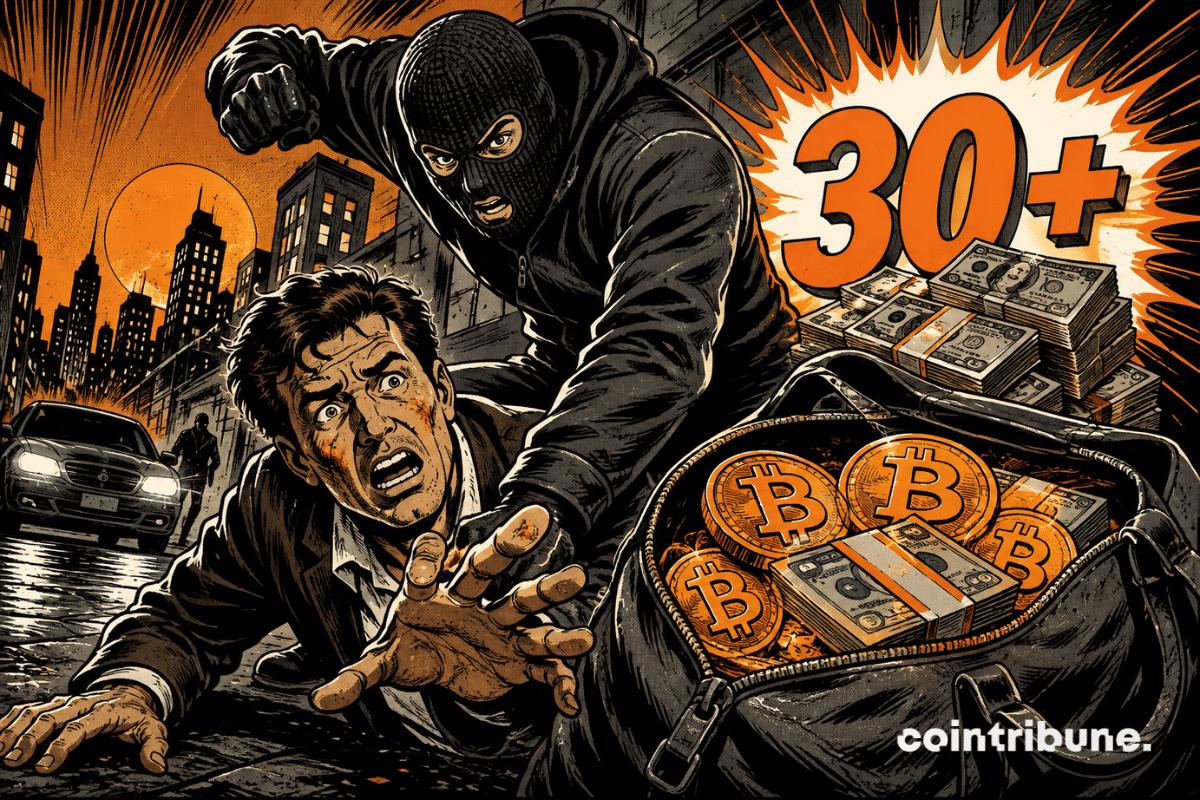
Attacks targeting digital asset holders continue to increase in 2026. A new report from Chainalysis shows that these violent attacks have already resulted in more than $30 million in losses in the first half of the year. Home burglaries are gaining ground, while France now has the largest number of recorded incidents. This development also highlights the adaptation of criminal networks, which use ever more sophisticated methods to divert crypto funds.
In brief
- More than $30 million was stolen in physical assaults in the first half of 2026.
- Chainalysis has recorded 46 violent attacks against cryptocurrency holders.
- Burglaries now represent 37% of documented incidents.
- France already has 30 attacks, the highest total in the world.
- Criminals are using increasingly sophisticated laundering techniques after thefts.
Attacks on crypto holders reach new high
The report published by Chainalysis identifies 46 physical attacks targeting cryptocurrency holders until the end of June 2026. According to the blockchain analysis company, these attacks have already generated more than $30 million in losses. Victims experience burglaries, kidnappings or hostage-taking intended to obtain an immediate transfer of their digital assets.
The perpetrators of these acts are primarily looking for people with easily transferable assets. Unlike traditional bank balances, cryptocurrencies can be sent quickly and irreversibly once the victim gives in under duress. This characteristic explains, according to reportthe growing interest of criminal groups in this type of target.
A forcible attack involves threatening or using physical violence to force a person to transfer their funds. This operating mode is taking an increasingly important place in the cases recorded. Criminals now favor scenarios that allow them to directly control their victim before gaining access to their digital wallets.
Burglaries become the preferred method
While kidnappings remain the most frequent type of assault, burglaries are increasing rapidly. They now represent 37% of documented incidentscompared to only 26% in 2023. This development reflects a change in strategy among the authors, who favor operations that are simpler to organize.
Chainalysis explains that burglaries provide a more controlled environment to coerce victims into making a crypto transfer. Conversely, a kidnapping requires more logistical preparation, mobilizes more resources and exposes the attackers for a much longer period. This difference makes home invasions particularly attractive to criminal networks.
The report also highlights another worrying development. Relatives and acquaintances of cryptocurrency holders also become targets. Attackers use this additional pressure to force victims to hand over their digital assets as quickly as possible.
France now has the largest number of incidents
France appears to be the main focus of these physical attacks in the first half of 2026. Chainalysis has already recorded 30 incidents in the territory, more than in any other country. This focus is attracting the attention of security specialists and investigators.
According to the same report, this increase could be linked to an alleged tax data leak that exposed information regarding wealthy crypto holders. Such exposure would make it easier for groups specializing in assault and extortion to identify potential targets.
The document also recalls that violence against investors continues to increase. In April, French authorities charged 88 suspects, including more than ten minors, as part of twelve investigations targeting organized gangs. In June, a man was also indicted after presenting himself as a police officer in a “wrench” type attack. Even more recently, five men were convicted in London for having kidnapped and tortured two French millionaires in the sector in order to extort their digital assets.
Increasingly sophisticated whitening techniques
The blockchain analytics company also observes stark differences in how stolen funds are moved after assaults. Some criminals have limited knowledge and move assets directly to centralized exchanges. This method leaves more traces and increases the risk of identification.
Other groups, however, have better control of the crypto ecosystem. They operate decentralized exchange platforms, bridges between blockchains, MEV bots as well as different decentralized finance tools to move assets between multiple networks. These operations complicate the tracking of funds and delay their possible identification.
The report also indicates that these players seek to avoid centralized platforms. They are aware of the existence of the compliance procedures and identity checks imposed by these services. They therefore postpone any interaction with these infrastructures as much as possible in order to limit the risks of blocking embezzled funds.
At the same time, attacks are no longer limited to Europe. In the United States, ransom demands demanding payment in bitcoins also attracted attention during the investigation into the kidnapping of Nancy Guthrie, the mother of presenter Savannah Guthrie. This diversification of business shows that physical attacks and extortion linked to digital assets now take several forms depending on the country and circumstances.
The coming months will allow us to observe whether this trend continues during the second half of 2026. The evolution of the methods used, the concentration of incidents in France and the growing sophistication of money laundering circuits will continue to be closely monitored, while attacks targeting crypto holders remain on the rise.
Maximize your Tremplin.io experience with our ‘Read to Earn’ program! For every article you read, earn points and access exclusive rewards. Sign up now and start earning benefits.