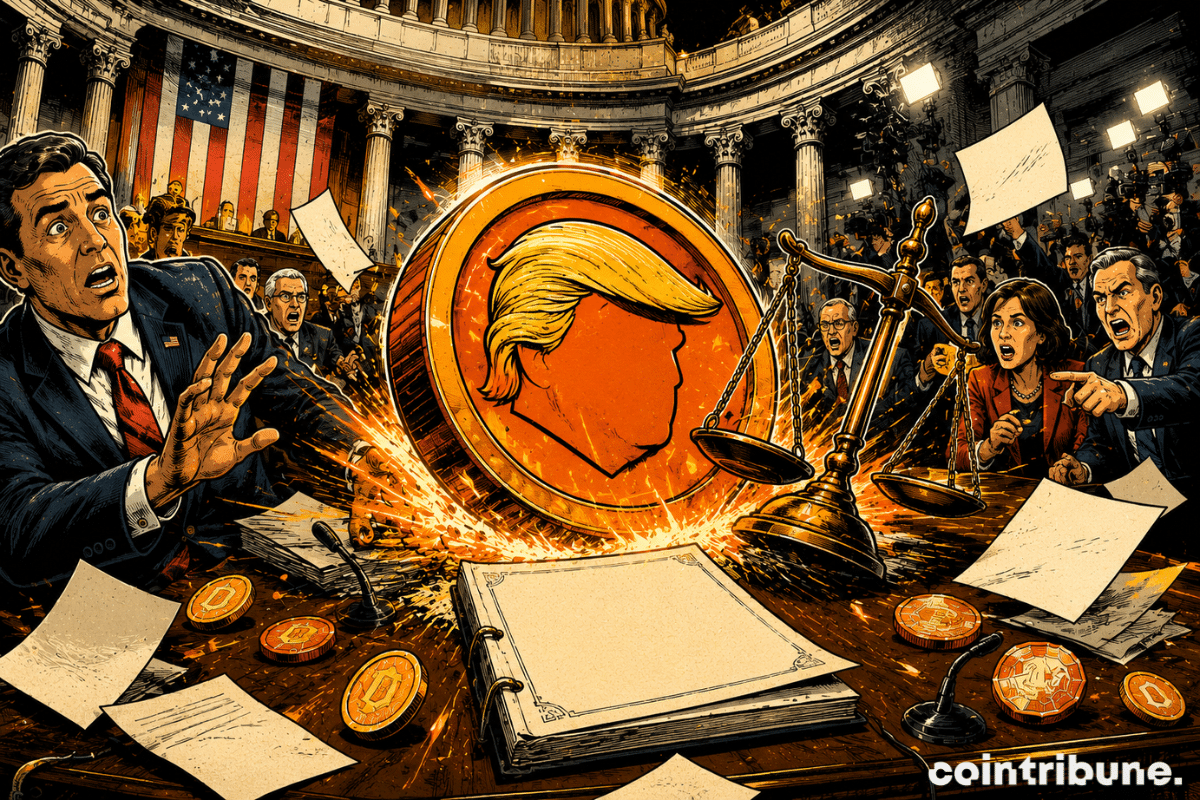
The TRUMP memecoin becomes a major political obstacle for American crypto regulation. Two senators are calling for an SEC investigation just as the Senate is trying to save the CLARITY Act before its August recess. The debate is therefore no longer only about the nature of the token. It directly touches on the conflicts of interest of the White House.
In brief
- Two senators call for SEC investigation into TRUMP memecoin.
- Nearly a million wallets reportedly lost $3.81 billion.
- The case complicates the CLARITY Act’s decisive week in the Senate.
TRUMP crypto returns to center of accusations
Elizabeth Warren and Richard Blumenthal call on SEC to investigate presidential memecoin. Their offensive continues the standoff already underway around the CLARITY Act, the adoption of which now depends as much on ethical rules as on technical questions on crypto regulation. In their letter addressed to SEC Chairman Paul Atkins, the two senators mention nearly a million crypto wallets having collectively lost approximately $3.81 billion since the launch of TRUMP.
They accuse Donald Trump of having actively encouraged his supporters to trade the token and ask the regulator to verify whether fraud or illegal enrichment has taken place. At this stage, these are political accusations and a request for investigation, not a judicial conclusion.
TRUMP was launched on January 17, 2025, three days before the presidential inauguration. Donald Trump then promoted it on his X account. According to the figures cited by the senators, the president would have made $636 million from the operation, while a large part of the crypto buyers who arrived later would have suffered heavy losses.
The case remains legally complex. The SEC has previously indicated that memecoins are generally not financial securities. An investigation could nevertheless examine other questions, such as communication made to investors, the organization of sales or the possible existence of deceptive practices. The debate therefore goes beyond the simple classification of the token.
The CLARITY Act turns into an ethical battle
The calendar makes this new offensive particularly sensitive. The Senate must interrupt its work on Friday August 7 for its summer break. Without rapid progress, the CLARITY Act risks sliding into a period dominated by the November elections, where finding a bipartisan compromise will become even more difficult.
In substance, the text must clarify the distribution of powers between the SEC and the CFTC. It also provides rules for crypto platforms, the protection of customer funds and certain players in decentralized finance. But these objectives are now eclipsed by a more direct question: can a president participate financially in the market that he himself helps to regulate?
This question was reinforced after the collapse of crypto tokens linked to Trump. The fall of TRUMP is no longer just the classic story of a speculative asset. It becomes a concrete argument for elected officials who demand stricter limits on the crypto activities of public officials.
The White House is therefore studying a new ethical compromise. A previous version prohibited high-ranking officials and their spouses from issuing or promoting certain digital assets. However, it did not cover all members of their family. It also entrusted the application of the rules to the Department of Justice, an option considered insufficient by several Democrats.
Can crypto regulation survive the Trump case?
The paradox becomes difficult to circumvent. The CLARITY Act seeks to provide the crypto sector with predictable rules. But its adoption now depends on guarantees designed around the financial interests of one man. The TRUMP memecoin acts almost as a living amendment, impossible to remove from the debate.
For the industry, failure would have immediate consequences. Without new law, the SEC would continue to develop its own regulatory framework through administrative decisions, exemptions and interpretations. This method could provide some answers, but it would remain more fragile than a law passed by Congress.
Defenders of the text must therefore choose between speed and credibility. Too weak a compromise could be presented as protection granted to the president. Rules that are too strict would, conversely, risk losing the support of the White House and certain Republicans.
The decisive battle around the CLARITY Act ultimately no longer concerns only the SEC, the CFTC or the platforms. It concerns public trust. As long as Washington does not clearly separate the presidential function from private crypto interests, Donald Trump’s concessions risk remaining insufficient. The TRUMP memecoin could then derail a reform expected by the entire industry.
Maximize your Tremplin.io experience with our ‘Read to Earn’ program! For every article you read, earn points and access exclusive rewards. Sign up now and start earning benefits.