MARA’s acquisition of Exaion continues to raise questions several months after its finalization. A complaint filed in the United States now calls into question the presentation of this operation to the French authorities. According to this court document, the development of Bitcoin mining would have been part of the project from its origin, while public communications mainly highlighted artificial intelligence and high-performance computing. This new procedure thus opens a debate that is both legal and political.

In brief
- A complaint claims that MARA hid its Bitcoin mining project.
- The mandate signed in 2025 already mentioned data centers dedicated to Bitcoin.
- AI and HPC would have served as the main argument with the French authorities.
- The plaintiffs are demanding 11.32 million euros in fees from MARA.
- The French state may have to clarify its knowledge of the initial project.
MARA’s project would have included Bitcoin mining from the first negotiations
On February 20, 2026, MARA finalized the acquisition of 64% of Exaion, a former subsidiary of EDF specializing in secure cloud, artificial intelligence and high-performance computing. The operation represents a total investment of 148 million euros. This sum includes 115 million euros injected into new shares and 33 million euros devoted to the repurchase of existing securities.
However, a complaint filed on July 22 in the federal court for the Southern District of New York provides a different reading of this transaction. François Garcin and several companies linked to him, including Athanor, LLC, Argenthal Global Holdings Ltd (Malta), Argenthal Sansovino SAS (France), are demanding payment of fees linked to the development of the company in France.
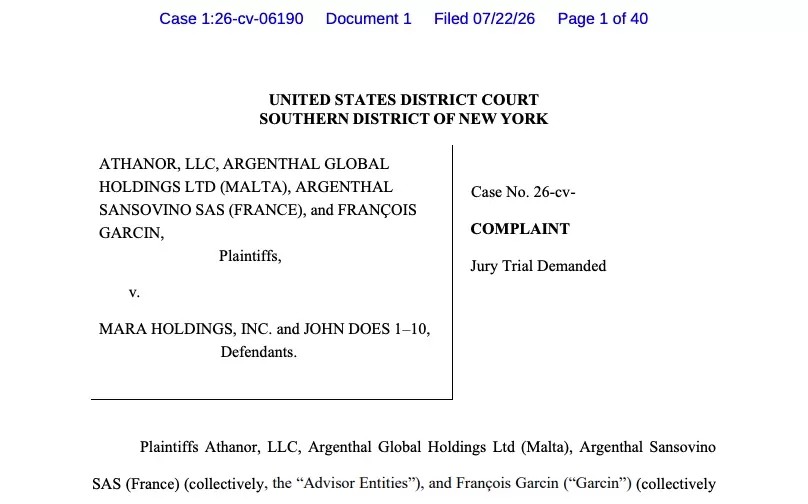
According to this document, the mandate signed in June 2025 did not only concern the acquisition of Exaion and energy partnerships. It also planned the creation of data centers intended for Bitcoin mining, an objective which would not have been put forward during discussions with EDF and the French authorities.
The document also claims that François Garcin, founder and CEO of Argenthal, would have organized discussions with EDF, TotalEnergies, Engie, RTE as well as other major players in the energy sector. His contract provided for remuneration of 2.4 million euros spread over twelve monthly payments of 200,000 euros. He was also to receive a commission equivalent to 4% of the investments made by MARA in Exaion. The plaintiffs are now demanding 11.32 million euros, part of which would depend on a new investment planned for 2027.
A communication strategy centered on AI rather than Bitcoin
THE official communications published by EDF and MARA during the acquisition presented Exaion as a European player in secure cloud, artificial intelligence and high-performance computing. These activities do exist within the company. However, the complaint maintains that this presentation would also have made the operation more politically acceptable by voluntarily leaving aside Bitcoin mining.
According to François Garcin’s statements, his mission consisted in particular of convincing Emmanuel Macron and several French officials that the arrival of MARA represented a strategic advantage for the country. His actions would have concerned the Élysée, Matignon, Bercy, the Treasury as well as the services responsible for controlling foreign investments in France.
The complaint also states that “ Fred Thiel allegedly asked François Garcin to convince the French authorities that the American company did not constitute a “Trojan horse “. She also specifies that “ the manager wanted to prevent other competing companies from developing similar partnerships with French players “.
Investments presented around energy infrastructure
The legal file also describes several exchanges relating to future investments in France. Gérard Mestrallet, former CEO of Engie who became an advisor to MARA in August 2025, is said to have mentioned to a senior French official a program of up to 4 billion euros over three years, then up to 10 billion euros over a period of between five and seven years.
The document also mentions a draft letter intended for EDF. This document presented the group’s strategy as a partnership ranging from electrical infrastructure to “Token Economics”. According to the plaintiffs, this wording directly established a link between electricity produced in France and future uses linked to Bitcoin.
Still according to the complaint, François Garcin wrote the main elements of this diplomatic letter in order to underline the strategic nature of the partnership with EDF. He would also have coordinated the strategy linked to the application with Exaion and recommended that the letter of intent be signed by the managers of MARA France. After several meetings organized in Paris, Fred Thiel then congratulated him on the progress of the discussions before encouraging him to strengthen these relations.
What could be the reaction of the French state?
In a statement granted to CryptoastBastien Desteuque, president of the National Bitcoin Institute (INBi), believes that the consequences will mainly depend on the scale taken by this affair in the public debate. According to him, a controversy is not enough to automatically call into question an operation that has already been finalized. Political and media attention will therefore play an important role in the outcome of the case.
Will they just ignore the matter? It will depend on the echo. When the entire political class mobilized against the takeover, particularly with the non-competition clause, […] the government had this clause removed, saying that it was thanks to its action.
Bastien Desteuque, president of the National Bitcoin Institute (INBi). Source: Cryptoast.
At this stage, there is no evidence to suggest that the conditions which authorized the takeover of Exaion have been violated. On the other hand, if the accusations according to which MARA deliberately minimized the role of Bitcoin mining were confirmed, the question would go beyond the simple contractual framework. The French government should then specify whether it was aware of this strategy at the time of authorization and whether it still considers that the operation was based on sufficiently complete information.
The next steps will now depend on the evolution of the procedure initiated in New York as well as possible reactions from the French authorities. If the elements put forward by the plaintiffs are examined in more depth, the case could evolve beyond the financial dispute and fuel a debate on the conditions in which foreign investments linked to BTC are presented and evaluated in France.
Maximize your Tremplin.io experience with our ‘Read to Earn’ program! For every article you read, earn points and access exclusive rewards. Sign up now and start earning benefits.