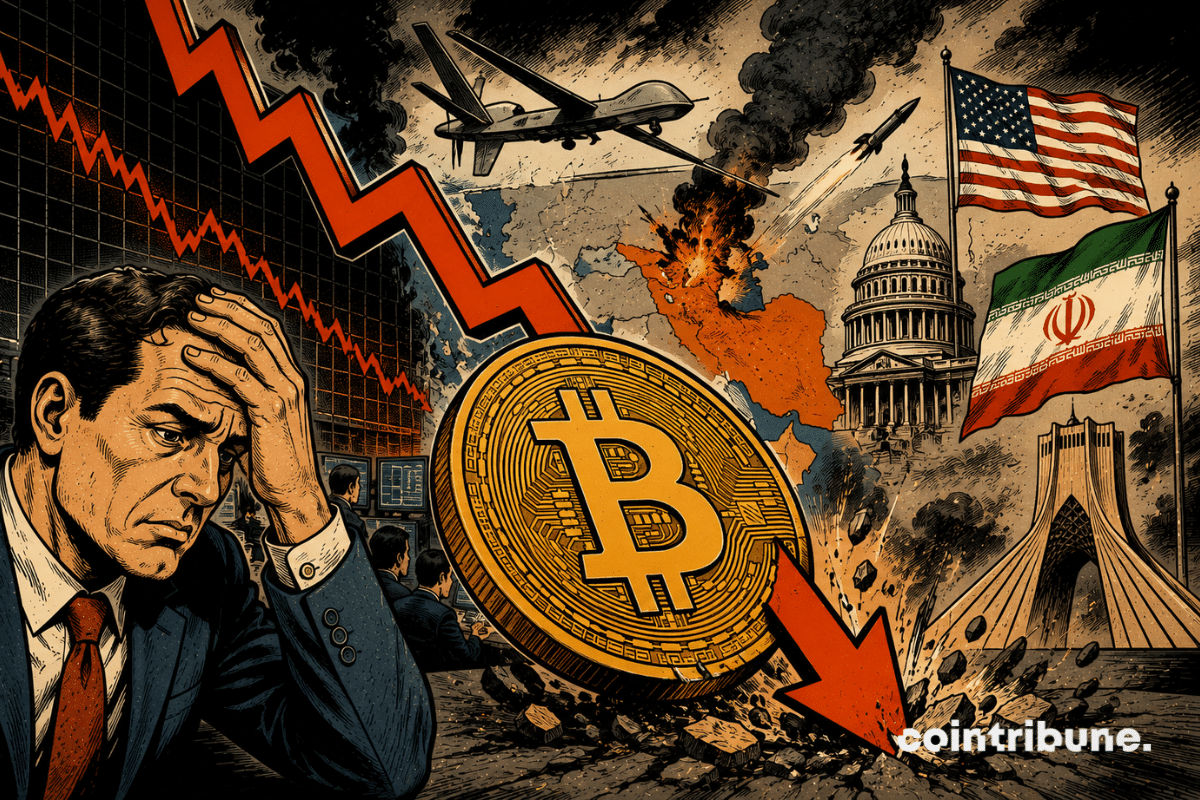
The markets only needed a few hours to falter. A surge in oil prices, triggered by escalating tensions in the Middle East, has reignited risk aversion and led to a sell-off in the most exposed assets. Bitcoin, which was still seeking to consolidate its recent gains, found itself caught in a well-known mechanism: rising American bond yields, declining expectations of a rate cut by the Federal Reserve and a sudden return of geopolitical uncertainty. Can cryptos still escape the turbulence of the macroeconomy?
In brief
- Bitcoin suffers from rising geopolitical risks and falls to a three-day low of $64,799.
- After attacks in the Red Sea, Donald Trump evokes a massive response against Iran, propelling Brent oil above $100.
- The rise in energy prices revives inflation fears, brings down Wall Street and pushes the US 10-year bond yield to 4.7%.
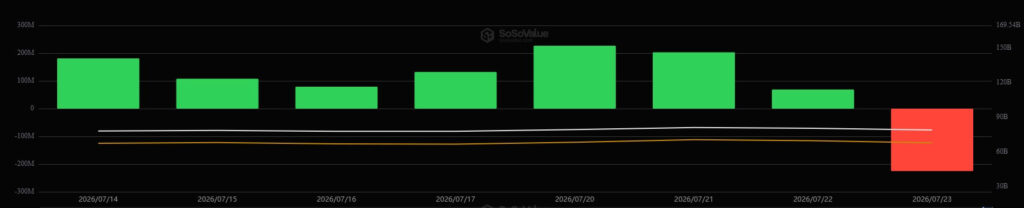
- Bitcoin Spot ETFs see $225.2 million in net outflows, breaking a 7-day streak of positive flows.
Military escalation in the Middle East and soaring energy prices
The price of bitcoin fell below the threshold of $65,000, reaching a three-day low of 64,799, under direct pressure from a renewal of extremely serious military tensions between Washington and Tehran. This correction was triggered after the attack by Iran-backed Houthi rebels on two Saudi oil tankers, the Encelia and the Layla, targeted by ballistic missiles, cruise missiles and drones in the Red Sea. A fire had broken out at the bow of the ship Encelia, although the crew escaped the strike unscathed.
Faced with this critical situation, the American government’s response was broken down into several major elements:
- The threat of a military response on an unprecedented scale: during an interview with the media AxiosUS President Donald Trump asserted : “ I’m aiming for a massive attack. Bigger than ever. I’m about to make a decision. We are all ready » ;
- Pressure on Iranian diplomacy: referring to discussions carried out through intermediary channels, Donald Trump declared about the leaders of Iran: “ they haven’t suffered enough pain yet » ;
- The involvement of regional allies: the American president clarified regarding the participation of Israeli forces that the country “ would join in two minutes if I asked them » ;
- Financial sanctions and official warnings: on the social network Truth Social, Donald Trump promised of the ” major military punishments “, suggesting that the damage to merchant ships could be covered by frozen Iranian assets under US control, as the US military completed a thirteenth consecutive night of targeted strikes.
The drop in stock market indices and the surge in bond rates
The impact of these statements and the naval clashes on global financial markets was immediate. Oil prices crossed the $100 per barrel mark for the first time since late May, with Brent futures gaining 7% to settle at $100.69 on July 23, while West Texas Intermediate (WTI) rose 6.3% to close at $92.28. According to analyst Giovanni Staunovo of UBS bank, oil loading in the Gulf region fell to 2.5 million barrels per day over the last seven days, compared to a thirty-day average of 6 million barrels, while Iranian loadings fell to zero from 1.5 to 2 million barrels per day at the beginning of July.
On Wall Street, stocks fell sharply under the influence of geopolitical risk, with the S&P 500 dropping 1.2% and the Nasdaq Composite falling 2.2%. At the same time, the yield on 10-year US Treasury bonds rose to around 4.7%, recording its highest level in 18 months and reflecting investors’ serious concerns about the return of inflationary pressures. As The Kobeissi Letter pointed out in a publication on the social network inflation expectations and interest rates are rising sharply again. “.
The vulnerability of the bitcoin market and the slowing down of buying dynamics
Beyond this macroeconomic instability coming from outside, the deterioration of the price comes at the precise moment when the internal structure of the bitcoin market shows obvious signs of technical and institutional fragility. US-listed spot Bitcoin ETFs recorded net outflows of $225.2 million on the single day of July 23, breaking a continuous series of seven consecutive sessions in the green which had made it possible to accumulate almost a billion dollars in capital inflows.
Based on on-chain data, Ki Young Ju, founder and CEO of CryptoQuant, observes that demand in the spot market has been almost zero or negative since June. The recent rebound in assets was therefore almost exclusively driven by the derivatives and futures market, but with a volume and intensity significantly lower than those recorded during the previous increase that occurred three months earlier. This increasing reliance on leverage makes long positions extremely vulnerable to a wave of forced liquidations if overall financial conditions were to tighten.
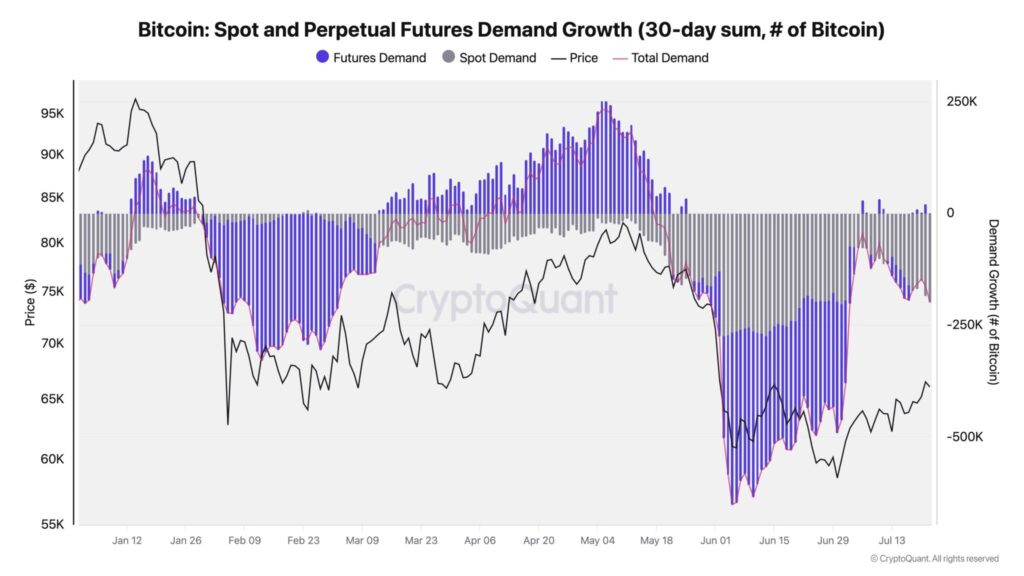
This asymmetry between the derivative market and the physical one fuels growing skepticism among investors, who fear a sudden reversal in prices. The Exitpump analyst therefore advocates the greatest caution and recommends the adoption of selling positions in the face of the inability of buyers to overcome key resistance. On the X network, he openly warns his subscribers: “July rally is coming to an end, price is at resistance, close your long positions, and go short once price breaks $65,000”.
Conversely, other market observers like trader Jelle favor a more temperate reading of the current chart situation. The latter believes that the bullish structure built since the beginning of the month is not yet definitively compromised, emphasizing that the decline movement retains for the moment the appearance of an orderly technical correction as long as bitcoin manages to maintain its price above the major support lines, and in particular around the 21-day moving average. He believes that “If the price manages to break this zone, there will be almost no resistance until $70,000. The movement could be very rapid before a new price range forms. Patience remains my strategy”.
According to crypto trader and analyst Michaël van de Poppe, the 21-week simple moving average, located at $64,073, constitutes a decisive level. “In theory, bitcoin has reached its target zone. As long as it is trading above the 21-day moving average, I am confident that its valuation will continue to increase in the short term”he wrote on X.
Furthermore, he adds: “There is only one last obstacle left before a real breakout: the resistance zone of $68,000. It has already been tested once, and the market is now preparing to put it to the test a second time”.
The return of the specter of monetary tightening and tensions on sovereign debt
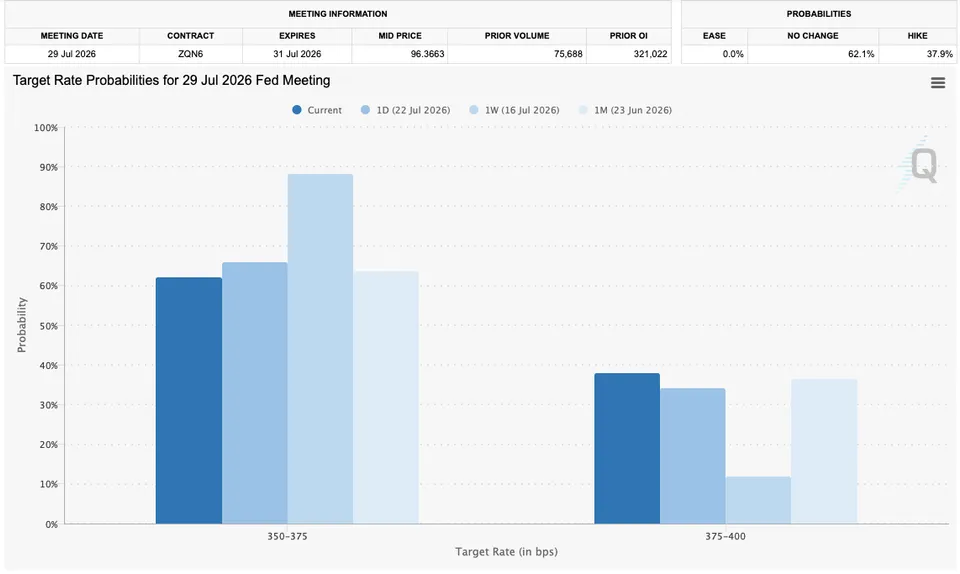
The sudden surge in the prices of energy raw materials fundamentally disrupts the calendar and monetary policy scenarios anticipated by major financial institutions. The CME FedWatch tool watch now a probability rising to almost 40% for an increase in interest rates of 25 basis points at the next meeting of the monetary policy committee of the Federal Reserve scheduled for July 28 and 29, while this contingency was only credited with 12% a week earlier.
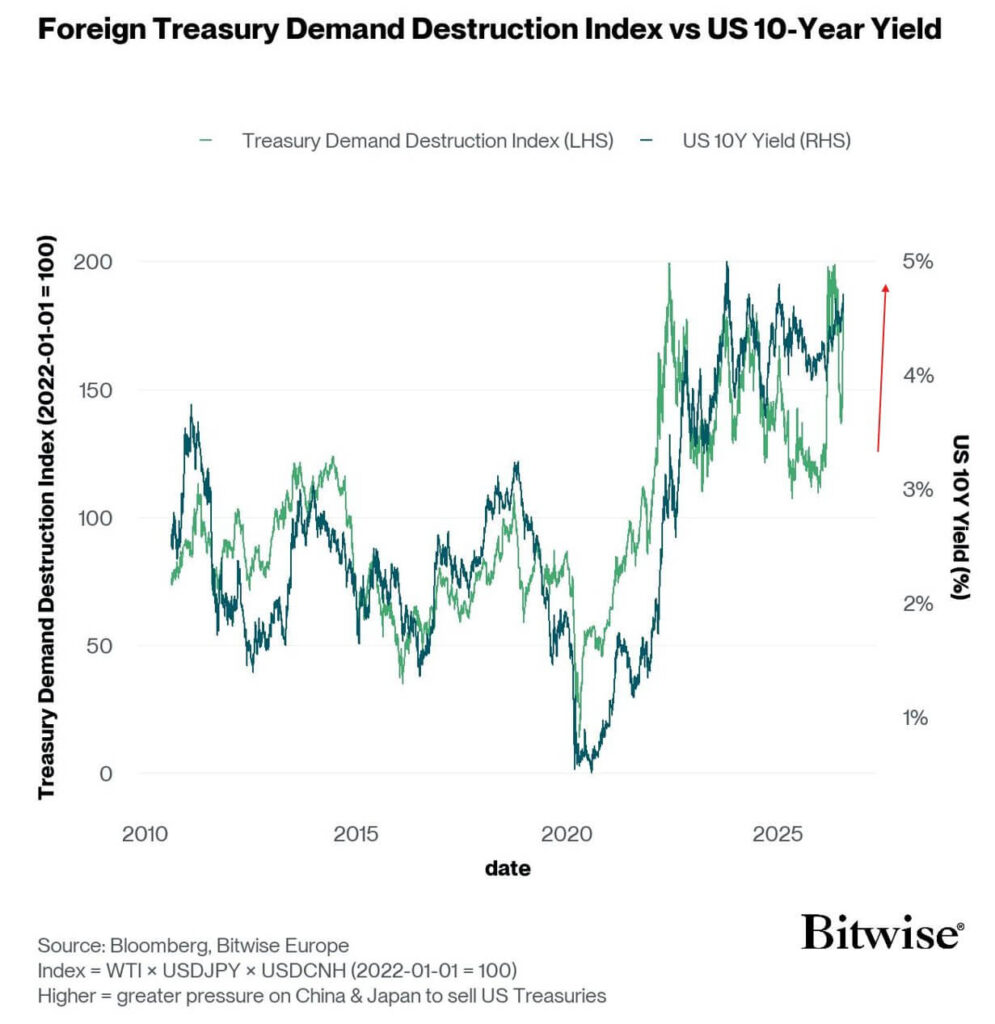
André Dragosch, head of research for Europe at Bitwise, warns of the cascading effects of persistently expensive oil, estimating that such a shock could propel the yield on the US 10-year sovereign bond beyond the 5% threshold. According to him, this situation would force the major crude importing countries, foremost of which is Japan, to massively liquidate their portfolios of American Treasury bonds in order to generate the liquidity necessary to pay their energy bill in dollars.
For his part, Jurrien Timmer, director of global macroeconomic research at Fidelity Investments, highlights the complexity of the current environment for portfolio managers. The correlation remaining positive between the stock market and that of bonds, the rise in term premiums deprives investors of traditional diversification mechanisms to absorb a global movement away from risk.
In the long term, the trajectory of bitcoin remains closely conditioned by the duration and severity of maritime disturbances in the strategic Straits of Hormuz and Bab el-Mandeb, a necessary passage to the Suez Canal. JPMorgan’s research teams estimate that each additional month of constraints on oil supplies will add between $7 and $8 per barrel of Brent, bringing the monthly average price towards 114 if the conflict were to continue for at least three months. Analysts at Goldman Sachs take an equally cautious stance, warning that Brent could exceed $120 during the fourth quarter if maritime flows do not return to normal.
In this context of major uncertainty, Binance Research recalls that Bitcoin ended the first half of 2026 around $59,500, or approximately 53% below its peak established above $120,000 in October 2025. Although Binance Research suggests that these valuation levels historically place bitcoin in a potential low point zone as the fourth quarter approaches, the firm specifies that this technical signal remains to be confirmed. The ability of bitcoin to preserve its supports will therefore depend on the outcome of the Fed’s decisions of July 28 and 29 and the stabilization of the geopolitical front in the Middle East.
Maximize your Tremplin.io experience with our ‘Read to Earn’ program! For every article you read, earn points and access exclusive rewards. Sign up now and start earning benefits.