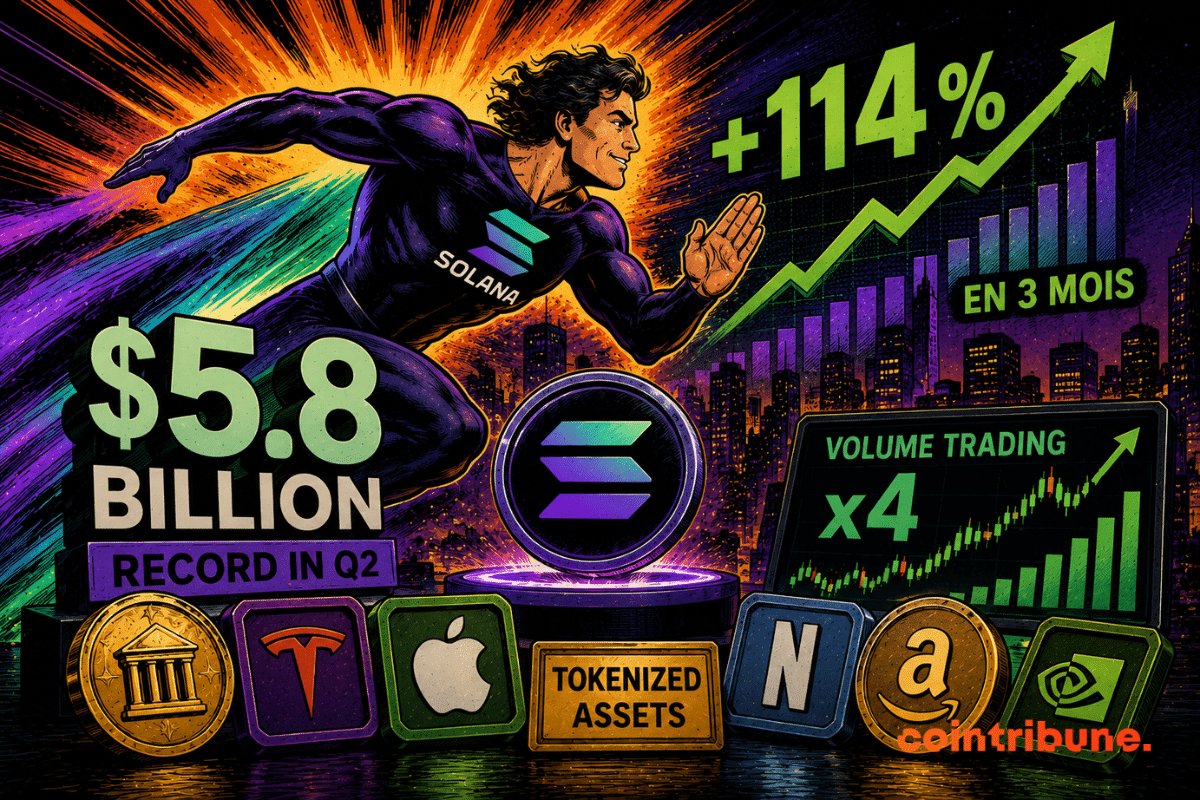
The rise of DeFi is transforming financial balances, but few blockchains have recorded such spectacular progress as that of Solana. This network has seen the volume of its tokenized assets reach dizzying heights, driven by a wave of enthusiasm for tokenized stocks. However, behind these record figures lies a troubling economic equation: the more the volume increases, the less revenue the network generates, a paradox which questions any informed observer of the crypto sphere.
In brief
- Solana recorded $5.77 billion in tokenized assets in Q2 2026, a 114% increase and a sixth consecutive record.
- Tokenized stocks quadrupled to $4.8 billion, driven by SpaceX’s IPO and Solana’s 97% dominance.
- REV collapsed by 43%, application revenue by 31%, and blockchain revenue market share fell to 12%.
- Seven systemic banks and SBI Holdings adopt Solana, while Alpenglow promises 150ms confirmation for August 2026.
Tokenized stocks and SpaceX: the cocktail that propels Solana to the top
The data for the second quarter of 2026 is dizzying: $5.77 billion in tokenized assets passed through Solana, an increase of 114% compared to the first three months of the year. This is not a flash in the pan, but the sixth consecutive quarterly record that this resistant network has achieved.
In June alone, the last week of the quarter set a weekly record at $1.42 billion, proving that the acceleration is not faltering late in the cycle. Tokenized stocks represent the bulk of this growth with $4.8 billion, a near quadrupling compared to Q1.
Solana now holds 97% of the volume of tokenized stocks across all blockchains, a hegemony that has lasted for fifty-four consecutive weeks. SpaceX’s IPO on June 12 acted as a detonator: the SPCX token, issued by Sunrise and distributed via Backpack, alone generated approximately $770 million in volume.
Four star assets, including Micron, SanDisk and the Roundhill Memory ETF, totaled more than $1 billion in transactions in June. This concentration raises the question: has Solana become the container of a new speculative bubble in the crypto universe, or are we witnessing a structural transformation of the market?
The economic paradox: Solana prospers but becomes poorer
The antithesis is striking. While tokenized assets explodeSolana’s Real Economic Value (REV) collapsed by 43% to $51 million. Priority fees drop 45%, Jito tips fall by half. Application revenue recorded its lowest level since the first quarter of 2024, at $228.4 million, a decrease of 31%.
Solana’s share of blockchain revenue fell from 18% to 12%, relegating the network behind Hyperliquid, Tron and Ethereum. DEX volume fell 44% to $160.8 billion. Solana maintains its first place with 32% of the market, but this leadership is accompanied by an erosion of margins.
“ Q2 provided the strongest evidence yet that sustainable, non-speculative demand is building for Solana », Says Blockworks Research in its report dated July 20, 2026.
This statement, although optimistic, obscures a disturbing reality for crypto investors. The memecoin frenzy, which boosted revenues in 2025, has run out of steam, giving way to a tokenized economy that generates less value for the network.
Is Solana trading one speculative lever for another, less profitable for its validators and its applications?
Banking giants and SBI Holdings: the institutional infrastructure is being built
Seven of the world’s twenty-nine systemic banks now have operational capabilities on Solana, led by JP Morgan Chase and Citigroup. Deployments cover the entire value chain: tokenization, settlement, custody, issuance of stablecoins, loans and monetary funds.
SBI Holdings, the Japanese investment giant, has pivoted its blockchain initiative to Solana, integrating the Solana Foundation into its joint venture with Sumitomo Mitsui Financial Group.
“ By creating a new market for digital assets of Japanese origin, this collaboration aims to establish Japan as a central hub for onchain finance in Asia », Announces SBI Holdings in its press release dated July 13, 2026.
Solana ETPs attracted $120 million in net inflows in Q2, surpassing Q1, while Bitcoin ETPs saw $3.7 billion in outflows and Ethereum ETPs saw $500 million. Staked SOL reached a record 427 million tokens, or two-thirds of the total supply.
The supply of stablecoins remained at $16.3 billion. The network processed 9.8 billion non-voting transactions, its second best quarter, with median fees of $0.0004. This institutional adoption confirms that Solana is establishing itself as a credible settlement infrastructure in the crypto ecosystem.
Key figures for the Solana quarter
- Volume of tokenized assets Q2: $5.77 billion;
- Tokenized stocks: $4.8 billion (quadrupling from Q1);
- REV: $51 million (-43%);
- SOL price at time of writing: $77.34;
- Solana ETP Inflows: $120 million.
Alpenglow: the upgrade that can change everything
The largest upgrade in Solana history, called Alpenglow, is expected in August 2026. It promises confirmation times of 150 milliseconds, a hundred-fold improvement over current performance.
The removal of onchain voting transactions, the introduction of a validation ticket at 1.6 SOL per epoch and a tolerance for offline validators increased to 40% should strengthen the resilience of the network.
The proposals SIMD-550, which would double the disinflation rate, and SIMD-553, which would burn between 7,500 and 9,000 SOL per day, demonstrate a desire to tighten the link between the use of the network and the value of the token.
However, a fragility remains. The focus on four star assets, including SpaceX, Micron and SanDisk, generated more than $1 billion in June. If these issuers withdraw, or if a competitor manages to match Solana’s technical performance, the shock could be brutal.
Is Alpenglow a technical response to a structural weakness, or a simple smokescreen in the face of the network’s inability to diversify its sources of income? Observers in the crypto sphere are holding their breath.
Solana has sparkling records, but this growth hides deep flaws. The concentration of assets and collapse in revenues are a reminder that the crypto industry has already experienced similar setbacks. Haven’t we recently observed a massive exodus of Solana validators over three years? The next shock may be closer than we think.
Maximize your Tremplin.io experience with our ‘Read to Earn’ program! For every article you read, earn points and access exclusive rewards. Sign up now and start earning benefits.