
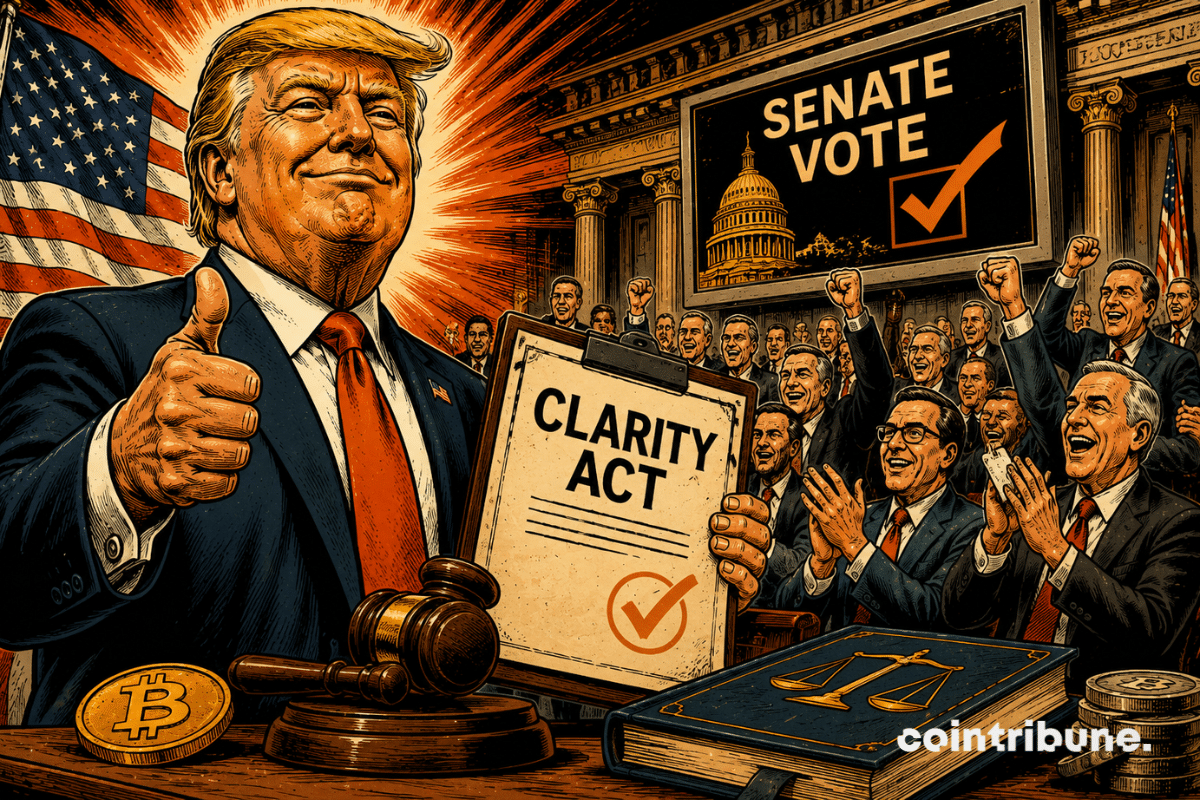
The White House validated an ethical component of the CLARITY Act and transmitted the text to Republican senators, removing the last major obstacle before a vote in session. Donald Trump personally gave his agreement, reviving hopes of adoption before the Senate summer recess.
In brief
- The White House sent the ethics language of the CLARITY Act to Republican senators on July 21, 2026.
- The device targets disputes related to Trump’s crypto tax return, valued at more than $1.4 billion in 2025.
- The Republicans have approximately 18 legislative days before the truce scheduled for the beginning of August to pass the text.
The ethical impasse finally comes to an end
For months, the CLARITY Act hit a wall that technology alone was not enough to overcome. The White House accepted an ethics package and sent it to Republican senators, a move that Donald Trump personally validated.
The blockage focused on ethics, not market regulation: Democratic senators Ruben Gallego and Angela Alsobrooks demanded a strict clause against conflicts of interest, covering the president, vice-president and Congress.
The origin of the dispute dates back to the president’s personal crypto holdings. Its 2025 financial statement estimates its revenues in digital assets at more than $1.4 billion, a lever for Democrats who considered unacceptable any provision lacking real enforceability.
This posture shaped the project’s trajectory, even as its market structure provisions garnered broad bipartisan support.
The information first circulated on X. Eleanor Terrett, host of the show Crypto in America, wrote that she had collected multiple industry sources confirming the agreement. Onchain analyst Wu Blockchain corroborated the scoop, marking the first sign of movement since talks broke down in early July.
I’ve heard from several industry sources that the White House has agreed to an ethics package for the Clarity Act and sent the language to some Republican senators this afternoon.
The CLARITY Act redefines the boundary between the SEC and the CFTC
The CLARITY Act aims to put an end to the jurisdictional war that has pitted the CFTC and the SEC for years over the qualification of digital assets. The project gives the CFTC primary oversight over digital commodities like bitcoin, once a network is deemed sufficiently decentralized, while the SEC retains authority over security-like tokens.
The text also classifies cryptos held by customers as their property in the event of an exchange’s bankruptcy, closing a legal loophole revealed by the collapse of Celsius and Voyager.
The Senate Banking Committee already advanced its version by a vote of 15 to 9 in May, after approximately ten months of merging the House and Senate texts. The details of this compromise, reported by Bitcoin.comremain confidential for the moment.
The supervision of market structures has also received praise. Coinbase’s director of public affairs called it “dramatic progress” for consumer protections in the committee vote, a sentiment reinforced by the length of the ethical standoff.
The legislative window closes at the beginning of August
Time now counts more than the content of the text. The Senate must begin its summer recess in the first week of August, leaving majority leader John Thune with a few legislative weeks to bring the bill into session.
The Republicans have 53 seats, which requires rallying at least seven Democratic senators to cross the 60-vote threshold necessary to break a filibuster. Bettors in prediction markets only gave the CLARITY Act a 39% chance of becoming law in 2026 as the impasse persisted, a sign of real doubt about Washington’s ability to decide in time.
Outside groups are applying pressure. A coalition of law enforcement organizations recently backed the bill, arguing that clear federal rules would make it easier to combat crypto fraud. Furthermore, Senator Cynthia Lummis, for her part, is publicly calling for a vote in session in July. Around 18 legislative days remain before the truce, and the revised version of the text is expected in the coming days.
In short, the White House ethics agreement transforms the CLARITY Act from a stalled issue into a tangible priority for the executive branch before August. Three catalysts converge: Trump’s direct involvement in the negotiations, support from law enforcement, and the urgency of the timetable. The American regulation of cryptos is part of a broader movement, already illustrated by the GENIUS law on stablecoins. The next revised text will say whether the Senate finally seizes its chance.
Maximize your Tremplin.io experience with our ‘Read to Earn’ program! For every article you read, earn points and access exclusive rewards. Sign up now and start earning benefits.


