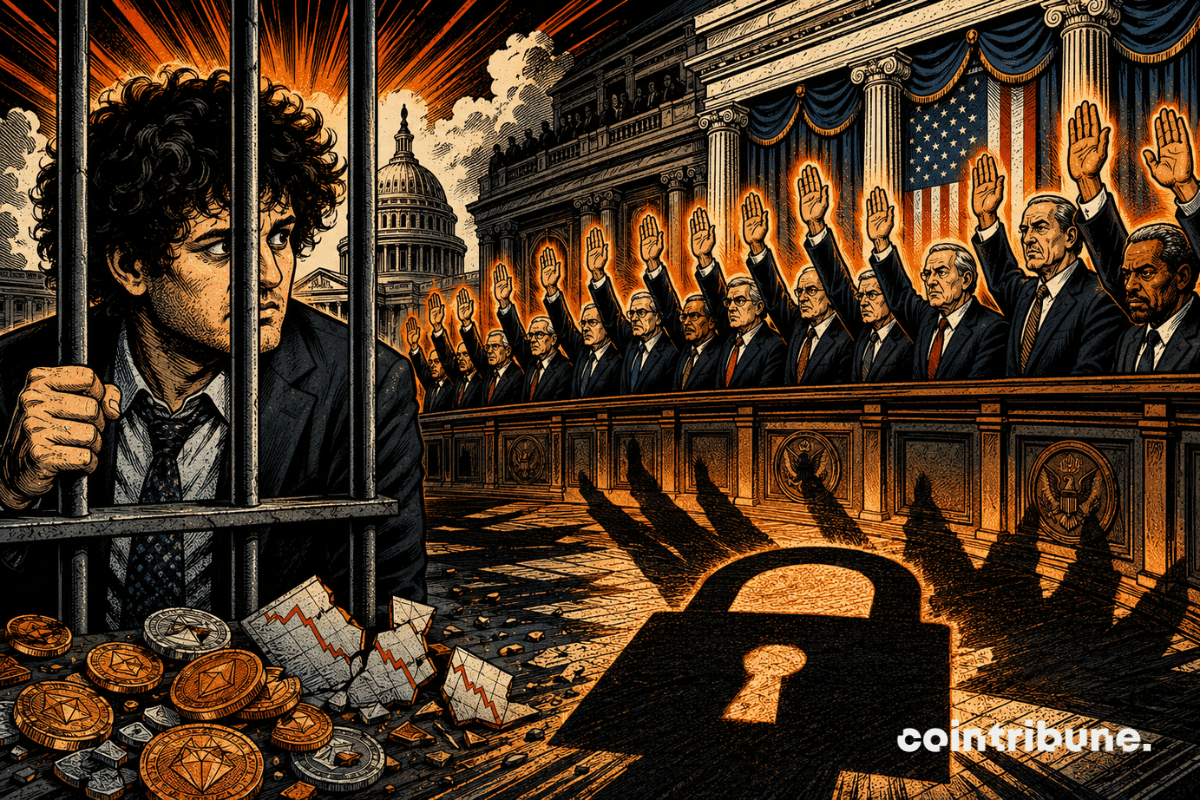
The US Senate has just sent a brutal message in the FTX affair. Sam Bankman-Fried should not benefit from any presidential pardon. This resolution does not legally block the power of the president. But it further isolates the former king of crypto, already sentenced to 25 years in prison for one of the largest American financial frauds.
In brief
- The US Senate unanimously opposes any pardon for Sam Bankman-Fried.
- The resolution is symbolic, but very politically heavy.
- The FTX affair remains a central marker for the credibility of crypto.
A rare vote against Sam Bankman-Fried
The US Senate adopted a clear resolution against any clemency in favor of the former boss of FTX. The text states that Sam Bankman-Fried should receive no pardon, no commutation of his sentence and no other form of federal clemency. The vote was obtained by unanimous consent. This means that no senator opposed its adoption. In an often fractured Congress, this consensus gives the issue strong political significance.
The resolution remains non-binding. It does not take away from the president his constitutional power of pardon. But she sets a public line. Granting a favor to SBF would now amount to opposing a position expressed by the entire Senate. The FTX affair continues to stick with the crypto sector. Sam Bankman-Fried had built an image as a genius, political donor and industry savior. His fall left a deep scar.
The jury convicted him in 2023 on seven fraud-related counts. In March 2024, the courts sentenced him to 25 years in prison. Prosecutors had described the collapse of FTX as one of the largest financial frauds in American history. For the crypto industry, this vote comes at a sensitive time. Serious players want to distinguish themselves from the era of opaque empires, untraceable balance sheets and inflated promises. The Senate’s message reinforces this boundary.
The leniency of SBF would have blurred this separation. It would have given the impression that notoriety, political networks or communication can mitigate massive fraud. This is precisely what elected officials want to avoid.
FTX remains a warning for the entire market
The text was written by Cynthia Lummis and Rubén Gallegotwo senators placed at the heart of discussions on digital assets. Their alliance gives particular weight to the initiative. Lummis is known for her pro-crypto stances. Gallego also defends a more structured framework for the industry. Their message is therefore not anti-crypto. Rather, it aims to separate digital innovation from fraud.
This is where voting gets interesting. The Senate is not saying crypto should be rejected. He says the FTX affair cannot be erased by a political gesture. Nuance matters. Sam Bankman-Fried has already tried several avenues of defense. He contested his trial, criticized the proceedings and sought to change his public narrative. But the courts have so far rarely followed this line. His legal path narrowed, as his appeal hearing showed.
The resolution does not free the victims. It does not reimburse losses. It does not repair the years of chaos that followed the bankruptcy. But it locks the symbol. FTX was not just a platform that collapsed. This was a failed test of trust on a grand scale. Customers thought they were depositing their funds in a secure infrastructure. They discovered a fragile, confusing and mixed system at Alameda Research.
For Sam Bankman-Fried, the political window is closing. His release planned around 2044 once again becomes the most likely scenario. For crypto, the message is broader: the industry will only be able to gain lasting public trust by accepting that the FTX affair remains a precedent, not an embarrassing parenthesis.
Maximize your Tremplin.io experience with our ‘Read to Earn’ program! For every article you read, earn points and access exclusive rewards. Sign up now and start earning benefits.