
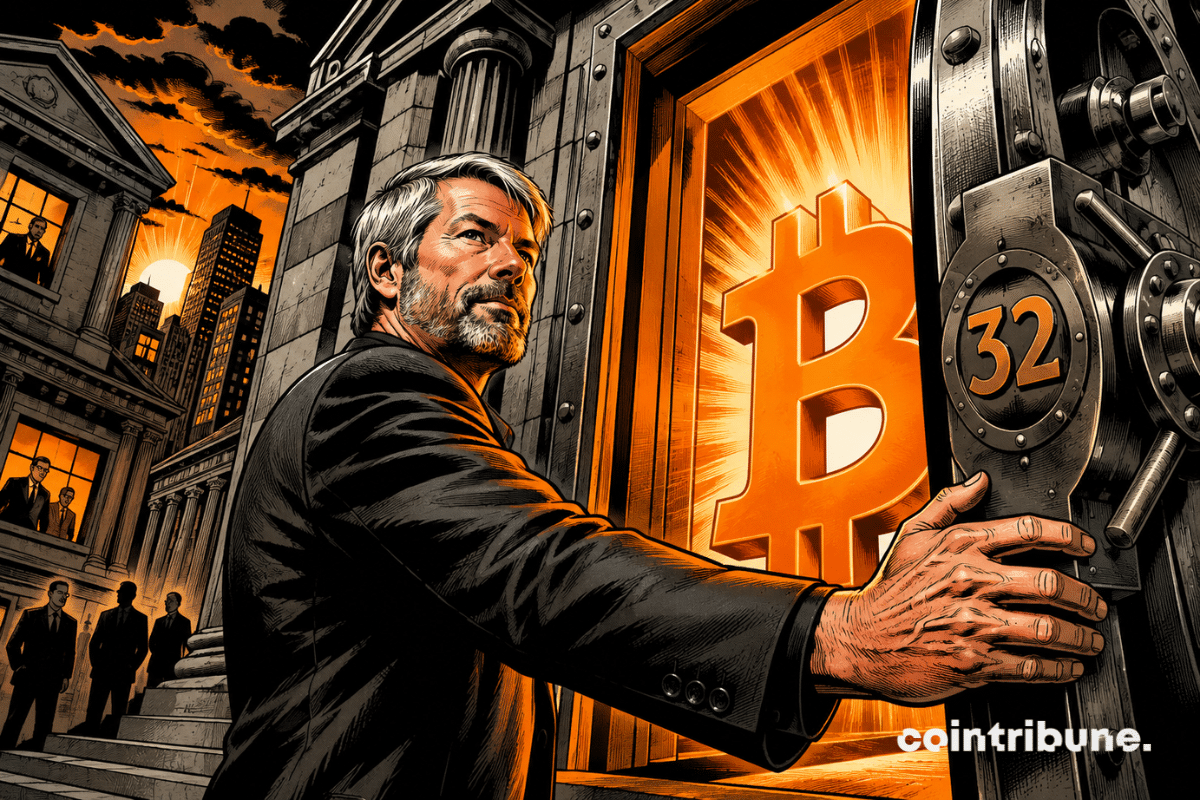
Bitcoin now has 32% adoption among major global banks, according to an index published by Strategy. Michael Saylor, founder of the first BTC reserve company, considers this breakthrough promising but still premature. Is the market on the verge of a banking shift?
In brief
- An index published by Strategy measures bitcoin adoption by major banks at 32% overall.
- Fidelity leads the ranking with a score of 71%, ahead of BNY Mellon (46%) and Goldman Sachs (45%).
- Strategy increased its cash reserve to $3 billion after a $467 million sale of MSTR shares.
Bitcoin attracts banks, but the market remains in its infancy
Strategy has long defended the idea that bitcoin would eventually find its way onto bank balance sheets. The company has just measured it in black and white via an index detailed by AMBCrypto: its new banking adoption index credits bitcoin with 32% overall penetration among large banks.
Michael Saylor describes this trajectory as accelerating, while recalling that the market remains in its infancy. For months, the manager has been deploying a bitcoin monetization strategy that goes beyond simple accumulation.
Bitcoin adoption by major banks is accelerating, but still in its early stages: 32% overall, according to the index.
The index covers several dimensions of banking activity : ETF trading, custody and credit. It provides a precise inventory of the institutional appetite for bitcoin. However, a score of 32% above all reflects a movement that is still in its infancy, far from saturation.
Fidelity dominates a still sparse ranking
Fidelity Trust leads the pack with a score of 71%. The establishment displays faultless custodianship, BTC holding, ETF trading and the issuance of stablecoins. Its position illustrates the ability of a historic player to embrace the entire bitcoin value chain.
BNY Mellon ranks second at 46%, followed by Goldman Sachs at 45%, which completes the top three. Other global players complete the picture, such as the Spanish bank Banco Santander, the French Société Générale and the British Standard Chartered.
These names confirm a gradual opening of traditional financial centers. The gap between the leader and his pursuers reveals the extent of the remaining path. Reference banks convert in fits and starts, not in a unanimous wave.
Saylor wants to make Strategy a “Bitcoin bank”
The most revealing section of the index concerns credit, that is to say the ability of banks to grant loans backed by spot BTC or ETFs like BlackRock’s iShares Bitcoin Trust (IBIT).
In 2026, most establishments have favored spot BTC ETFs as collateral rather than bitcoin itself. This preference highlights the persistent distrust of the native asset.
The use of this collateral for the futures market still remains marginal. Saylor has several times mentioned the desire to make Strategy the “first Bitcoin bank in the world”. The company could mobilize its own BTC reserve as collateral to issue new credit instruments, beyond its STRC product, relying on banking partners.
The score of 32%, however, shows that bitcoin is not yet treated as high-quality collateral. By extension, its vision of a “BTC bank” remains, for the moment, difficult to achieve. Strategy nevertheless strengthened its financial position: a sale of MSTR shares of 467 million brought its cash reserve to 3 billion dollars, or twenty months of coverage of its obligations.
In short, bitcoin is gradually settling into the banking fold without yet being fully admitted. Three catalysts shape the future: the rise of BTC-backed credit, the expansion of collateral to spot ETFs, and the capacity of Strategy to structure its own instruments.
The company’s cash reserve, increased to 3 billion dollars after a sale of MSTR shares of 467 million, offers it twenty months of coverage of its commitments. This financial base, which Saylor estimates can last for decades without a rise in bitcoin, fuels its patient conquest of bank status. The changeover is engaged, not yet sealed.
Maximize your Tremplin.io experience with our ‘Read to Earn’ program! For every article you read, earn points and access exclusive rewards. Sign up now and start earning benefits.


