
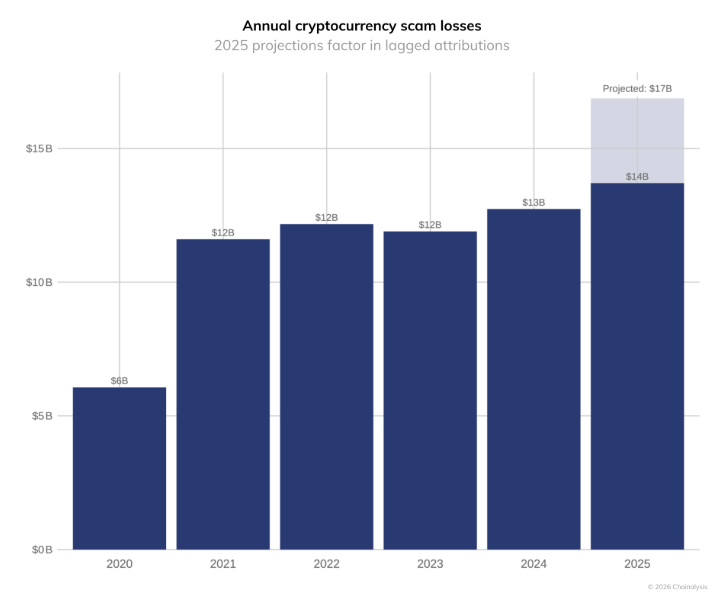
Cryptocurrency scams will reach a new level in speed and scale in 2025, as artificial intelligence tools make fraud more credible and harder to detect. A new report from blockchain analytics firm Chainalysis reveals that scammers are extorting more money per victim while running cheaper, larger-scale operations. Estimated losses would amount to $17 billion for the year, a historic record.

In brief
- AI-powered crypto scams now generate much higher losses per victim, with average harm up 253%, as automation increases the speed and credibility of scams.
- Deepfakes and impersonation scams rose sharply in 2025, allowing criminals to deploy trust-based fraud at scale to thousands of targets simultaneously.
- Romance scams and pig butchering remain the most destructive, obtaining higher amounts by banking on a long-term relationship rather than speed.
- Scammers are increasingly bypassing exchanges, using DeFi and AI-assisted identity fraud to move and cash out stolen cryptocurrencies faster.
Chainalysis Finds AI Scams Profit 4.5x More Than Traditional Schemes
According to Chainalysis, this explosion in losses is not simply explained by an increase in the number of scams, but by optimized execution. The average amount extorted per transaction increased from $782 in 2024 to $2,764 in 2025, an increase of 253%. Faster contact, credible impersonations and automated messaging allow criminals to collect more in less time.
Eric Jardine, head of research at Chainalysis, points out that artificial intelligence has profoundly changed the speed at which these scams grow. More than 70% of AI-powered scams are now among the top 50% in terms of transfer volumes. Transactions are faster, appear more authentic, and extract more money with each interaction.
Scams that rely on on-chain AI service providers generate an average of $3.2 million per transaction. This figure is approximately 4.5 times higher than that of scams without this type of link. Many schemes are based on face swap software, deepfake videos or even linguistic models marketed by suppliers based in China, often distributed via Telegram channels.
Credibility plays a central role. Once victims see familiar faces or authority figures, trust increases. Criminals then extend these interactions to thousands of targets simultaneously. Government identity theft scams show how effective this approach is. Schemes using fake images or videos of officials increased by more than 1,400% in 2025, with criminals posing as employees of public agencies, banks and crypto platforms.
Romantic scams remain the most costly
One of the largest phishing campaigns recorded targeted US residents through fake E-ZPass toll alerts. Chainalysis traced the operation to a Chinese group known as Darcula, also called the Smishing Triad. At the height of their activity, these scammers were sending up to 330,000 text messages in a single day. Despite this scale, infrastructure costs remained low, with phishing kits likely selling for less than $500.
The different types of scams differ according to their balance between scope And trust :
- Large-scale phishing relies on inexpensive automation and a very broad target.
- Imitation via deepfake builds trust and enables larger payments.
- Relationship scams trade speed for a higher profit per victim.
- AI tools reduce the time required for each interaction.
- Very low operating costs significantly increase margins.
Long-term frauds, known as pig butchering, remain among the most harmful. Scammers establish a personal or romantic relationship over several weeks or months, before tricking victims into sending increasing amounts of cryptocurrency. The name refers to a method of slowly fattening up the victim before emptying their funds.
These scams generally result in much higher losses per victim than giveaways or fake airdrops scams. Jardine points out that scammers are constantly balancing volume and credibility. Quick scams reach more people, but trust-based schemes extract much larger sums from fewer victims.
A recent example illustrates this formidable effectiveness: in December, a woman living in San Jose, California, used ChatGPT to confirm that her new romantic partner was actually a scammer in a pig-butchering scam. By then, she had already lost nearly $1 million in cryptocurrency.
Many impersonation scams are moving away from centralized platforms and toward decentralized tools, DeFi bridges and on-chain protocols. These permissionless technologies allow funds to flow without checkpoints, making their traceability and recovery more complex.
AI also transforms conversion into traditional currencies
At this stage, artificial intelligence still plays a limited role in on-chain transfers, which can often be executed via simple scripts. On the other hand, more advanced AI tools could intervene at the final stage of collection. Jardine says AI could enable the mass generation of fake KYC-enabled exchange accounts, making it easier to convert to fiat currencies.
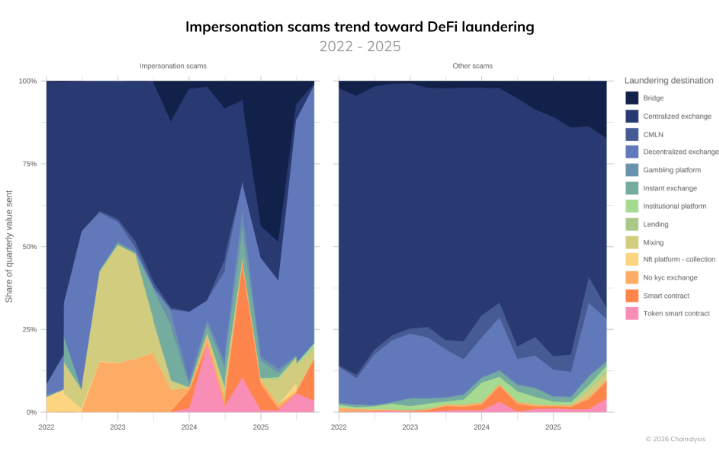
Spoofing scams move toward DeFi laundering
- Moving funds from centralized exchanges to DeFi.
- Increased automation of transfers.
- AI-assisted identity theft during cash-out.
- Reduced entry barriers, even for large-scale campaigns.
- Faster recycling of stolen assets.
In parts of Myanmar and Cambodia, entire complexes have transformed pig butchering into a formal industry. Victims of human trafficking are forced to perpetrate these scams, under threat or violence. The cryptos thus extorted are then laundered through the purchase of luxury goods.
Chainalysis notes that the latest interventions by law enforcement confirm the close link between these schemes and organized crime. In December, the U.S. Department of Justice launched an operation to shut down several web domains associated with a massive fraud ring in Myanmar. Authorities have uncovered criminal structures exploiting both financial victims and forced laborers.
With AI tools becoming more and more accessible and inexpensive, Chainalysis warns: the effectiveness of scams will continue to grow. Unless there is rapid improvement in automated detection, user education, and cross-border investigative cooperation, crypto fraud will remain one of the biggest economic threats to the ecosystem.
Maximize your Tremplin.io experience with our 'Read to Earn' program! For every article you read, earn points and access exclusive rewards. Sign up now and start earning benefits.