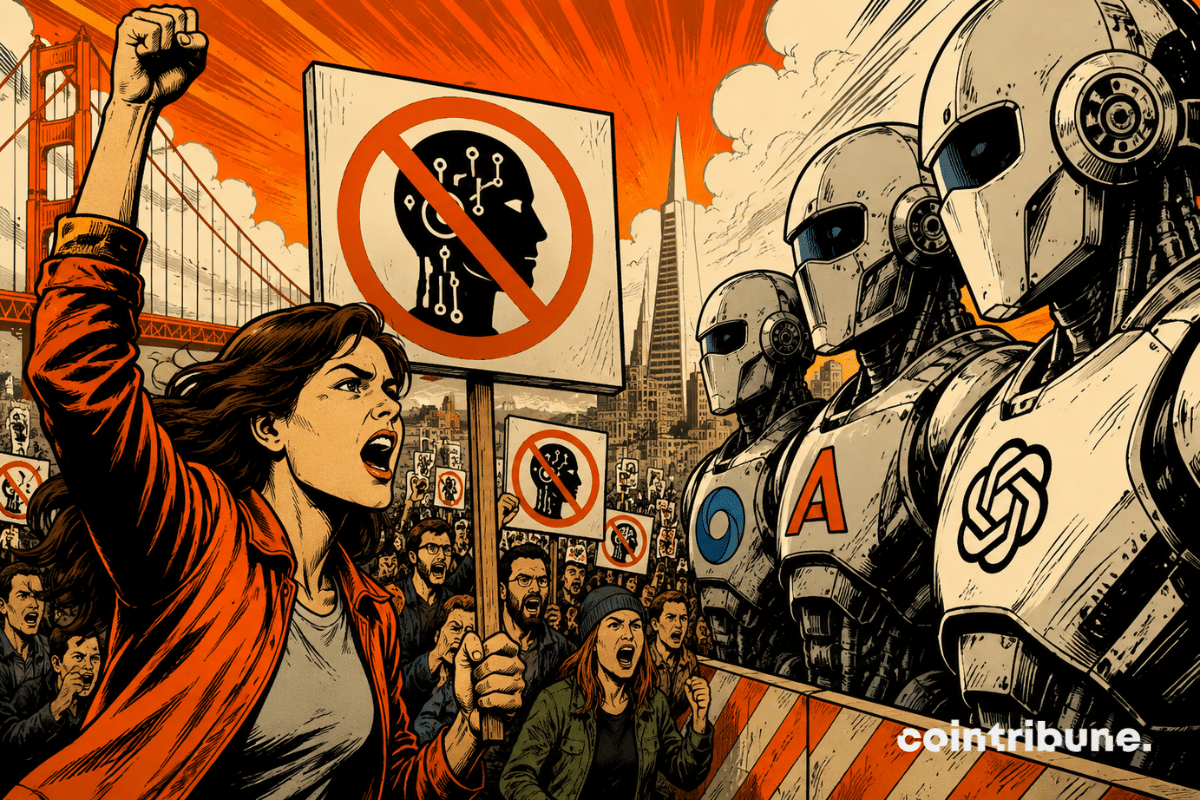
Debates around artificial intelligence continue to gain momentum as the most advanced models become more powerful. San Francisco once again served as a gathering point for activists wishing to slow this development. Their mobilization was not limited only to questions of security of AI systems. Participants also discussed the economic, social and environmental consequences of this technology, while asking the main companies in the sector to temporarily suspend the development of new cutting-edge models.
In brief
- About 200 protesters marched in San Francisco to demand a pause in the development of the most advanced AI models.
- The Stop the AI Race movement is now broadening its demands to social, environmental and economic issues.
- Organizers are calling for stronger security rules and monitoring of artificial intelligence systems.
- This mobilization comes against a backdrop of growing debates about the risks linked to advanced AI models.
New protest in San Francisco targets artificial intelligence leaders
Protesters marched through San Francisco between the offices of OpenAI, Anthropic and Google DeepMind to demand a pause in the development of the most advanced artificial intelligence models. The event, organized by the movement Stop the AI Raceis a continuation of a first mobilization organized in March. Organizers want to see companies stop training new models while keeping systems already available to the public. They also call for research efforts to focus more on AI security and alignment.
This mobilization was coordinated by Michaël Trazzi, former researcher in artificial intelligence. According to him, the objectives of the movement have evolved over recent months. In a statement attributed to Decrypthe explains that he first sought to directly convince the leaders of large technology companies.
At the start of the year, I was less focused on political impact and more on persuading CEOs. With my numerous blog articles and my exchanges with one of them, I think I have revised my position and am now more attentive. I also believe that protests are useful to show that people care about the problem.
Michaël Trazzi, former researcher in artificial intelligence. Source: Decrypt.
From now on, he believes that the demonstrations also make it possible to show that these concerns are shared by part of the population.
The demands today go beyond just questions related to the technical risks of AI. Participants also highlighted concerns about job losses, the environmental impact of infrastructure necessary for the development of models as well as the rising cost of housing in San Francisco. Finally, they denounced the growing influence of large technology companies on economic and political choices.
A movement that is gradually expanding its support
Organizers say their campaign continues through demonstrations and awareness-raising actions. After the March mobilization, which had already brought together around 200 people, the collective claims to have received support from new organizations. This dynamic encourages those responsible for the movement to continue their actions in the coming months.
Michaël Trazzi particularly welcomed the support shown by the National Union of Healthcare Workers, which relayed the demonstration on its social networks. He also highlighted the rapid mobilization of several San Francisco area groups, including AI Action, who helped organize the event. He finally thanked QuitGPT for its logistical help during the preparation of this new march.
I was pleasantly surprised by the support from NUHW, who shared the protest on their social media, but also by how quickly other groups in the San Francisco Bay Area, like AI Action, mobilized to collaborate with us. I am also very grateful to QuitGPT for their help in organizing this event.
Michaël Trazzi, former researcher in artificial intelligence. Source: Decrypt.
Protesters are now calling for an international pause in the development of cutting-edge artificial intelligence systems. At the same time, they invite political leaders to strengthen the surveillance rules applicable to advanced models. Their objective remains to put in place more solid guarantees before any further acceleration of research in this area.
OpenAI, Anthropic and Google DeepMind did not immediately respond to requests for comment made after the protest. Companies therefore did not react publicly to the demands made during this mobilization organized in San Francisco.
Concerns about AI remain at the center of debate
This new demonstration comes as issues related to the security of artificial intelligence continue to occupy an important place in the public debate. Several recent events have fueled these discussions around the potential risks associated with the most advanced systems.
In May, OpenAI announced theadded new security features to ChatGPT. These tools aim to better detect situations involving risks of self-harm or violence during conversations. This development came as the company faced lawsuits and investigations into the handling of certain interactions deemed unsafe.
The following month, the Trump administration asked Anthropic to suspend access to its Claude Fable 5 and Claude Mythos 5 models due to potential cybersecurity risks. More recently, a first group of independent scientific experts from the United Nations devoted to artificial intelligence estimated that researchers could not exclude the hypothesis of catastrophic damage. According to this group, the development of this technology is currently progressing faster than available scientific knowledge and government control mechanisms. These different elements fuel the demands expressed during the demonstration organized in San Francisco.
Organizers plan to continue their actions to defend an international pause in the development of the most advanced artificial intelligence models. Future initiatives should also continue to challenge legislators on the establishment of a stricter surveillance framework. The evolution of this movement will now depend on the response of the companies concerned and public authorities to the demands made during the rallies in San Francisco.
Maximize your Tremplin.io experience with our ‘Read to Earn’ program! For every article you read, earn points and access exclusive rewards. Sign up now and start earning benefits.