
An exclusive study carried out by the Cambridge Center for Alternative Finance at the University of Cambridge has just redefined the environmental hierarchy of crypto blockchains. It indeed demonstrates that Ethereum clearly outperforms Solana in terms of energy intensity compared to its market value. A real revolution for the crypto ecosystem! Figures, methodology and complete analysis in the paragraphs that follow.

In brief
- Ethereum consumes approximately 7.87 GWh of electricity per year, a continuous power output of 0.90 megawatts.
- Its energy intensity is the 2nd lowest in the PoS panel studied by Cambridge, behind BNB Chain.
- Solana displays the highest absolute consumption (13.48 GWh/year) and an intensity 8.5 times higher than that of Ethereum.
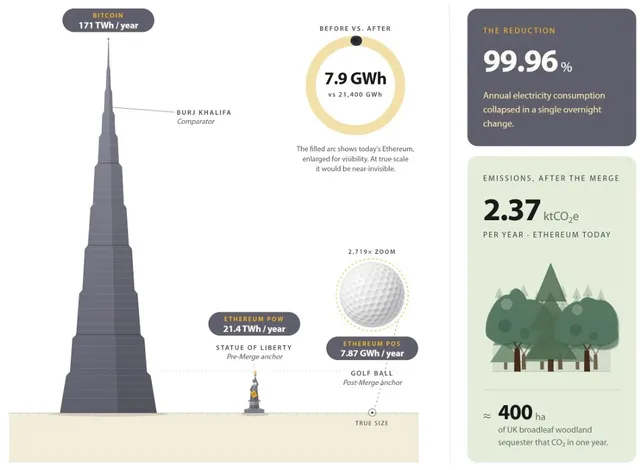
- The Merge reduced Ethereum’s ongoing power demand from 2.4 GW to 0.90 MW, a drop of over 99.9%.
Annual electricity consumption of 7.87 GWh for Ethereum according to Cambridge
The Cambridge Center for Alternative Finance has just published a report entitled “ Ethereum After the Merge – A Change in Power “. The document indicates that the global annual power consumption of Ethereum now stands at around 7.87 gigawatt hours (GWh). This corresponds to a continuous power demand of just 0.90 megawatt (MW). Which keeps the crypto network more than 99.9% below its initial baseline of 2.4 gigawatts (GW).
To arrive at this precise data, the Cambridge researchers audited the overall physical structure of the Ethereum network using a bottom-up approach. More concretely, they directly tested the power consumption of 20 combinations of client software used by the nodes on two types of hardware.
Results :
- A typical residential configuration consumes a median value of 18 watts.
- A professional workstation climbs to 153 watts.
By weighting these results by the actual distribution of nodes, Cambridge obtains an average consumption of around 105 watts per node.
The study identifies 8,522 identifiable complete nodes:
- 36% operate on residential connections;
- 64% in cloud or enterprise infrastructures.
The United States hosts 31% of these nodes, followed by Germany (16%), Finland (8%), and France (6%). These four countries alone therefore concentrate nearly 62% of the network of nodes measured by Cambridge.
Ethereum outperforms Solana in terms of energy intensity
Certainly, Ethereum uses more electricity than most small PoS networks due to the vastness of its validator fleet. When we adjust the electricity consumption to the market value, the efficiency of Ethereum however becomes indisputable.
According to the Cambridge University study reportthe crypto network only consumes 33 kilowatt-hours (kWh) for every million dollars of market capitalization. It is thus classified as the second most sober blockchain in the world behind BNB Chain.
Conversely, Solana records the highest absolute consumption of the PoS networks studied with around 13.48 GWh per year. Its energy intensity peaks at 283 kWh per million dollars of market capitalization.
This ratio demonstrates that Solana is approximately 8.5 times more energy intensive than Ethereum to secure equivalent economic value. Enough to sweep away the preconceived idea according to which Solana’s throughput performance would guarantee greater sobriety than the historical architecture of Ethereum.
All crypto networks included in the Cambridge comparison consumes approximately 38 GWh cumulatively over the period studied. Other blockchains are between 3.6 and 5.1 GWh. This is particularly the case of:
- NEAR ;
- Tron;
- YOUR.
Cardano and BNB Chain remain below the gigawatt-hour mark.
Cambridge, however, makes an important point: the study does not claim that Ethereum consumes the least electricity in absolute value.
Ethereum: a carbon footprint now linked to the electricity mix
L’annual carbon footprint of Ethereum amounts to just 2.37 kilotons of carbon dioxide equivalent (ktCO₂e). This represents a drastic reduction of 99.98% compared to the Proof-of-Work era. The network’s climate impact is now equivalent to the annual carbon footprint of 900 British households.
Still according to studies carried out by Cambridge researchers, 39.4% of the electricity consumed by the Ethereum network comes from renewable sources and 17% from nuclear power. We therefore obtain a total of 56.4% of low-carbon origin. The remaining 43.6% comes from fossil fuels, with natural gas alone making up 27.7% of the mix.
Alexander Neumüller, head of research at the Cambridge energy program, sums up this shift in one sentence:
Electricity is no longer the price of security under PoS.
Cambridge nevertheless clarifies an important point: no estimate per transaction has been made. The reason is that around 92% of Ethereum ecosystem transactions are now regulated on layer 2 networks. Which makes the calculation incomplete.
Another clarification: electricity no longer constitutes the variable for adjusting the cost of security. The residual ecological footprint therefore depends exclusively on the decarbonization of the national electricity networks which host the nodes. As the energy transition progresses in the main host countries, Ethereum’s overall environmental footprint is structurally destined to decline continuously over the coming years.
Ethereum after The Merge: an established, but nuanced, transformation
The Merge of September 15, 2022 undoubtedly remains the tipping point in this story. By definitively abandoning Proof-of-Work, the Ethereum network has in fact achieved an unprecedented technical feat: modifying its engine in mid-flight.
The Cambridge study demonstrates that this transition contracted the Ethereum power demand of 3.5 orders of magnitude.
Decryption: if Ethereum’s power consumption before the update was comparable to the height of the Statue of Liberty, the post-Merge network no longer represents more than a simple “golf ball placed at its base”. A striking metaphor which illustrates the immediate collapse of energy needs!
That’s not all! By replacing miners with validators staking Ether, Ethereum also dropped its ongoing power demand from 2.4 gigawatts to 0.90 megawatts. A drop of more than 99.9%. This structural change explains why the energy consumption of Ethereum remains today a preferred subject of comparison compared to other proof-of-stake networks.
According to researchers at the University of Cambridge, lightweight verification could reduce the hardware requirements of future nodes. However, broader network participation could reverse these gains. The report therefore treats future demand as an unknown rather than an established downward trajectory.
In any case, the Cambridge study confirms the ecological success of Ethereum after its technological transformation. By surpassing Solana in terms of energy intensity, the crypto network demonstrates its ability to combine economic power and environmental responsibility. Enough to consolidate its hegemony among institutional investors!
Maximize your Tremplin.io experience with our ‘Read to Earn’ program! For every article you read, earn points and access exclusive rewards. Sign up now and start earning benefits.