
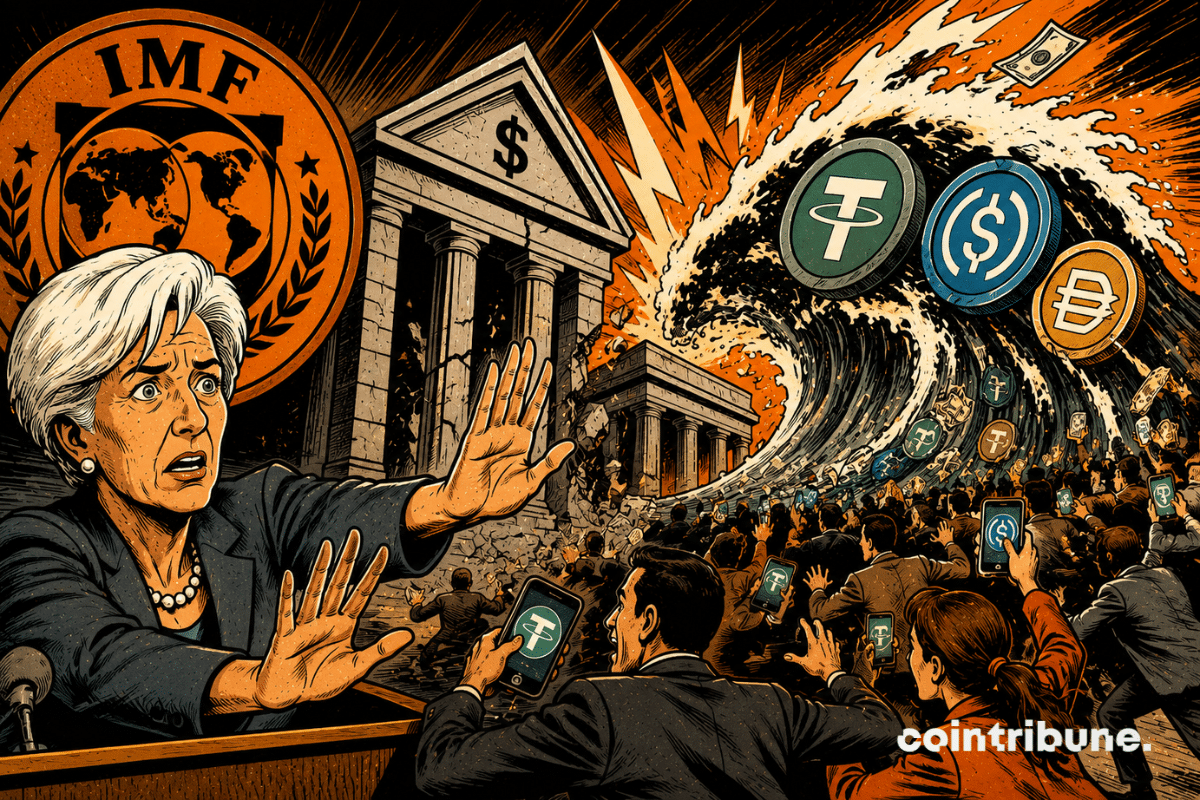
Stablecoins are today macroeconomic forces capable of destabilizing states. On July 11, 2026, an IMF working paper led by Brandon Joel Tan broke a taboo. In economies with managed exchange rates, crypto-dollars compensate for the rationing of official currencies, but act as formidable accelerators of crises. By displaying the scarcity of the dollar in real time, these assets cause massive and coordinated capital flight.
In brief
- Stablecoins are emerging as a new macroeconomic force.
- The IMF shows that they are circumventing restrictions on access to the dollar.
- Stablecoin prices instantly reveal the dollar shortage.
- This signal promotes rapid and coordinated capital outflows.
The rise of stablecoins
Technical analysis published by the International Monetary Fund reveals an economic phenomenon of monetary substitution accelerated by the technological infrastructure of cryptos. According to the findings of economist Brandon Joel Tan, US dollar-pegged stablecoins play a role as financial facilitators in jurisdictions where official access to greenbacks is severely rationed by central banks or local financial institutions.
The study rigorously demonstrates that these assets make it possible to materialize viable alternatives in the face of the inability of institutional exchange channels to satisfy the overall demand of the population. Furthermore, the author of working document explicitly highlights this reality by indicating that stablecoins make “easier to access dollar-type debts” for local economic actors seeking to protect themselves against the depreciation of their own currency. This mechanism acts as a direct response to restrictions imposed by national authorities, offering citizens unprecedented flexibility.
Such a dynamic modeled by the IMF finds applications and empirical illustrations particularly documented in recent years within several emerging economies subject to strong monetary constraints:
- The alternative of “crypto caves” in Argentina (2024): financial reports indicated that Argentine citizens massively used these underground informal structures to exchange their pesos for stablecoins pegged to the US dollar. This widespread practice aimed to align with rates closer to the unofficial market, allowing residents to preserve the integrity of their savings in the face of the collapse in the value of the peso and the tightening of capital controls;
- The Bolivia Pricing Index (June 9, 2025): Airport retailers in Bolivia have been observed using the USDT token as a reference pricing unit for their merchandise, while continuing to accommodate physical U.S. dollars or traditional bolivianos in parallel for settlement of transactions.
The Blockchain Scarcity Signal
The fundamental contribution of the IMF working paper, however, lies in the identification of a major structural vulnerability caused by the widespread adoption of these distributed ledger technologies. The study demonstrates that the diffusion of stablecoins is not limited to offering an alternative solution, but that it profoundly modifies the collective psychology of the markets in periods of acute monetary crisis.
Economist Brandon Joel Tan reveals that crypto exchange platforms constantly generate a visible and high-frequency price reflecting in real time the intensity of demand for the US dollar. When the official exchange rate set by a state deviates disproportionately from the macroeconomic reality of the market, this transparent crypto price turns into a public and instant wake-up call. It materializes in everyone’s eyes an increasing scarcity of the dollar, acting as an informational detonator which modifies the behavior of savers.
This reference price, scrutinized simultaneously by a large segment of the population via mobile applications and online platforms, induces a formidable phenomenon of coordination of capital outflows. Instead of witnessing a diffuse and gradual flight from the national currency, the unique signal emitted by the price of the stablecoin encourages a multitude of economic actors to abandon the local legal tender at the same precise moment.
The IMF working paper explicitly states that dollar stablecoins can “help coordinate the outflow of local currencies during periods of exchange rate crisis” and, therefore, “amplify monetary panics when pressure on the national currency becomes serious”. Faced with this technological acceleration of liquidity crises, central banks face an unprecedented challenge. The absolute transparency of on-chain data, once hailed as a democratic advance, turns against traditional financial architectures by removing the temporal inertia that once made it possible to stem classic banking panics.
The response of regulators to the macroeconomic threats of cryptos
Faced with this technological acceleration of liquidity crises, international financial institutions are falling into a phase of strict regulatory counter-offensive. To stem the contagion effect of coordinated withdrawals, the IMF economist puts forward immediate and binding courses of action for States.
The working document suggests explicitly that national regulatory authorities could be forced to introduce “temporary limits on unusually large or panic-driven transactions” in order to break the destructive feedback loops that threaten foreign exchange reserves. This cautious approach reflects the desire of multilateral bodies to regain control over cross-border capital flows which now escape traditional banking circuits and traditional surveillance tools.
Thus, this IMF analysis corroborates and reinforces the formal warnings formulated for a long time by other international financial monitoring bodies, such as the Financial Stability Board (FSB). In its institutional reports on March 24, the FSB already urged global lawmakers to meticulously evaluate the development of the stablecoin sector.
The organization insisted that dollar-backed stablecoins directly expose emerging economies to major risks of monetary substitution, to a weakening of the scope of their domestic monetary policies, as well as to the “circumvention of capital flow control measures”. The FSB then ordered the authorities to design frameworks capable of responding to operational and liquidity risks before interconnection with the traditional financial system becomes irreversible.
The future arbitration of monetary authorities will require great nuance, oscillating between the legitimate protection of the individual assets of citizens and the imperative safeguard of the financial sovereignty of States. Authoritarianly blocking crypto transactions in times of crisis could accentuate general panic and encourage the development of even more opaque black markets. Conversely, a total absence of regulation would deprive central banks of the tools necessary to stabilize their national currency during exogenous shocks.
Maximize your Tremplin.io experience with our ‘Read to Earn’ program! For every article you read, earn points and access exclusive rewards. Sign up now and start earning benefits.


