

The cryptocurrency market has experienced mixed developments in recent days, but Ether stood out with an increase of 3% between Thursday and Friday. This increase comes in a context marked by the rise of tokenization, the successful launch of Robinhood Chain and the continuation of purchases made by several companies. Despite this favorable dynamic, crossing the $1,800 threshold remains out of reach. On-chain data and indicators from derivative markets still show signs of weakness, limiting the potential for progress in the short term.

In brief
- Ether increased by 3% in one week, supported by the rise of Tokenization and institutional purchases.
- Robinhood Chain has already attracted $106 million in deposits and is strengthening the Ethereum ecosystem.
- Ethereum retains 47% of the real-world asset (RWA) market, confirming its lead in tokenization.
- On-chain indicators and derivatives markets remain weak, slowing a lasting rise above $1,800.
- BitMine accumulated 198,370 ETH in 30 days, illustrating continued buying by institutional investors.
Ether benefits from the rise of tokenization and Robinhood Chain
Ether’s recent progression is primarily based on the rapid development of initiatives related to asset tokenization. Notably, Robinhood launched Robinhood Chain, a layer 2 solution using ETH as its native gas token. This new infrastructure quickly increased user interest in the Ethereum ecosystem. At the same time, the platform is expanding its offering of tokenized shares to an international clientele, consolidating the adoption of infrastructures compatible with the EVM.
Here is the main figures which illustrate this dynamic:
- $106 million in deposits already recorded on Robinhood Chain;
- 120 countries now have access to tokenized shares offered by Robinhood;
- 47% market share for Ethereum in the real-world assets (RWA) sector;
- $260 billion in total value locked (TVL) on Ethereum;
- $210 billion in capitalization for Ether, a level below the network’s TVL.
Tokenization thus continues to strengthen Ethereum’s dominant position in the real-world asset market. Apart from stablecoins, assets like Tether Gold (XAUT), Ondo US Dollar Yield (USDY) and Franklin Templeton iBENJI government bonds illustrate this development. The tokenized stocks STRCx from Strategy and CRCLon from Ondo are also among the main benchmarks in the sector.
This dynamic feeds the analyzes of specialists. Leon Waidmann, director of research at Lisk, believes that the gap between the total locked value of the network and the capitalization of Ether reflects a lower relative valuation than that observed during the bear market of 2022. This reading fuels the debate on the current positioning of the asset without changing the fundamentals of the network.
On-chain indicators are still slowing down progress
Despite this improvement in the price of Ether, several indicators show that network activity remains less dynamic than before. Layer 2 solutions continue to develop and institutional investments continue, but overall demand for blockchain remains limited. The 2026 bear market has reduced activity across several segments, while some competing blockchains have increased their presence in synthetic perpetual futures and automated yield vaults.
THE main on-chain data illustrating this slowdown in activity on Ethereum are the following:
- $11 million in weekly revenue generated by DApps, compared to $20 million in the first quarter of 2026;
- Sky: $3.1 million in weekly revenue;
- Titan Builder: $2.4 million in weekly revenue;
- Chainlink: $1.1 million in weekly revenue;
- Active addresses fell from 5.4 million to 3.2 million, confirming the decline in on-chain activity.
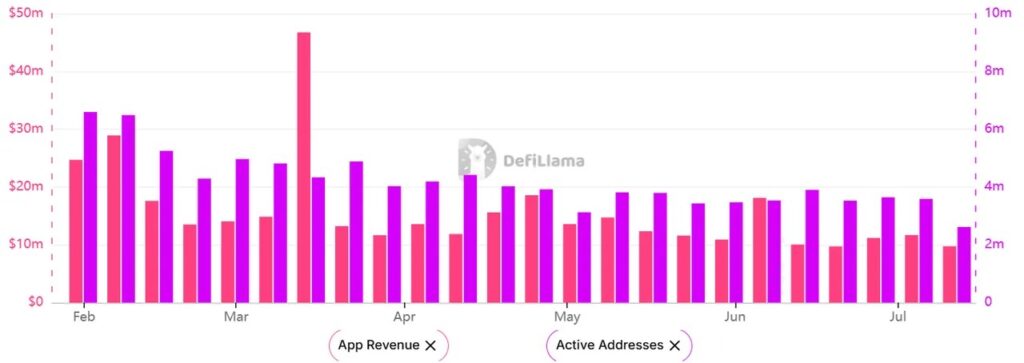
This development limits Ether’s ability to immediately extend its rebound. Even though the fundamentals surrounding tokenization remain strong, network usage metrics are not growing at the same pace. Investors therefore continue to monitor these indicators to determine whether the recent price increase can be accompanied by a lasting recovery in activity on Ethereum.
Institutional purchases still support the market
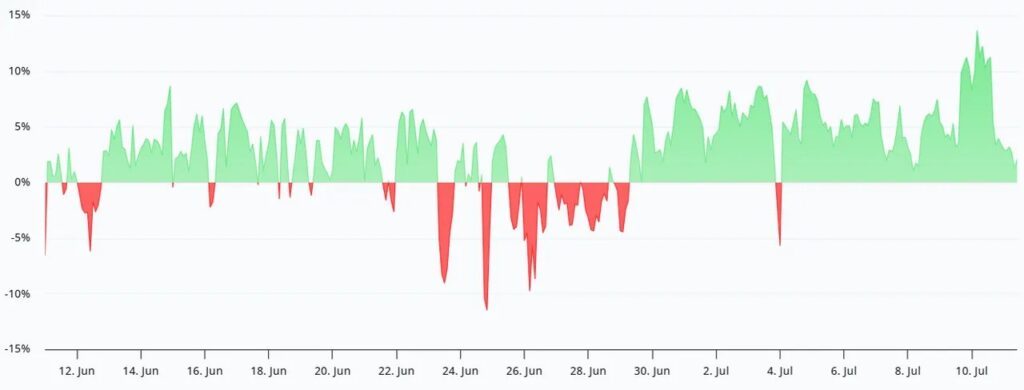
Derivative markets also provide a more measured signal. According to the data of Laevitasthe annualized funding rate of perpetual Ether futures contracts fell to 3% on Saturday, after reaching 12% the day before. This level remains below the neutrality threshold set at 6%, which reflects weaker demand for long positions. This development suggests that operators remain cautious despite the recent increase in prices.
At the same time, institutional flows continue to support the market. Arkham Intelligence identified a withdrawal of 20,500 ETHrepresenting approximately $36 million, from Galaxy Digital to a new wallet. This movement matches a pattern already observed in purchases previously attributed to Tom Lee via BitMine Immersion. Over the past thirty days, BitMine has accumulated 198,370 ETH, bringing the total value of its reserves to $10.3 billion.
These acquisitions provide additional support to the market, even if they are not enough to erase the more cautious signals observed on technical and on-chain indicators. Tokenization continues to expand network use cases, while institutional investments maintain steady demand. On the other hand, real activity on the blockchain remains below the levels observed at the start of the year.
Future movements will therefore depend on the balance between these factors. If tokenization continues to develop and institutional purchases continue, Ether could maintain a solid base. Conversely, a sustainable recovery will also require an improvement in on-chain indicators and derivatives markets in order to confirm the return of broader demand across the entire ecosystem.
Maximize your Tremplin.io experience with our ‘Read to Earn’ program! For every article you read, earn points and access exclusive rewards. Sign up now and start earning benefits.


