
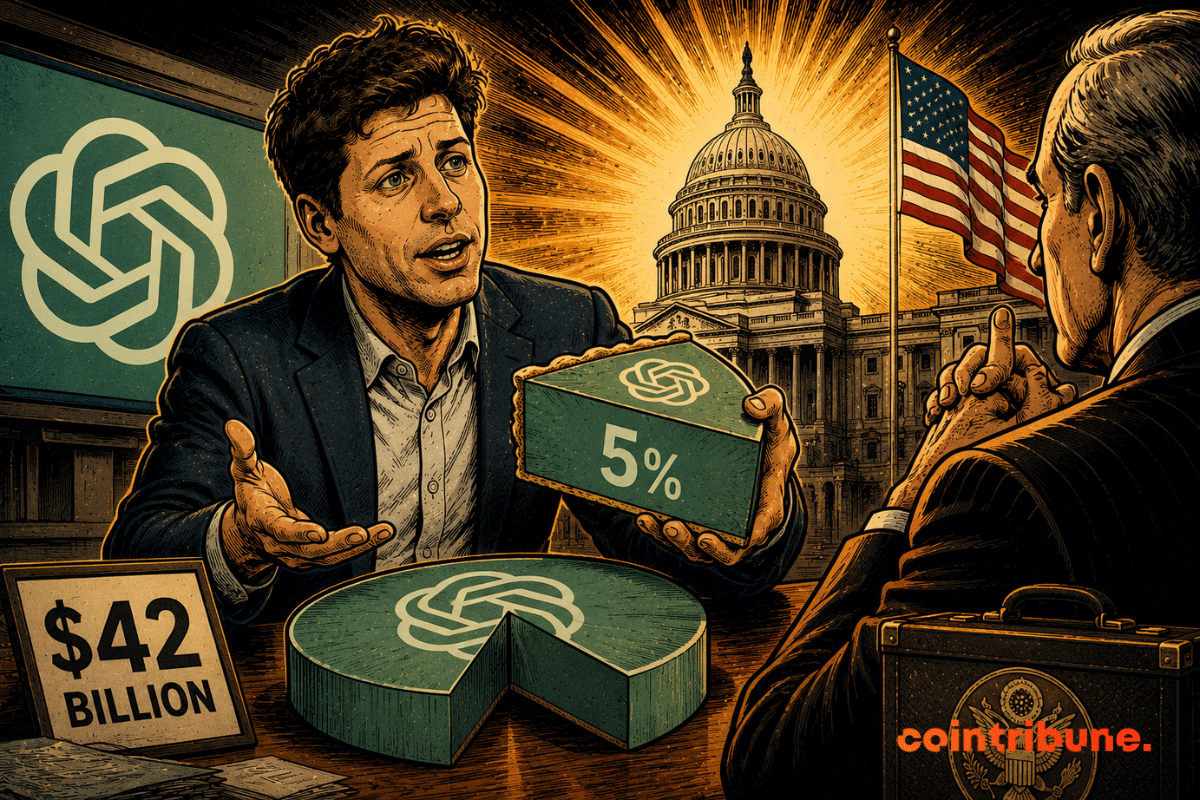
Between the Tech giants, it is a merciless war on all fronts. Innovations, market shares and world conquest are the key words of this fierce competition. But the stability of a project depends on many parameters, and state support is an integral part of this. Sam Altman has just made a proposal that could redefine the rules of the game in the AI industry. An initiative that raises as many questions as tempting promises.
In brief
- OpenAI has proposed to the US government to give it 5% of its capital, a stake valued at around $42.6 billion based on its current valuation of $852 billion.
- Sam Altman personally presented this offer to President Trump, as well as Commerce and Treasury Secretaries Howard Lutnick and Scott Bessent, in preliminary discussions.
- The US government has already taken strategic stakes in Intel (9.9%) and MP Materials (15%), which could set a precedent for the AI industry.
- Senator Bernie Sanders is proposing a much more radical measure, requiring that the largest AI companies give 50% of their shares to a public fund.
OpenAI offers $42.6 billion to government for AI
OpenAI, whose IPO is valued at $852 billion, has offered to sell 5% of its capital to the US government. The stake is valued at approximately $42.6 billion on the markets. Sam Altman presented this idea directly to Donald Trump, Howard Lutnick and Scott Bessent.
The proposal comes amid growing pressure on AI companies. The Trump administration recently delayed the deployment of GPT-5.6 and imposed export controls on Anthropic's models.
Altman presents the offer as a way to democratize the benefits of AI, modeled on the Alaska Oil Fund. The paradox is striking: the boss of OpenAI offers to share the wealth, but only after having suffered government pressure.
Does the generosity displayed hide a real appeasement strategy? The ethics of this approach questions the true motivations of the company in this context.
A proposal that divides the world of AI
Altman's proposal is historic and unprecedented in the industry. This would be the first US government stake in a private AI company. However, it comes when the State already exercises control over the versions of the most advanced artificial intelligence models.
Senator Bernie Sanders goes much further by proposing 50% ownership of the largest AI companies. Anthropic, for its part, refuses certain partnerships with the federal government.
The dialectic is disturbing: Altman offers 5% to perhaps avoid having to give 50%. Does the promised democratization look like a strategy of appeasement?
The antithesis is clear: on the one hand, a boss who wants to share the riches of AI. On the other, a senator who believes that the people deserve half of the benefits. The war of numbers is now on in the AI industry.
The American government, new shareholder of AI?
The US government has already taken stakes in strategic companies like Intel and MP Materials. The arrival of the State in the capital of OpenAI could create a major precedent for the AI industry.
Other countries could demand similar deals from global tech giants. The OpenAI and Anthropic IPOs, valued at more than $1 trillion, could be transformed by this public participation. The government would then become a shareholder in the largest AI company in the world.
The question of ownership of AI and the distribution of its benefits is more than ever at the heart of the debates. Altman's proposal is perhaps only the beginning of a profound overhaul of the relationship between the state and the AI giants.
The key figures of the proposal
- 5% of OpenAI’s capital offered to the government;
- $42.6 billion: value of stake;
- $852 billion: valuation of OpenAI;
- 9.9% government ownership in Intel;
- 50% proposed by Bernie Sanders for the AI giants.
Altman's proposal marks a turning point in the history of AI. The rivalries between OpenAI and Anthropic are no longer limited to scientific research. Each company draws its dagger, ready to strike to defend its interests. The battle for control of AI has only just begun.
Maximize your Tremplin.io experience with our 'Read to Earn' program! For every article you read, earn points and access exclusive rewards. Sign up now and start earning benefits.


