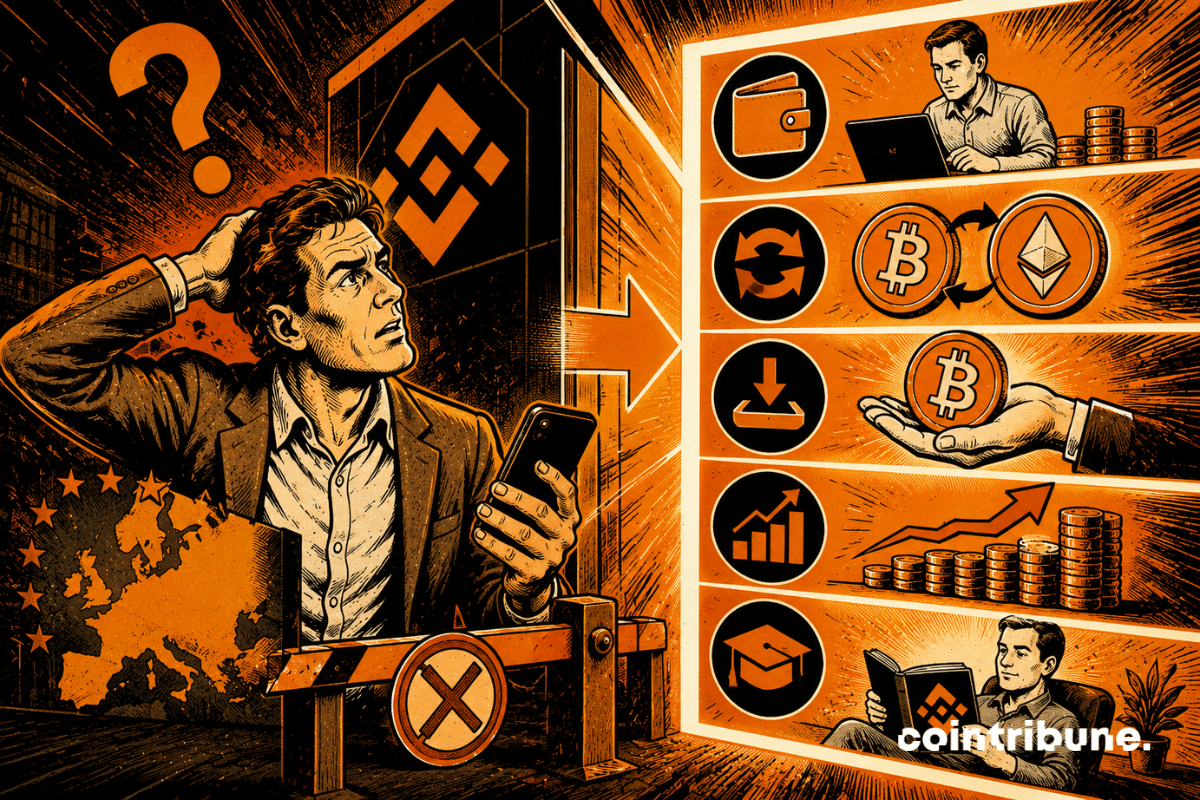
The regulatory architecture of cryptos in Europe is entering an unprecedented era of harmonization, overnight redrawing the operational boundaries of the largest global players in the sector. This historic change is materialized by the effective entry into force of the Crypto Market Regulation (MiCA) throughout the European Union. Such a major legislative transition is no longer a distant theoretical deadline, but a restrictive reality which disrupts exchange platforms not yet fully authorized within the framework of this unified regime. Thus, Binance, the global exchange giant, is forced to stop its crypto-related services on several EU markets because it did not obtain the necessary authorizations in time.
In brief
- Binance suspends part of its services in several European Union countries due to lack of authorization in accordance with the MiCA regulation.
- Relevant investors retain access to their assets, but restrictions vary depending on the rules in force in each Member State.
- Under the leadership of ESMA, unauthorized platforms must review their strategy to continue operating on the European market.
- The application of MiCA accelerates the transformation of the crypto sector in Europe and redefines the competitive balance between market participants.
MiCA's operational restriction and limited access to funds
The immediate implementation of the MiCA rules forced the Binance platform to suspend its crypto services in the European Union markets directly affected by this lack of license.
As soon as the regulations were effectively implemented, access to accounts was limited for some European investors, which led the company to deploy crisis communication focused on the following key points:
- An immediate restriction of services: the forced cessation of purchase, sale and exchange activities on the European markets affected by the absence of MiCA authorization;
- A commitment to transparency: management hastened to to announce officially: “As the MiCA-related changes come into force today in the EU, we would like to reassure affected users that we remain fully committed to supporting you throughout this transition, with clarity, kindness and responsibility”;
- The Reserve Solvency Guarantee: the categorical affirmation that its clients' assets remain secure, available and covered at a strict 1 to 1 (1:1) ratio.
On a purely factual level, the concrete arrangements for this transitional phase differ greatly from one Member State to another, depending solely on the exact geographical location of the investor and the current regulatory status of their account. The limitation of services is still in effect, but the possibilities of withdrawing funds to external wallets and transferring assets remain technically feasible in countries where local laws still allow it.
Binance is now handling this situation on a case-by-case basis, sending targeted notifications and individual instructions to each affected customer to notify them of remaining exit options. The emphasis is on rigorous technical execution. The platform systematically directs users to its official support channels in order to resolve disputes and answer specific questions related to account blocks.
Pressure from regulatory authorities on Binance
This partial restriction by Binance is not the result of a spontaneous internal initiative, but results from strict compliance with directives issued directly by the European Securities and Markets Authority (ESMA). Indeed, the European regulator had given very firm instructions to all unauthorized crypto entities under the new regime, namely to immediately cease the onboarding of new clients, to plan the orderly closure of their activities, and to guarantee absolute transparency vis-à-vis the public.
Faced with this rigid framework, Binance had to adjust its European regulatory strategy, a step backward marked by the formal withdrawal of its initial MiCA license application in Greece. Now deprived of this access route, the company finds itself forced to seek a completely new authorization route in order to try to acquire legal status in line with EU requirements while continuing to actively discuss with the relevant authorities. MiCA now imposes a single rulebook for member countries, standardizing oversight, licensing and investor protection, eliminating the regulatory arbitrage that some platforms previously took advantage of.
To maintain operational dialogue with its customers, Binance management is deploying constant restructuring efforts in the face of imposed access restrictions. In order to insist on the minimum continuity of its management, the firm has formulated a second official update for impacted accounts: “your assets remain secure on Binance, and affected users will continue to have access to the options that have already been communicated to them, including transfers and withdrawals where they are applicable”. The exchange is now focusing primarily on ongoing discussions with various European regulators, in a desperate attempt to obtain global accreditation under this unified EU framework in order to stem the erosion of its market shares on the old continent.
Future impacts and the overall recomposition of the European crypto market
For the entire crypto ecosystem, the medium and long-term repercussions of this forced regulatory alignment promise to be profound and particularly nuanced. On the one hand, the firmness of ESMA and the cyclical ousting of the world leader in certain European markets validate the institutional maturity of the crypto space, by offering a secure framework likely to attract traditional capital and reassure institutional investors.
On the other hand, this initial rigor could lead to a massive concentration of the market for the benefit of more agile regional players, who have anticipated MiCA compliance, or other American giants that already have adequate legal structures. How the situation develops will depend above all on Binance's ability to quickly reorganize its subsidiaries in order to comply with the requirements of the single European rulebook.
This transition to the MiCA regulation ultimately marks the end of a vague zone of tolerance for cryptos within the European market, and the emergence of a highly standardized space where legal compliance emerges as the primary competitive advantage, thus redefining the power dynamics between global platforms and public authorities.
Maximize your Tremplin.io experience with our 'Read to Earn' program! For every article you read, earn points and access exclusive rewards. Sign up now and start earning benefits.