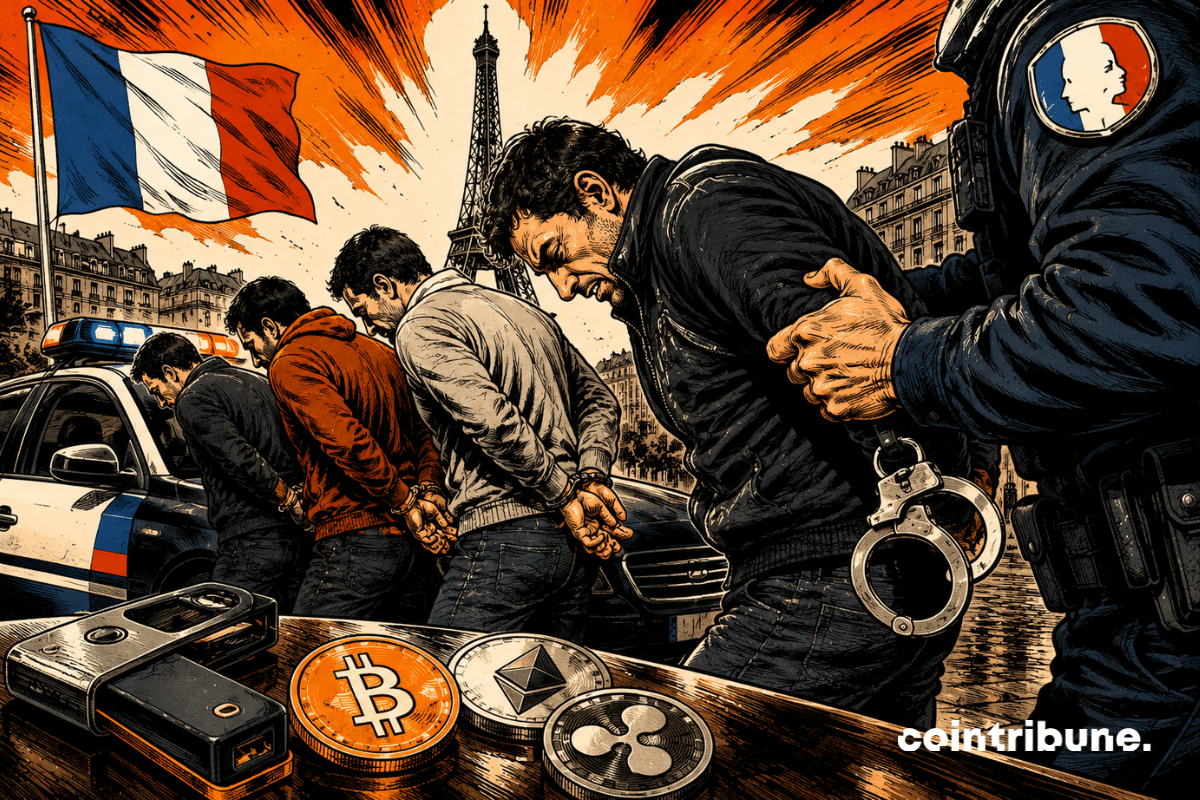
The arrest of four men in Marseille revives concerns around violence linked to digital assets. According to information provided by the police, the case began with an attempted theft of crypto before taking a more serious turn with a hostage taking. This episode comes in a context marked by the multiplication of attacks targeting holders of cryptocurrencies in France.
In brief
- Arrest in Marseille of four individuals after an extortion attempt targeting cryptocurrency wallets, including a hostage taking.
- Increase in violence in France targeting holders of digital assets, with several cases of kidnapping and extortion.
- Targeting victims via data that is sometimes old or from leaks/sensitive information.
- Concerns related to regulation (DAC8), which centralizes more financial data of crypto users.
- Increased risks of internal leaks and cyberattacks, which could facilitate the identification of investors and criminal attacks.
France: arrest of four suspects in an extortion case linked to cryptocurrencies
For several months, cases of violence linked to cryptocurrencies have been increasing in France, with holders of digital assets becoming the target of extortion attempts and attacks aimed at recovering their assets. It is in this context that the affair revealed in Marseille takes place.
According to thearticle from the newspaper La Provaince, relayed by Cryptopolitanthe events took place on the night of June 13 in several communes of Bouches-du-Rhône. The suspects first attempted to enter a home located in the 13th arrondissement of Marseille around three in the morning. After this failure, they left the scene, leaving behind a license plate number.
The elements collected during the investigations would then have made it possible to establish a link between this attempt and two other attacks reported in Gardanne and Gignac-la-Nerthe during the same night. Ultimately, four individuals were arrested while holding two women against their will in order to gain access to digital wallets.
This case constitutes the first case of this type reported in the Marseille region. More broadly, France has been facing an increase in criminal acts targeting people associated with cryptocurrencies for several months. The victims targeted during this series of attacks possessed or had possessed digital assets, according to the first elements communicated.
Furthermore, the attackers could have relied on old information to identify their targets. In the case of Marseille, the targeted family would be linked to an investor who sold his digital assets more than a year ago.
Crypto holders become prime targets of criminal networks
This new case illustrates a trend observed for several months. Attacks targeting crypto holders or their loved ones are increasing, with methods ranging from direct threats to extortion attempts.
France is increasingly establishing itself as a major center of crime linked to cryptocurrencies and the authorities are still unable to gain control over this phenomenon. Around 40 cases of organized kidnappings involving holders of digital assets would have been handled in the territory between 2023 and the end of 2025, illustrating the rise in power of these targeted operations.
This progression also continued in 2026. According to the figures communicated on this phenomenon, more than forty cases of this type have been recorded since the start of the year in France. The networks involved are often established abroad, even if their operating methods vary depending on the files.
Furthermore, according to data reported by journalist Grégory Raymond, co-founder of The Big Whale, via a publication on the
Financial losses can also be significant. Some attacks, referred to as “key attacks,” aim directly to coerce victims into transferring their digital assets under threat.
Sensitive data at the heart of investigations
Recent cases highlight another commonality: attackers often appear to have precise information about their targets.
A case in Nancy reported by Le Parisien showed that individuals posing as police officers knew the amount of a victim's digital assets. This case has reignited concerns around the exposure of crypto-related data.
Several cybersecurity incidents have also raised questions about the flow of personal and financial information. Some platforms keep data allowing the identification of cryptocurrency holders and their transactions.
This information can represent a target for criminal groups seeking to identify people with crypto assets. The concentration of financial and personal data thus increases the risks of exploitation when this information falls into the wrong hands.
Finally, the Marseille affair should provide a better understanding of how the suspects identified their victims and obtained the information used during their operations. The next elements could provide more details on the methods used to target holders of digital assets.
DAC8: a regulatory framework that questions investor security
Since January 1, 2026, the entry into application of the European directive DAC8 requires crypto exchange platforms to report their customers' transactions to tax authorities. Concretely, these actors will have to transmit profiles of formidable precision. This includes full identity (name, address, date and place of birth), tax identification number, exact value of wallets as of December 31, as well as the cumulative volume of purchases and sales made over the year.
However, this extreme centralization of financial information creates a colossal cyber and human risk. The paradox is chilling: under the guise of fighting against money laundering, this hyper-concentration of vulnerable data ultimately offers criminal networks the perfect catalog for profiling and attacking potential targets.
In this context, the threat is not a trivial hypothesis. The recent case of Ghalia C., a tax officer from Île-de-France under investigation, illustrates the vulnerability of this type of infrastructure. This official, according to Yahoo Finance reportillegally consulted the “Mira” database, normally reserved for ultra-sensitive tax files, to transmit confidential information to criminals.
Discreetly paid via Western Union, it targeted public figures like Vincent Bolloré, prison guards, but above all crypto investors, considered ideal prey for extortion attempts. An internal flaw which illustrates the risks linked to access to sensitive data that could be of interest to criminal networks.
This new case reminds us that the risks associated with cryptox are not limited to cyberattacks or online scams. The increase in physical attacks and extortion attempts targeting holders of digital assets shows that personal security is now becoming a major issue for investors. In this context, it is essential to exercise vigilance by limiting the disclosure of information about one's assets, protecting one's personal data and remaining discreet about one's activities related to cryptocurrencies. Caution remains today one of the best protections for crypto holders in France.
Maximize your Tremplin.io experience with our 'Read to Earn' program! For every article you read, earn points and access exclusive rewards. Sign up now and start earning benefits.