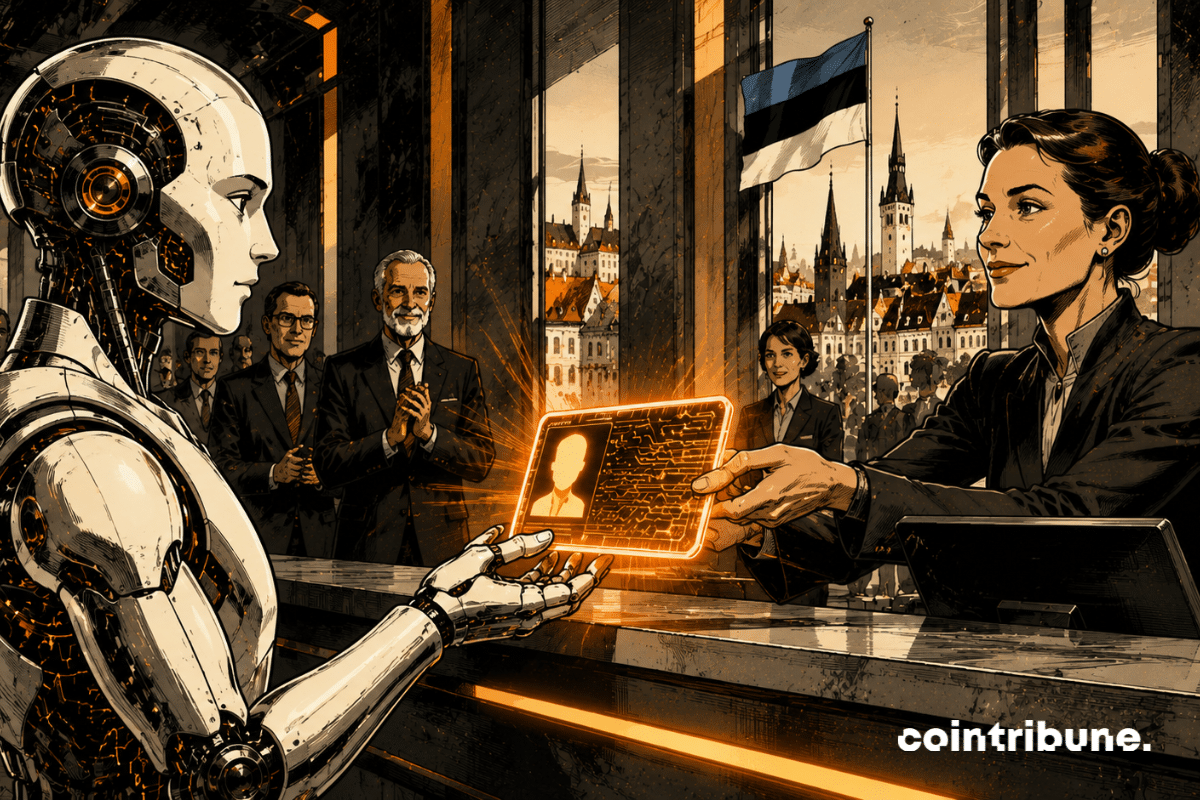
The arrival of autonomous agents is changing the very notion of sovereignty and infrastructure in the digital age. Faced with a rise in technology that is often faster than the old rules, it becomes essential to give legal existence to algorithmic entities. Estonia, a pioneer in innovative institutions and 100% digital, has once again confirmed itself as the global laboratory of this transition. By granting official status to artificial intelligence, the Baltic State is charting a new path in the history of technological governance.
In brief
- Estonia is taking an unprecedented step by preparing to grant an official digital identity to artificial intelligence agents, with the ambition of becoming the first state to recognize them as a distinct status.
- This new system should allow AIs to carry out certain administrative and financial actions autonomously, while limiting their powers through control and audit mechanisms.
- This initiative is part of a broader digital transformation strategy, as AI agents are already integrated into Estonian public services through several government programs.
- Supported by a digital infrastructure based in particular on the KSI blockchain, this development also raises major questions around the legal and financial liability of artificial intelligence in the event of error or damage.
A state digital identity for artificial intelligence agents
This Wednesday, June 17, Kristen Michal, Prime Minister of Estonia, officially approved a proposal from the advisory council relating to the establishment of a “AI personal identification code” (AI personal identification code). This historic measure will give artificial intelligence agents their own digital state identity, different from that of the individuals, companies or institutions that own or operate them.
Through this approach, the head of government intends to place his country at the forefront of global technological regulation. Kristen Michal declared publicly on the social network “the first country in the world to provide AI agents with an official digital identity”.
In operational terms, this device aims to solve a persistent structural problem: the current requirement that an algorithm must borrow the global digital identity of its human owner in order to accomplish common tasks. The new system will give machines limited, controllable and audited rights. Far from giving blind and permanent access to the personal data of its principal, this slogan will limit the agent to strictly compartmentalized acts:
- Exclusive consultation of a specifically designated public or administrative register;
- The independent drafting and secure transmission of an official document;
- The execution of a financial payment autonomously, blocked at a maximum amount previously set by the user.
The immediate integration of AI agents within the state bureaucracy
This transition towards identifiable agents occurs within a state ecosystem where artificial intelligence is already operationally integrated. Since the launch of its national AI development program, “Eesti.ai»in January, the Estonian government sets up autonomous systems in schools and ministerial services.
For this, the country is relying in particular on Bürokratt, a tool officially defined by the administration as “a state-created AI-powered digital assistant that helps institutions provide modern and efficient customer service”. This massive deployment made it necessary to develop a protocol for partitioning these internal computer accesses.
To explain why it is so important to legally regulate these interactions, Prime Minister Kristen Michal shared her vision for the technological future on social media: “In the future, artificial intelligence will perform digital actions on behalf of a person, company or institution: writing reports, preparing declarations or communicating with information systems. But we need to know who acts, in whose name, with what powers, and who responds.”. The requirement for such a framework is reflected at the international level, where private initiatives such as Sam Altman's decentralized World network are also trying to structure the distinction between human and robotic requests.
KSI Blockchain Foundations and Legal Accountability Challenges
This high degree of bureaucratic integration relies on a mature and decentralized digital infrastructure. In December 2024, Estonia moved 100% of its public services online and has always relied on the KSI blockchain (Keyless Signature Infrastructure) to ensure the integrity of its legal, health and property records since 2012.
The country is also experiencing a series of world firsts, with the internet having been declared a universal service in 2000, paving the way for legislative elections in 2023 where the majority of votes were cast online. This immutable and entirely digital architecture will serve as a technical foundation to transparently host and audit the signatures and transactions of AI identities.
However, the absence of clear safeguards on financial responsibility can have serious consequences in these connected networks. The latest, an unsupervised autonomous agent created an unexpected bill of $6,531 on Amazon Web Services (AWS) in less than a day, after scanning a network without human validation, forcing its creator to launch a donation drive in cryptos like bitcoin to cover the damage. This drift is the perfect example of the risks of software autonomy when they interact directly with financial or cloud infrastructures without any precise legal accountability framework.
Estonian progress opens up major perspectives as well as complex questions about the future of digital law. By concretizing the identity of algorithmic agents, Estonia offers a model likely to significantly reduce the risks of abuse and fraud, while securing economic interactions in the context of Web3 and the AI economy. However, a nuanced analysis requires highlighting the gray areas of the project. No official implementation date has been communicated, and the government has not provided any details on how financial or legal responsibility will be allocated in the event of a costly mistake made by an AI with its own code.
Maximize your Tremplin.io experience with our 'Read to Earn' program! For every article you read, earn points and access exclusive rewards. Sign up now and start earning benefits.