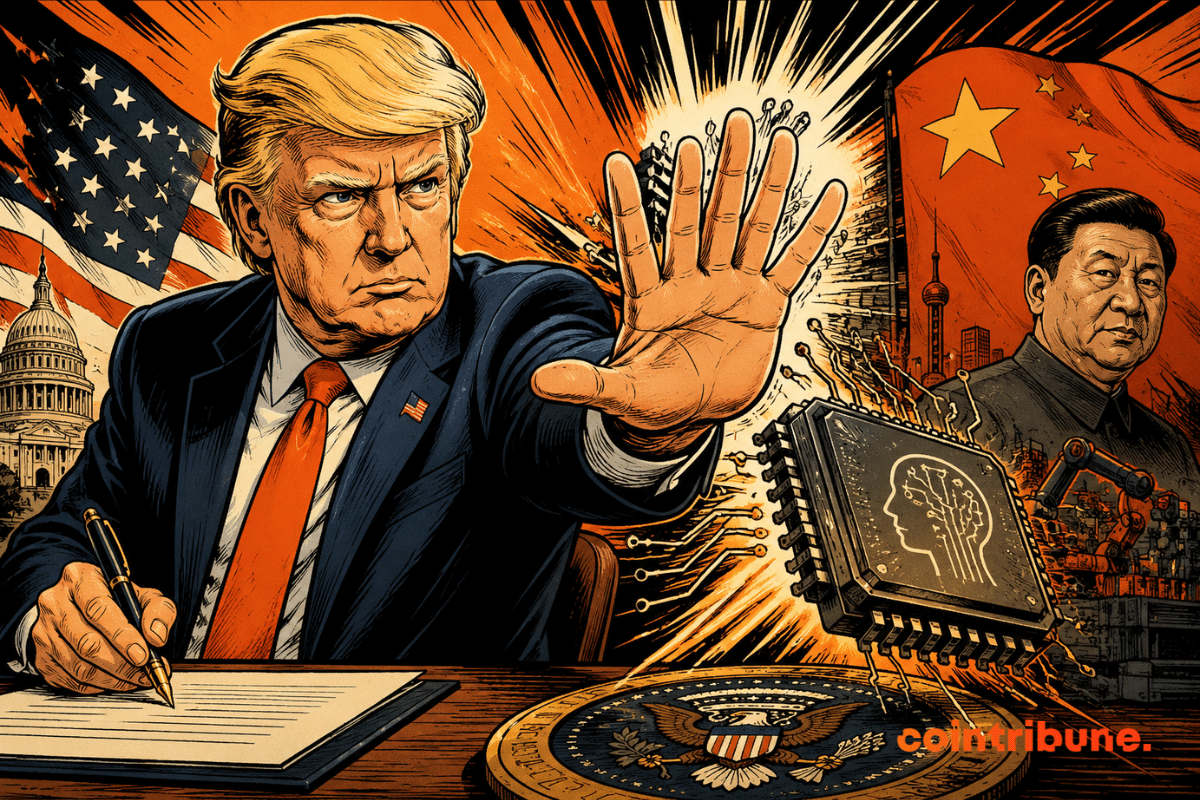
The unexpected postponement of the presidential decree on artificial intelligence is relaunching the debate in Washington. Trump suspended the signing ceremony after judging that certain measures could slow down the American advance. In a context of technological rivalry with China, the White House is seeking a balance between national security, industrial innovation and international competitiveness, according to the American president.
In brief
- Trump suspended signing his AI executive order so as not to jeopardize the United States' technological advantage.
- The draft decree aimed for early access to AI models for security testing and critical infrastructure.
- The decision reflects the strategic competition with China in the field of artificial intelligence.
- Trump says the US administration is seeking a balance between national security, industrial innovation and international competitiveness.
Trump and the AI decree: the standoff between Washington and Beijing
The standoff between Washington and Beijing has just entered a new episode. Trump explained, from the Oval Office, that he did not like several aspects of the text. According to him, the project risked reducing American leadership in the global race for artificial intelligence. He insisted on a central point:
Some aspects I don't like. I think this harms our leadership vis-à-vis China. We are ahead of everyone else. And I don't want to do anything that could compromise that leadership.
Donald Trump, President of the United States.
Trump, however, did not identify the specific provisions that were problematic. He also did not give a timetable for a new version of the decree. This lack of detail leaves room for uncertainty for AI companies, federal agencies and critical sectors involved.
The postponement also occurs in a broader political sequence. The same day, the administration presented the dismantling of environmental rules affecting refrigeration equipment. The White House places this decision within a logic of deregulation, with the objective of reducing costs, preserving jobs and canceling policies of the Biden era unfavorable to the industry.
The AI framework envisaged in relation to China
THE decreeannounced earlier this month, was to establish a voluntary framework for reviewing advanced artificial intelligence models. Participating companies reportedly gave the federal government early access to certain models before their release. The objective was on security tests, but also on the evaluation of their national capacities. Trump believed, however, that this mechanism could become a brake on innovation.
The proposal also provided for early access for critical infrastructure providers, including banks. It also included a cybersecurity component intended to identify vulnerabilities in unpublished models. This approach was intended to address concerns related to sensitive uses of AI, particularly in complex digital operations. In this context, China remains a constant reference point for assessing American competitiveness.
Finally, the file comes at a time when specialist companies strengthen ties with US defense and intelligence agencies. OpenAI, Google and xAI have stepped up these partnerships, while the NSA is already using Mythos on classified networks, according to the information provided. This dynamic illustrates the strategic place that AI takes in national security against China.
National security, deregulation and an uncertain timeline
Trump said “ support the development of artificial intelligence and consider this technology as an engine of economic growth”. However, he considered that “the decree, in its current form, could introduce poorly calibrated constraints”. This position summarizes the line followed by the administration: securing advanced models without slowing down the industry.
The project comes after tests showing that Claude Mythos, developed by Anthropic, could identify numerous software vulnerabilities and execute complex cyber operations. These elements reinforce the concerns of American authorities about the effects of advanced models for national security. Trump also stressed that discussions with Xi Jinping confirm the strategic importance of this competition, and that China remains a major player in this technological race.
Trump has not set a date to resume signing the text. In the short term, the administration could seek a more flexible version of the decree on artificial intelligence, capable of meeting security requirements without hindering innovation. What happens next will depend above all on the balance found between control, competitiveness and protection of national interests.
Maximize your Tremplin.io experience with our 'Read to Earn' program! For every article you read, earn points and access exclusive rewards. Sign up now and start earning benefits.