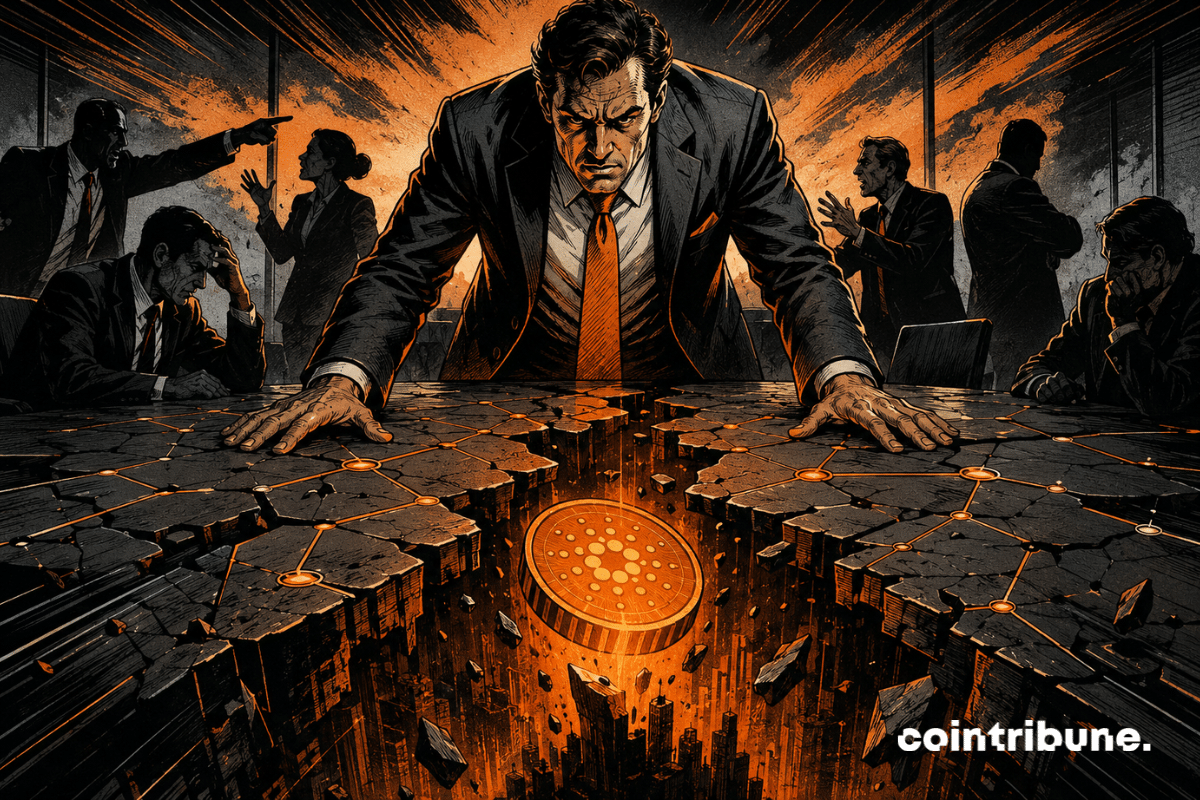
Cardano is going through a funding crisis that directly threatens its scientific base. Charles Hoskinson warns of a major risk: without sufficient support, part of the research ecosystem could be dismantled. For a crypto that has claimed an academic approach for years, the signal is heavy.
In brief
- Cardano faces a funding crisis surrounding its fundamental research.
- Charles Hoskinson believes that the scientific identity of the project is threatened.
- The dReps vote rekindles the debate on the limits of decentralized governance.
Cardano faces a vote that goes beyond the simple budget
The current crisis touches the very heart of Cardano. Charles Hoskinson has long defended a vision based on research, the scientific method and long-term development. This line had already been put forward in its desire to raise Cardano to the top of the crypto market, despite criticism of the pace of the project.
This time, the subject is more sensitive. Several Japanese delegated representatives, called dReps, voted against a funding proposal deemed crucial. For Hoskinson, this rejection does not only threaten an administrative agenda. It could weaken the laboratories, researchers and intellectual identity of Cardano.
The founder of the network speaks of a risk of dismantling. The word is strong, but calculated. He wants to make it clear that fundamental research is not an accessory. According to him, it represents the DNA of Cardano. Without it, the project would lose part of what sets it apart in the crypto industry.
Cardano has always presented itself as a separate blockchain. His story relies on academic publications, formal methods and a desire to build slowly but solidly. This approach has often been criticized for being slow. It also served as a shield against faster, but sometimes less rigorous, projects.
The problem is that this image is expensive. Maintaining research teams, funding laboratories and retaining high-level scientists requires stable resources. Hoskinson says this talent could leave if funding becomes patchy or uncertain.
This is where the debate becomes deeper. Cardano wants to be decentralized, but decentralization sometimes produces decisions that are difficult for its founders to accept. If dReps can vote against a policy proposal, then the system works. But if this vote threatens the scientific basis of the network, governance becomes a minefield.
Decentralized governance shows its limits
The Japanese dReps vote reveals a classic tension in crypto. On the one hand, communities are demanding more power. On the other hand, they must assume the consequences of their choices. Decentralization does not always guarantee a common vision. It can also create blockages.
Some community members believe it is contradictory to advocate for open governance and then criticize the outcome when it is displeasing. The argument is strong. A blockchain governed by its participants cannot function only when votes go in the direction of historical leaders.
But Hoskinson responds on another ground. For him, it is not a simple budgetary disagreement. He believes the vote could destroy the “heart” of the Cardano ecosystem. The debate therefore opposes two visions: the democratic discipline of the protocol and the preservation of a strategic asset, research.
Cardano plays a tricky game
Cardano is not just facing an internal dispute. The network is testing its ability to finance its own scientific ambition in a decentralized framework. It is a serious test. A blockchain can have open governance, but it must also protect what makes it unique.
Hoskinson's exit shows that the issue of funding is becoming political. Who decides the future of Cardano? The founders, the researchers, the dReps, or all ADA holders? The answer will determine the strength of the model.
If Cardano manages to resolve this crisis, it will be able to strengthen its discourse on the maturity of its governance. Otherwise, this case will join other moments where the security and robustness of the Cardano network have been called into question. And this time, the fault would not come from the code, but from the financing.
Maximize your Tremplin.io experience with our 'Read to Earn' program! For every article you read, earn points and access exclusive rewards. Sign up now and start earning benefits.