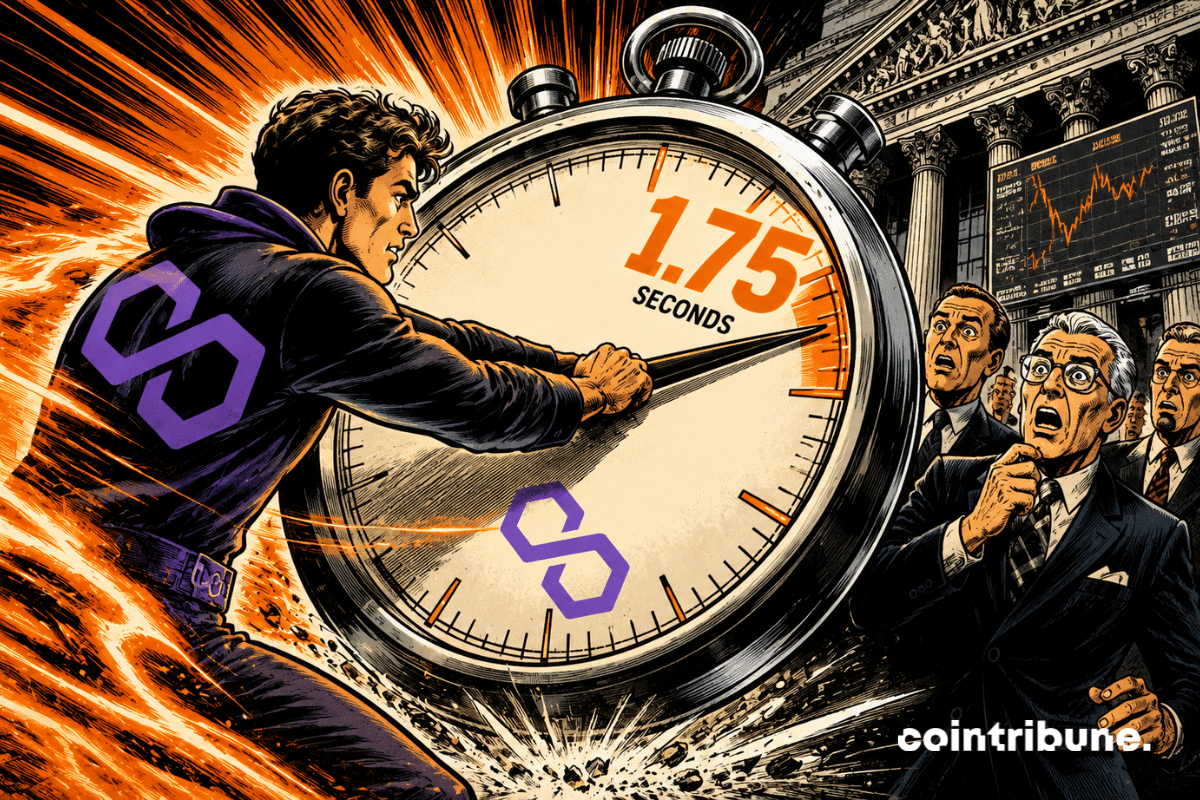
The crypto market is currently going through a strange digital waiting room. Prices sometimes advance like tired robots under low battery, yet blockchain laboratories continue to accelerate their experiments. Blockchain on blockchain, protocols on protocols, the crypto-sphere now resembles an immense cybernetic assembly line. No one really throws in the towel. Behind the sometimes sluggish graphics, crypto developers are already tinkering with infrastructures capable of absorbing billions of instant payments tomorrow without massive congestion or crippling latency.
In brief
- Polygon is reducing its historic block time to massively accelerate now global institutional stablecoin payments today.
- The new “ZK proofs” now allow private stablecoin transfers compatible with full international regulatory audits.
- Visa is now adding Polygon to its experimental program dedicated to making international stablecoin settlements much faster today.
- Despite several major technical advances, the POL token currently remains seriously weakened on crypto markets.
Polygon goes under two seconds and discreetly transforms digital payments
Polygon, with a new crypto strategy, has just reduced its block time to 1.75 seconds. This movement seems tiny on paper, yet it acts like a surgical operation on the entire network infrastructure. Indeed, Polygon now earns approximately 14% more transactions per second.
The network now reaches a theoretical capacity close to 3,260 TPS.
Lucca Martins, software engineer at Polygon, summed it up directly on X:
We just reduced the block time by 250 milliseconds. This means approximately 14% more TPS and a 0.25 second reduction in finality time.
Source: X / @0xlucca30
Above all, this reduction represents a much deeper strategic shift for Polygon. The network now targets high-frequency payments, stablecoins and certain sensitive institutional uses.
Congestion becomes shorter, fees explode less suddenly and validations more closely resemble modern banking infrastructures.
Private stablecoins become the new laboratory of blockchain giants
Polygon is now pushing its pawns towards much more discreet finance. The new wallet presented this week hides the sender, the recipient as well as the amounts transferred. Yet the system remains compatible with KYT controls and regulatory audits.
This mechanism is based on zero-knowledge proofs, the famous “ZK proofs”. Polygon is therefore attempting an extremely delicate exercise: offering more confidentiality without frightening financial institutions.
The official Polygon account has also summarized this acceleration with a particularly aggressive formula:
Every payment on Polygon gets faster. We just improved the channel again with 14% more payouts every second.
Source: X / @0xPolygon
In the commentsseveral crypto developers point out why this speed is now becoming essential. User @criptoedegen even believes that slow confirmations are further destroying the mass adoption of stablecoins on a large scale throughout the crypto industry.
Visa observes the network while the POL token still keeps the brakes on
Polygon is accelerating technically, yet the POL token remains surprisingly fragile. The ex-MATIC is currently trading around $0.0990 after an annual decline of close to 54%. This paradox now intrigues the entire crypto-sphere. On the one hand, Polygon is increasing institutional integrations.
Visa recently added Polygon to its stablecoin pilot program. Meta also uses Polygon for some USDC payments for digital creators.
At the same time, the Gigagas roadmap now aims 100,000 GST. The Bhilai, Rio then Madhugiri upgrades have already profoundly transformed the Polygon architecture. The network is gradually resembling a financial highway built for massive global flows.
However, several crypto investors are still waiting for adoption to be explosive enough to sustainably absorb the emissions of the POL token.
The figures that are currently shaking up Polygon dashboards
- Polygon now reduces its historical block time to just 1.75 seconds;
- The Polygon network is gradually aiming for a theoretical capacity close to 100,000 TPS;
- POL Price: $0.0990 during this extremely volatile writing currently;
- Visa is now integrating Polygon into its global stablecoin pilot;
- Institutional crypto volumes are now becoming a priority in the Polygon strategy.
The crypto market slows down at times, yet blockchain infrastructures continue to advance like engines on digital steroids. Ethereum itself is now making adjustments at an almost surgical pace. The future Glamsterdam evolution would even promise to triple certain network capacities while gradually moving transaction fees closer to zero.
Maximize your Tremplin.io experience with our 'Read to Earn' program! For every article you read, earn points and access exclusive rewards. Sign up now and start earning benefits.