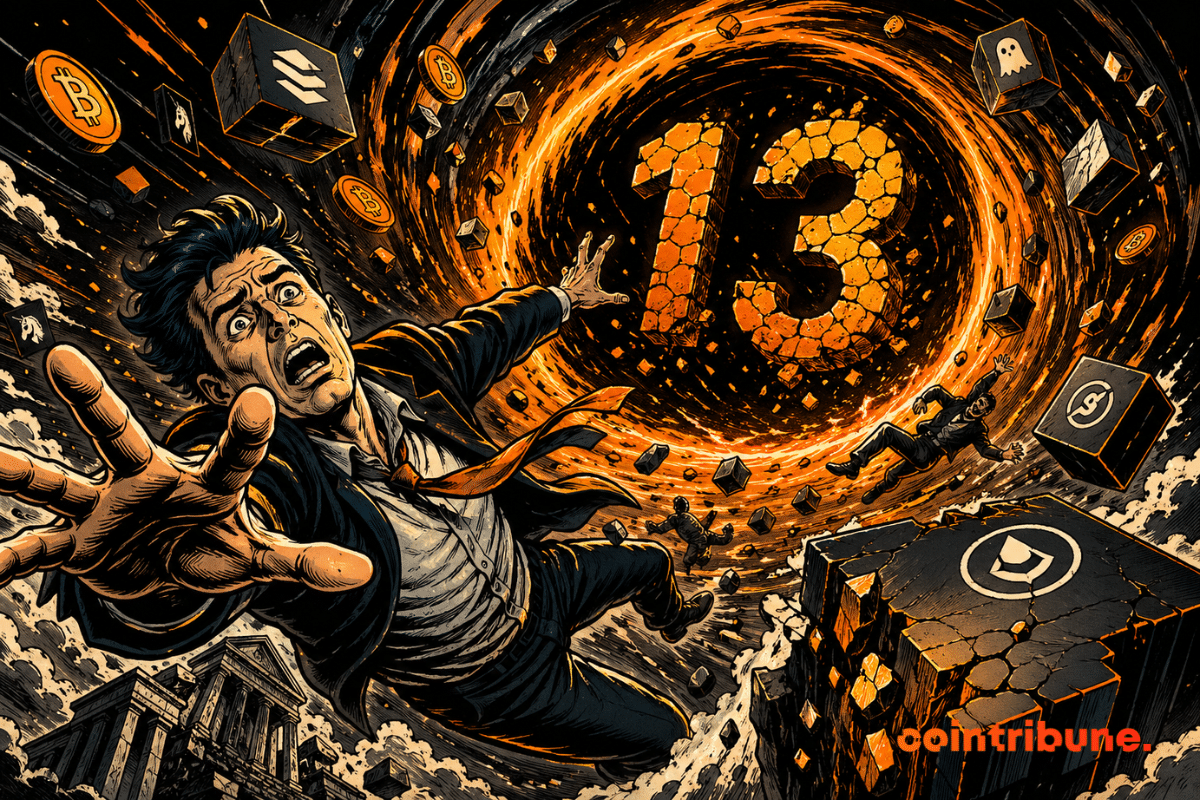
According to the latest crypto market data, DeFi lost almost $13 billion in one month. Behind this figure, however, lies a more worrying reality: a deep crisis of confidence which is weakening all of decentralized finance. Complete decryption.
In brief
- DeFi lost around $13 billion in one month.
- Several hacks and incidents have weakened market confidence.
- The KelpDAO case illustrates both risk and resilience.
- Liquidity and TVL are declining on many protocols.
- The crypto market is entering a critical stress phase.
13 billion dollars in losses, a major crisis signal
Analysts agree on one point: the drop of $13 billion is not a simple adjustment, but a real crypto market stress. In reality, this drop directly affects the TVL. This is a key indicator of the health of decentralized protocols.
Decryption: less capital means less liquidity, therefore more volatility.
In a few weeks, several DeFi platforms saw their funds withdraw massively. This movement reflects a flight of capital in the face of rising risks. The phenomenon is reminiscent of the beginnings of traditional financial crises: a gradual loss of confidence which suddenly accelerates.
In this environment, even Strong DeFi protocols are under increased pressure. This clearly means that decentralized finance is entering a phase of tension rarely observed since 2022.
KelpDAO: between hack and rescue, DeFi shows its two faces
L'affair KelpDAO alone sums up the paradox of DeFi. On the one hand, an exploit highlights the flaws in smart contracts and security. On the other hand, a rapid reaction helps limit the damage.
This type of event reveals a netless system. Unlike traditional finance, no central authority intervenes. Everything depends on the coordination of actors and the transparency of the blockchain.
In this case, the community and developers acted quickly. The proof: part of the funds could be recovered. However, the signal sent to the market remains worrying. The fact is that each hack reinforces the idea of a unstable environment.
DeFi thus appears as a system capable of defending itself, but incapable of avoiding its own flaws.
Towards a systemic risk for the DeFi market?
When liquidity decreases and losses accumulate, the domino effect becomes possible. A crypto protocol in trouble can therefore lead to others, notably via interconnected mechanisms.
Decentralized finance is based on a complex infrastructure where dependencies are numerous. A simple exploit can thus trigger a cascade of withdrawals and amplify the crisis. In this context, investors are becoming more cautious. Capital is moving to areas deemed safer, slowing adoption. To put it simply, the question is no longer just technological. It becomes structural.
One thing is therefore certain: DeFi is not collapsing, it is revealing itself. Behind the losses and hacks, a full-scale test is underway. The question remains open: is crypto ready to become a real financial infrastructure or is it still too fragile to survive its own crises?
Maximize your Tremplin.io experience with our 'Read to Earn' program! For every article you read, earn points and access exclusive rewards. Sign up now and start earning benefits.