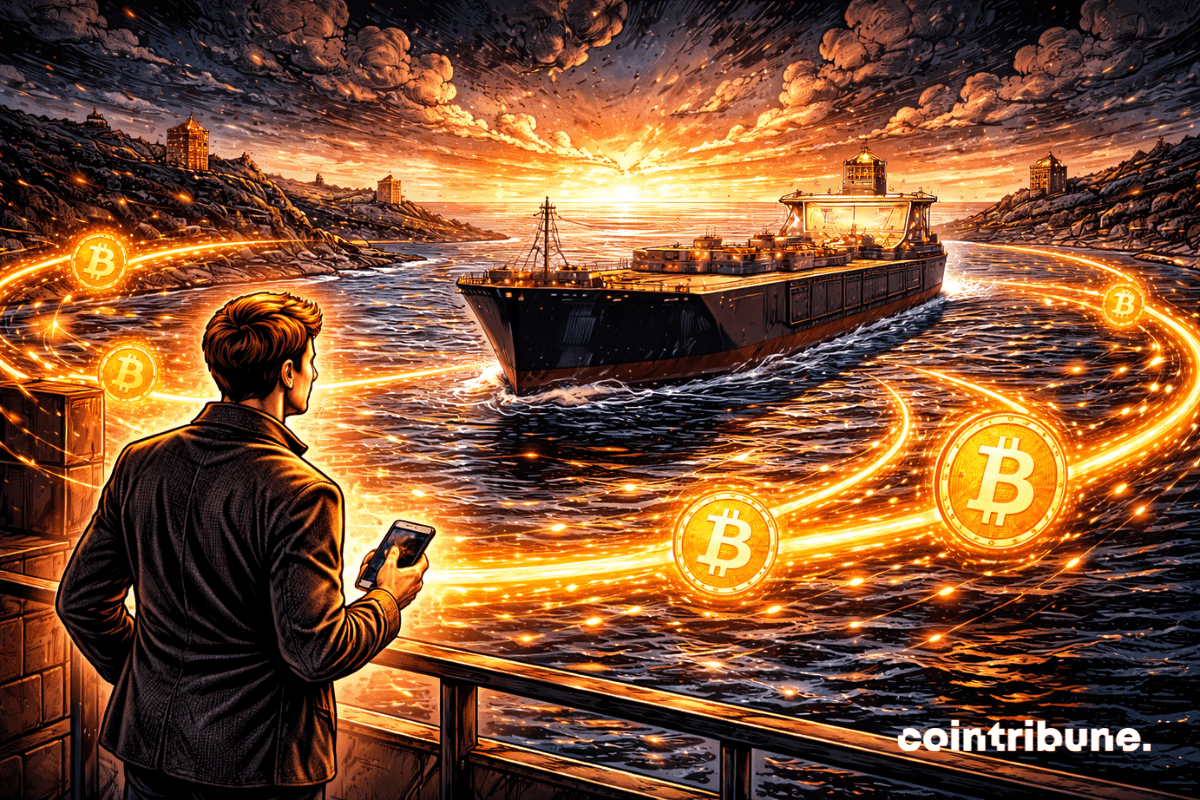
The Strait of Hormuz, the nerve center of global oil, could become the scene of an unexpected monetary experiment. According to several revelations, Iran is considering imposing crypto payments on oil tankers crossing this strategic route. Behind this hypothesis lies an attempt to circumvent international sanctions while testing an alternative financial model. At the crossroads of energy and digital issues, this initiative places bitcoin at the heart of an unprecedented balance of power between States and markets.
In brief
- Iran is considering a crypto oil toll at the Strait of Hormuz, with fees of up to $2 million per ship.
- The Bitcoin community reacted strongly to this hypothesis, with some seeing it as a logical step forward in the face of international sanctions.
- Voices from the sector defend the superiority of Bitcoin, considered more resistant to censorship than stablecoins that can be frozen.
- Questions are emerging about technical feasibility, particularly around the speed of payments and the limits of the Lightning Network.
Iran tests bitcoin oil toll
According to several revelations, Iran is considering imposing a right of passage on oil tankers crossing the Strait of Hormuz, with crypto payments. The amounts mentioned would range between $200,000 and $2 million per ship, a high level considering the strategic traffic passing through this area.
The stated objective would be to circumvent the financial restrictions imposed by international sanctions. In this context, certain players in the crypto ecosystem move forward arguments in favor of bitcoin.
- Justin Bechler says: “USDT and USDC incorporate blacklisting mechanisms… their issuers can block their use at any time”;
- It also specifies: “bitcoin has no issuer… no freezing function. Iran's shift toward this asset stems directly from this structural reality.”.
These statements highlight a central point: the resistance to censorship of bitcoin in the face of centralized assets.
For Jack Mallers, bitcoin aims to play a role as a global reserve currency thanks to its neutrality, its resistance to censorship and its inability to be devalued.
One of the technical elements mentioned concerns the speed of execution of payments. Transactions completed in seconds have been mentioned, suggesting the potential use of the Lightning Network.
This hypothesis is debated, in particular because of the current limits of the network, whose largest transactions reach around one million dollars. A simpler alternative would consist of direct payment via a Bitcoin address or a QR code provided by the Iranian authorities, a method already observed in certain uses.
Between technical constraints and alternative monetary strategy
Beyond the payment mechanism itself, divergences appear as to the assets actually envisaged. Alex Thorn, head of research at crypto investment firm Galaxy, raises the possibility of using stablecoins or even the Chinese yuan, introducing uncertainty over Tehran's exact monetary strategy.
This ambiguity reflects the complex trade-offs between stability, liquidity and resistance to censorship. In this context, the criticisms addressed to stablecoins relate precisely to their dependence on centralized issuers, capable of blocking funds, which limits their usefulness in an environment under sanctions.
Iran is not discovering cryptos with this project. The country has already developed infrastructure linked to these assets, notably through mining and the use of stablecoins for international transactions. Recent data suggests flows reaching several billion dollars, a sign of gradual adoption in certain economic sectors. This prior experience could facilitate the implementation of such a system, even if the technical and logistical constraints remain significant.
In the long term, this type of initiative could mark an evolution in the use of cryptos by States. If bitcoin were to be used in transactions linked to energy trade, it would take a step forward by becoming part of international strategic exchanges. Such a dynamic would also raise the question of the reaction of regulators and the great powers to a monetary tool capable of circumventing certain traditional financial infrastructures.
Maximize your Tremplin.io experience with our 'Read to Earn' program! For every article you read, earn points and access exclusive rewards. Sign up now and start earning benefits.