
PayPal's stablecoin is finally leaving its American backyard. The company has just announced its deployment in 70 countries, an expansion which confirms its global ambition. Facing the behemoths Tether and Circle, the battle for cross-border transfers is officially launched.

In brief
- PayPal is rolling out its stablecoin PYUSD to 68 new countries, bringing total coverage to 70 markets.
- Users can now receive, hold and send PYUSD, with rewards on their holdings.
- The expansion targets the Asia Pacific, Europe, Latin America and North America regions.
A global offensive to democratize the stablecoin
PayPal announces the expansion of its PYUSD stablecoin to 70 countries, covering Asia, Europe, Latin America and North America. Until now limited to the United States and the United Kingdom, this deployment marks a change of scale. The objective is clear: integrate the stablecoin into the heart of daily uses.
Concretely, users can now send, receive and hold digital dollars directly from their PayPal account. This development responds to a real need, particularly in emerging markets where international transfers remain costly and slow.
“ Enabling PYUSD in 70 markets gives users faster access to their funds, cheaper international transfers and a more direct route to the global economy “, explains May Zabaneh, head of crypto at PayPal.
The PYUSD acts here as an optimization lever. By removing certain banking intermediaries, it reduces friction. In countries where monetary restrictions are strong, it also makes it possible to maintain exposure to the dollar, without immediate conversion.
Beyond simple transfers, users in new markets can also receive rewards on their PYUSD holdings, an advantage which reinforces the attractiveness of the stablecoin compared to traditional bank accounts, which often pay little in emerging countries.
A defensive… and offensive strategy in the face of competition
This expansion does not come out of nowhere. It comes in a context of increased pressure on PayPal. Between the rise of solutions like Apple Pay or Google Pay, and the ambitions of Stripe, the group must reinvent itself.
The stablecoin then becomes a strategic tool. Since its launch in 2023 with Paxos, PYUSD has seen rapid growth. Its market capitalization exploded 600% in 2025, from around $500 million at the start of the year to $4.1 billion. It now ranks as the seventh largest dollar-pegged stablecoin in the world, according to CoinGecko.
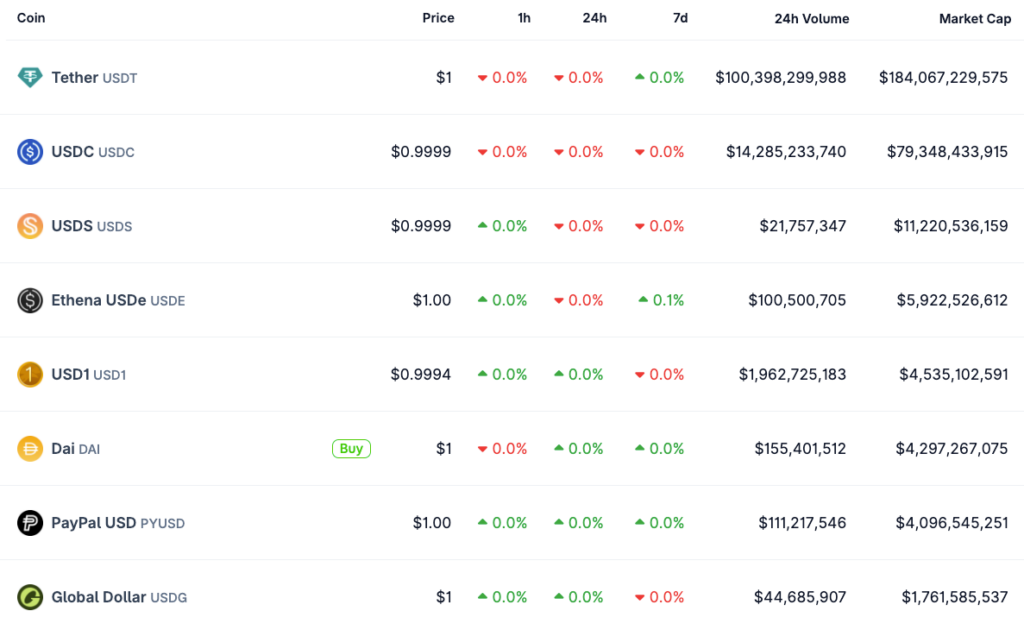
This trajectory is part of an equally ambitious technical expansion strategy. By September 2025, PayPal had already expanded PYUSD to nine new blockchains, including Tron and Avalanche, using the LayerZero protocol. A diversification that strengthens the liquidity of the stablecoin and opens the way to broader DeFi uses.
Despite this dynamic, competition remains fierce. Tether largely dominates with 171 billion dollars in capitalization, followed by Circle and its 74 billion. Faced with these giants, the PYUSD still remains modest. PayPal, however, has a major advantage: a base of more than 430 million users and a solid reputation built over two decades in online payments.
Finally, the timing of this expansion is not trivial. In the United States as in Europe, regulators are making progress in regulating stablecoins. In this new regulatory context, established, compliant and credible players have a competitive advantage that new entrants will find difficult to fill.
Maximize your Tremplin.io experience with our 'Read to Earn' program! For every article you read, earn points and access exclusive rewards. Sign up now and start earning benefits.