In 2026, Real World Assets (RWA) will transform finance by connecting physical assets and blockchain. Hedera, Chainlink, Avalanche and Stellar dominate this growing sector, attracting investors and companies. Why are these projects exploding the development rankings?
In brief
- Hedera, Chainlink, Avalanche and Stellar dominate the RWA sector in 2026, with 70% of the activity.
- Their success is based on strategic partnerships, innovative technology and growing adoption by institutions.
- These projects open up opportunities for investors, particularly in the luxury, tech and Asian markets sectors.
RWA: Hedera, Chainlink, Avalanche and Stellar explode activity in 2026
In 2026, the Real World Assets (RWA) landscape is clearly dominated by four projects: Hedera, Chainlink, Avalanche and Stellar. According to Santiment data, these capture the majority of development activity, with impressive scores over the last 30 days! Hedera (HBAR) leads with 278.17 activity points, followed by Chainlink (LINK) with 215.37 points, Avalanche (AVAX) with 135.13 points, and Stellar (XLM) with 110.9 points.
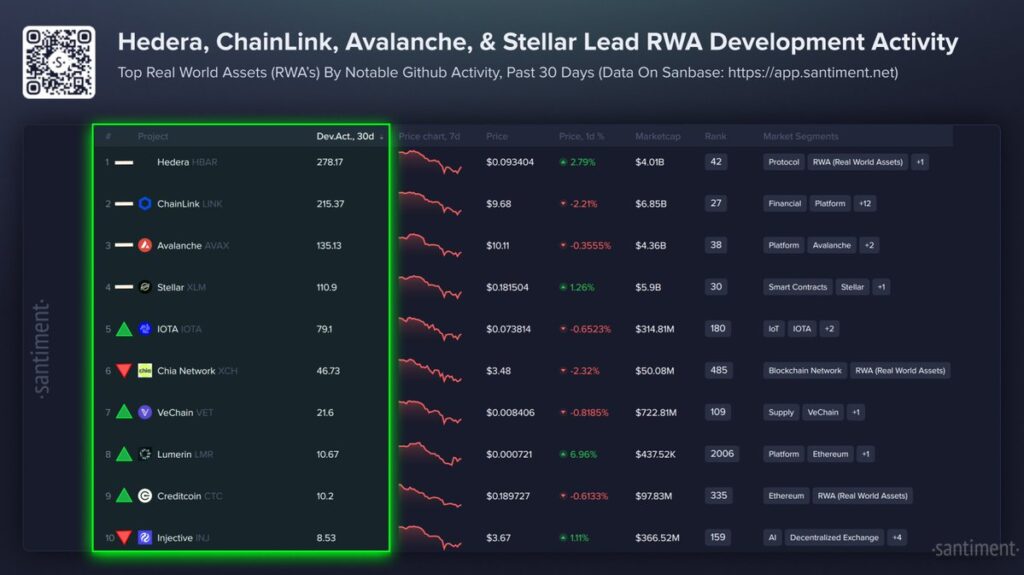
This concentration shows that these projects are not only popular, but also the most active in terms of innovation and adoption. Hedera, for example, stands out for its enterprise-focused approach, while Chainlink remains essential for its decentralized oracle solutions. Avalanche and Stellar, for their part, focus on scalability and cross-border payments respectively.
Why do these 4 projects dominate the RWA sector in 2026?
Several factors explain the domination of these four RWA projects in 2026. First of all, their ability to attract strategic partnerships plays a key role. Hedera, for example, benefits from the support of companies like Google and IBM, which strengthens its credibility with institutions. Chainlink, for its part, has become essential infrastructure for connecting RWAs to blockchains thanks to its CCIP protocol.
Then, these projects were able to specialize in promising niches. Avalanche excels in asset tokenization through its subnet technology, while Stellar focuses on low-cost international payments. Finally, their constant development activity, measured by metrics like GitHub commits, proves their long-term commitment. This dominance reveals that investors favor stable projects, especially in this context of economic volatility.
2026, the year when RWAs will become the new crypto treasures?
The year 2026 could well mark a turning point for RWAs. With increasing adoption by institutions and increasingly clear regulation, these tokenized assets are poised to become a pillar of the crypto ecosystem. Projects like Hedera, Chainlink, Avalanche and Stellar, already leaders, could see their influence expand even further.
RWAs offer a concrete solution to a major problem: the volatility of cryptocurrencies. By anchoring real assets (real estate, bonds, commodities) on the blockchain, they attract traditional investors looking to diversify their portfolios. Additionally, governments and regulators are beginning to recognize their potential, which could accelerate their integration into the global economy.
If this trend continues, 2026 could be the year when RWAs move from promising niche status to that of an industry standard. For investors, this means new opportunities, but also the need to choose your projects carefully. However, what if the RWA market is actually not worth much?
Maximize your Tremplin.io experience with our 'Read to Earn' program! For every article you read, earn points and access exclusive rewards. Sign up now and start earning benefits.