
Investment firm VanEck believes that the first quarter of 2026 could be favorable for risky assets, driven by a more understandable tax policy, more stable monetary signals and a renewed interest in several major investment themes. After several years of uncertainty, improved visibility is now influencing how investors position their portfolios heading into the new year.

In brief
- VanEck believes that more readable fiscal policies and more stable rate signals restore investor confidence, particularly in cryptocurrencies, AI, gold and credit.
- After the 2025 downturns, AI-related assets appear more attractive, with a selective approach favored as infrastructure demand shifts the risk/return balance.
- Demand for gold remains supported by central bank purchases, while India stands out as a long-term growth opportunity driven by structural reforms.
- The bitcoin cycle seems less predictable since 2025, but the long-term outlook remains bullish despite high short-term volatility.
Clearer Tax Signals, Rate Stability Boost Investor Confidence, Says VanEck
In a message published on X, VanEck indicated that the markets are evolving in an environment of clarity not seen in several years. Analysts point to more precisely defined public spending plans, a reduction in political surprises and interest rate expectations that have become more predictable. Taken together, these elements allow investors to reassess opportunities in artificial intelligence, private credit, gold, India and cryptocurrencies.
After a marked decline at the end of 2025, assets linked to AI now appear more attractive. VanEck notes that sectoral corrections have created better entry points for investors in the medium term. Interest in AI-related infrastructure, particularly in areas like nuclear power, has increased, shifting the risk-return balance toward more selective exposure, away from widespread speculation.
The improvement in US public finances also supported market sentiment. VanEck cites Treasury Secretary Scott Bessent's recent statement calling current rates “normal.” A signal suggesting that abrupt political changes would be less likely in 2026. More gradual adjustments and reduced volatility thus make it easier for markets to assess risk.
Private credit has also regained investor attention after a difficult 2025, particularly in the business development company segment. Although yields remain high, a large part of the credit risk is already priced into valuations. In this context, VanEck considers private credit to be more attractive than it was a year ago.
Gold Pullbacks Attract Buyers as Bitcoin Adjusts to New Market Cycle
Gold continues to consolidate its role as a reserve asset. Sustained demand from central banks, combined with gradual diversification away from the US dollar, is increasing its appeal as a global store of value.
Despite technical indicators sometimes suggesting an overbought situation, price declines continue to attract buyers. India is also highlighted as a strong conviction long-term opportunity, driven by structural reforms, favorable demographics and stable economic growth.
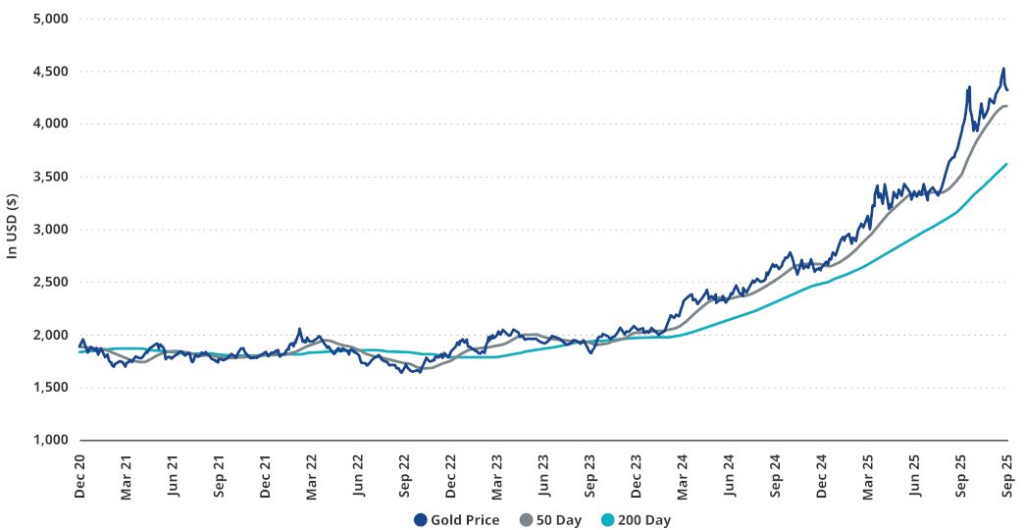
VanEck's primary investment themes include:
- A favorable environment for risky assets, supported by a more understandable fiscal and monetary policy
- AI and its associated infrastructure, after a valuation reset
- Private credit offering attractive returns following market corrections
- Gold, supported by central bank demand and the decline in dollar dominance
- India well positioned for long-term sustainable growth thanks to reforms
Despite this positive outlook, opinions remain divided regarding Bitcoin. VanEck analysts believe that the traditional four-year cycle appears to have disintegrated in 2025, making short-term signals less reliable. The company therefore anticipates more choppy price action over the next three to six months as market dynamics adjust.
Some leaders, however, take a more constructive approach. Matthew Sigel and David Schassler show greater confidence in Bitcoin's near-term cycle, while others remain more cautious. VanEck also points out that Bitcoin has recently decoupled from stocks and gold following a significant deleveraging event in October.
VanEck Says Bitcoin Could Reach $2.9 Million By 2050 As Adoption Expands
The company's past research remains decidedly bullish over the long term. VanEck has previously argued that Bitcoin could reach $2.9 million by 2050, provided it captures a significant share of global trade settlements and central bank reserves.
External analysts are nevertheless more measured in the medium term. Arctic Digital's Justin d'Anethan explains that recent price action reflects healthier market conditions in a low-leverage environment. According to him, the excess speculation observed last year has largely dissipated, giving way to more realistic expectations.
Finally, despite persistent geopolitical tensions and potential friction with American decision-makers, the overall appetite for risk has allowed the crypto market to regain some momentum. HashKey Group's Tim Sun believes the adjustments made in late 2025 have set a clearer trajectory for early 2026, positioning Bitcoin and other cryptocurrencies to benefit. For his part, crypto investor Will Clemente adds that the current environment is closely aligned with the original vocation of Bitcoin.
Maximize your Tremplin.io experience with our 'Read to Earn' program! For every article you read, earn points and access exclusive rewards. Sign up now and start earning benefits.