
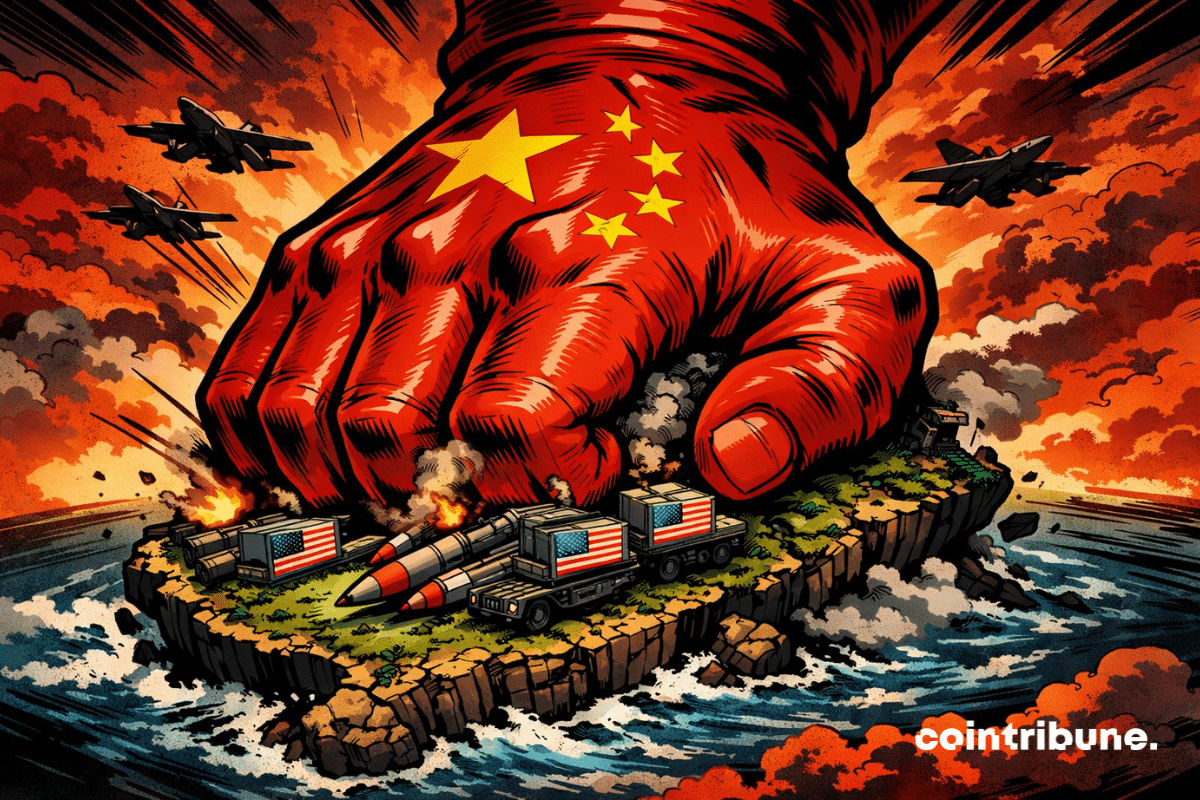
The year 2026 promises to be one of high tension. Far from being confined to Ukraine or the Middle East, instability is also spreading to Asia and Latin America. Between China and Taiwan, or even Venezuela and its neighbors, the sparks are multiplying. Several analysts fear that the great powers will enter into direct confrontation. The atmosphere is heavy, alliances are frozen, weapons are circulating. If nothing changes, the conflagration may no longer be a simple hypothesis.
In brief
- China begins massive military maneuvers around Taiwan after an American arms deal.
- Beijing denounces a strategic provocation, demanding an immediate end to arms sales to Taiwan.
- Trump downplays the incident, calling it “mere naval exercises,” despite growing tensions in the region.
- The Taiwanese economy is experiencing disruptions, with flights diverted and ports threatened by a potential military blockade.
China: military maneuvers that speak louder than words
Beijing no longer hides its anger, while some analysts, as early as January, were already sensing a possible imminent invasion. After Washington's announcement of a colossal $11.1 billion arms contract for Taiwan, China responded with an unprecedented military deployment. Called “Justice Mission 2025”, these maneuvers saw the navy and air force encircle the island, with 130 planes detected in less than 24 hours and more than a dozen missiles fired offshore.
Officially, this is to test blockade and coordinated attack capabilities. Unofficially, it is a show of force. People's Liberation Army spokesman Shi Yi said the drills are a stern warning to Taiwan independence separatist forces and foreign powers.
At the same time, the Chinese Foreign Ministry warned:
External forces attempting to use Taiwan to contain and arm China will only encourage pro-independence arrogance and push the Taiwan Strait into a perilous situation of imminent war.
A war economy… for the economy itself
If military tension remains at the heart of the news, the issue is also deeply economic. What ignited the powder? A massive arms deal. The United States validated an $11.1 billion sale to Taiwan in December, including ATACMS missiles, drones and HIMARS systems. A historic sale, perceived as a direct provocation by Beijing.
The Chinese response was not long in coming: 20 American companies, including Boeing, Northrop Grumman and L3Harris, were targeted by immediate sanctions. Their assets are frozen in China, all cooperation is prohibited, and ten leaders are now persona non grata in the territory.
Wang Yi, the head of Chinese diplomacy, warned bluntly that any attempt to hinder China's unification with Taiwan was, in his view, doomed to failure.
But beyond the response, Beijing is sending a strong strategic signal. It is about maintaining constant pressure on Taiwan, while testing the solidity of Western alliances.
In the background, it is also China's economic credibility that is at stake. Because an armed conflict in this area would endanger maritime routes essential to world trade. The economy, once again, becomes a weapon of massive deterrence.
Trump downplays risks, but Taipei is not fooled
While the world is worried, Donald Trump is trying to defuse the situation. The former US president, who has an ambivalent relationship with Beijing, said:
I don't think he's going to do it… They've been conducting naval exercises in this area for 20 years.
A way of trivializing Chinese exercises around Taiwan. However, this is the first time that China has published an official map of no-fly and maritime zones around the island. A move seen as a clear escalation by Taipei, which has mobilized 14 ships to monitor Chinese movements.
On the ground, residents are showing resilience. A Taipei merchant explains that these exercises have become routine, as they have multiplied in recent years. Others, more concerned, emphasize that it is no longer just a question of military posture, but a concrete demonstration of what a real blockade could look like.
Clearly, if Trump calms things down, the military reality is much more alarming.
What to remember (figures & facts)
- $11.1 billion: record amount of US arms sales to Taiwan;
- 130 Chinese military planes detected around the island in 24 hours;
- 20 American companies hit with sanctions by Beijing;
- 5 designated Chinese military blockade zones around Taiwan;
- $88,458: price of bitcoin at the time of writing this article
According to some geopolitical experts, China is taking inspiration from Russia's modus operandi in Ukraine. Rather than an immediate frontal war, it would develop a secret strategy combining military pressure, informational destabilization and progressive isolation of the island. A long, discreet tactic, but extremely effective in imposing one's views… without firing a bullet.
Maximize your Tremplin.io experience with our 'Read to Earn' program! For every article you read, earn points and access exclusive rewards. Sign up now and start earning benefits.


