
Artificial intelligence is transforming the way people experience and interact with the online world. Major platforms are now facing a rise in non-human traffic and synthetic content, pushing the internet into a phase where real users must question both what — and who — they are interacting with. Researchers say this shift erodes trust as machine-generated material spreads into spaces once dominated by humans.
In brief
- Automated traffic reached 51% in 2024, marking the first year bots outperformed human users on major public platforms and networks.
- Articles written by machines have surpassed human production by the end of 2024, increasing concerns about authenticity in the online world.
- Users report weaker cues to spot real people as automated posts mimic human behavior and blur the line between real and synthetic.
- More people are turning to private chats and closed groups as public platforms become noisier, less reliable, and harder to navigate.
Bots are overtaking humans online, raising new questions for crypto platforms
Much of the internet still relies on human activity, but recent trends indicate a significant shift toward automation. Posts created by AI and botnets are circulating on social platforms at a pace that is making the digital world less human than before. The trend, researchers say, reflects the ideas behind “dead internet theory,” a once-fringe belief that posits that much online content is generated by machines mimicking human behavior.
Many dismissed the theory as a conspiracy theory when it first appeared years ago on forums such as 4chan and Agora Road's Macintosh Café. However, the growing prevalence of automated activity has caused some experts to reassess how unrealistic it once seemed.
Imperva's Bad Bot 2025 report found that bots accounted for 51% of all web traffic in 2024 — marking the first time that automated systems have outperformed humans. Advanced and moderate bots accounted for 55% of attacks that year, with many designed to copy human browsing habits. These systems can evade detection by imitating the behavior of ordinary users, making their identification much more difficult.
Basic bot attacks are also on the rise, with automated activity reaching 45% in 2024, up from 40% the previous year. Analysts attribute the rise to easily accessible automation tools that allow less skilled attackers to run high-volume campaigns with minimal effort.
Synthetic articles overtake human authors as trust declines online
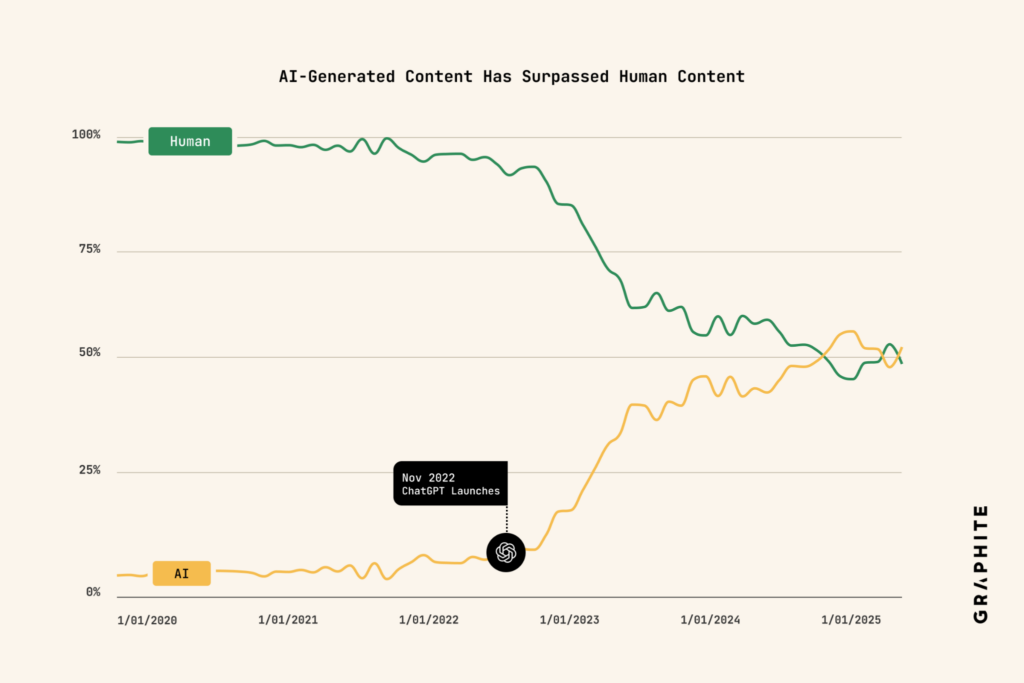
Aside from automated bot attacks, article and content trends seem to follow a similar path. Analytics firm Graphite reported that machine-generated articles have surpassed human productions for the first time in late 2024. This shift adds to growing concerns about authenticity on news sites and social platforms.
Sociologist Alex Turvy explained that while precise measurement is impossible, there are clear signs that online spaces are undergoing significant change. Automated posts now fill comment sections, newsfeeds, and forums, often appearing similar to authentic human contribution.
Concerns extend beyond traffic numbers, as people must now rely on subtle behavioral cues to determine whether someone is genuine. Once bots start copying these cues, user trust begins to decrease. Some users withdraw; others begin to question almost everything they see.
The main pressures shaping this evolution include:
- Growing automated activity on major platforms.
- Increased use of tools that mimic human behavior.
- A growing production of articles and synthetic publications.
- A decrease in reliable signals to identify real users.
- A growing movement toward smaller, more controlled online communities.
Many users are now migrating to private spaces, such as Discord channels or group chats, where their identity seems easier to confirm. Turvy said communities can adapt, but trust could continue to decline as automated activity increases. For now, people remain active online, but they face more machine-generated noise than ever before.
Maximize your Tremplin.io experience with our 'Read to Earn' program! For every article you read, earn points and access exclusive rewards. Sign up now and start earning benefits.


