The king of cryptos lost ground yesterday, slipping below the symbolic threshold of $100,000. Investors are fleeing risky assets amid tight liquidity. This brutal correction raises the question: are we witnessing a simple technical decline or the start of a prolonged bearish phase?

In brief
- Bitcoin falls by more than 4% and is struggling to maintain the $100,000 mark.
- Sellers dominate the market after failing to hold above $103,500.
- A downtrend line has formed with key resistance at $102,200.
- Long-term investors are showing signs of capitulation by liquidating their positions.
Bitcoin drops below $100,000 and worries the markets
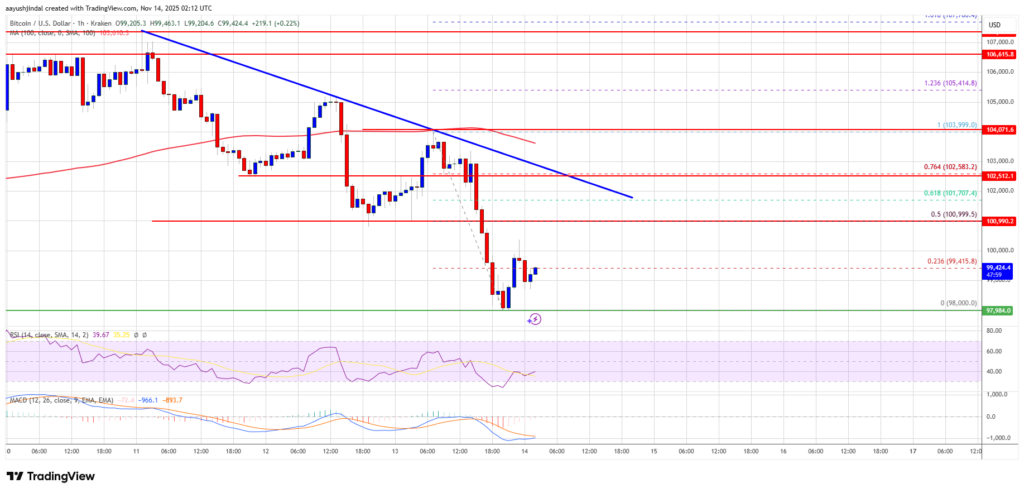
Bitcoin suddenly broke several critical supports this Thursday. The flagship crypto went from $103,999 to a low of $98,000 in a matter of hours. Sellers took control after the price failed to cross the $103,500 mark, the pivotal level that separated optimism from caution.
Technical analysis reveals a worrying situation. BTC is now trading below its 100-hour moving average and faces a downtrend line with resistance at $102,200.
The indicators confirm the ambient gloom: the MACD accelerates into the negative zone while the relative strength index (RSI) plunges below the threshold of 50 points.
Attempts to rebound come up against a wall of resistance. If buyers attempt a rally, they will first need to break through $100,500, then $101,000 which corresponds to the 50% Fibonacci retracement.
Beyond that, the area of $102,200-103,500 represents a major obstacle before hoping to return to recent highs.
The opposite scenario is more worrying. Failing to recapture these levels, Bitcoin could plunge towards $96,500 or even $95,000 in the short term. Analysts set the main support at $92,500, a threshold whose breach would open the door to a bearish acceleration.
Macroeconomic factors that paralyze the market
The macroeconomic environment largely explains this risk aversion. The longest shutdown in American history has just ended, but its repercussions continue to be felt.
Unlike 2019 where a similar situation propelled Bitcoin by 300%, the crypto this time shows a decline of 12% since the start of the budget blockade.
The paralysis of federal agencies like the SEC and CFTC has frozen any regulatory progress. Expected ETF approvals remain on hold, while discussions on a legal framework for cryptos stall. This uncertainty deters institutional capital, which is essential for the next bullish phase.
The odds of a Fed rate cut in December fell to 67%, down from more than 90% in previous months. This sudden reversal in monetary policy cools enthusiasm. Paul Howard, director at Wincent, notes that “ cryptocurrency is now more than ever closely linked to macroeconomics “.
The stock markets are amplifying the movement. The Nasdaq lost 2% and the S&P 500 lost 1.3%, dragging crypto stocks in their wake. Miners exposed to AI infrastructure suffer the most severe losses: Bitdeer collapses by 19%, Bitfarms by 13%. Exchange platforms are not spared with drops of between 7% and 8%.
Some glimmers of hope nevertheless remain. JPMorgan maintains its target of $170,000 in the next six to 12 months, relying on a miner production cost of $94,000 being a solid floor.
In addition, Taiwan is preparing a report to assess the integration of bitcoin into its strategic national reserves by the end of 2025, a signal that could inspire other Asian nations.
Consolidation necessary before the rebound?
The crypto market is going through a phase of questioning. November, traditionally the best performing month with an average increase of 41.78% since 2013, has so far disappointed expectations. This consolidation could, however, prove beneficial after the euphoria of October and the historic peak at $125,100.
Analysts remain divided. Some see this decline as an opportunity for accumulation, others fear that the peaks of 2025 are already behind us. The answer will largely depend on the return of liquidity to the markets and the clarification of US monetary policy in the weeks to come.
Maximize your Tremplin.io experience with our 'Read to Earn' program! For every article you read, earn points and access exclusive rewards. Sign up now and start earning benefits.