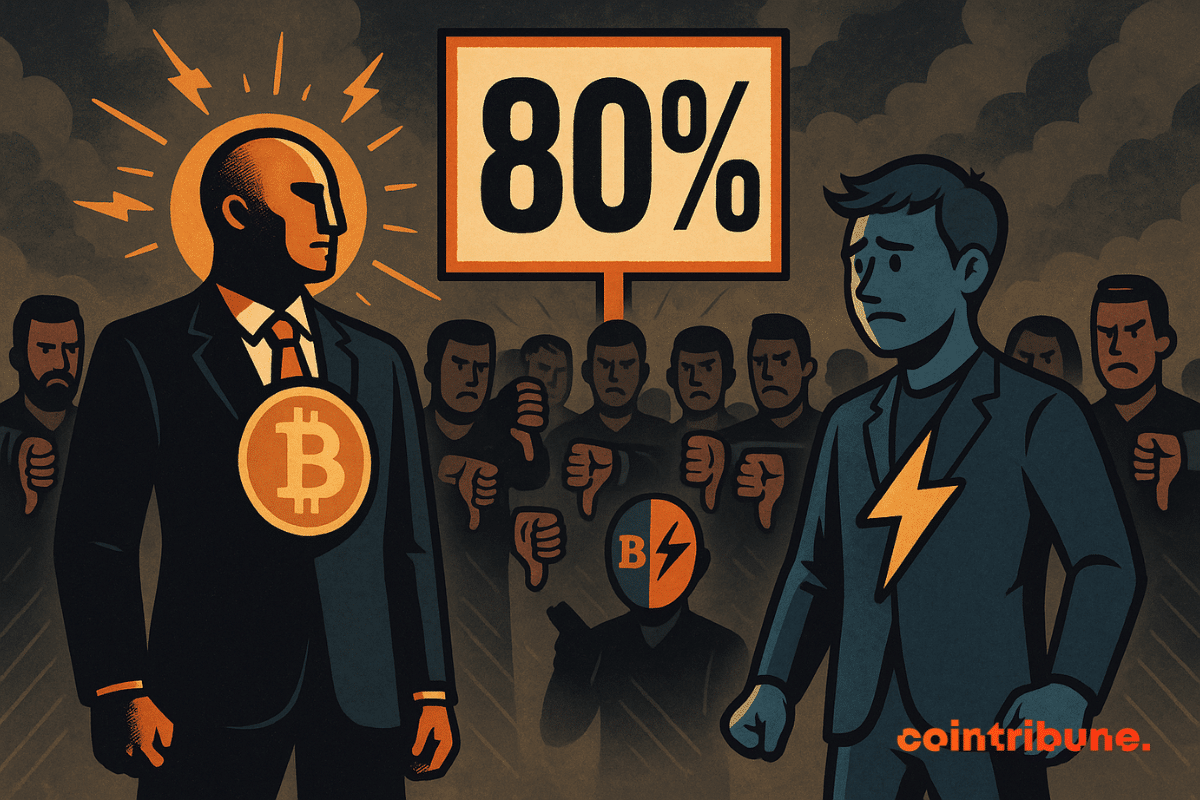
An online survey has set things alight: more than 80% of voters believe that Lightning is not “real bitcoin”. A massive figure, and a clear divide between technical promise and market perception. The debate exploded on X, pitting pro-Lightning figures against harsh critics. Let’s summarize, decode, project.
In brief
- Survey shows 80% of respondents don't consider Lightning to be real bitcoin
- The debate pits critics citing complexity and dependence on liquidity against defenders emphasizing real usage and micropayments
- Metrics stagnate while gated products gain ground, hence the priority on better UX and improvements like splicing.
Shock survey, disrupted narrative
The message is brutal, for a large majority, Lightning does not embody “native” bitcoin. This perception is based on a simple intuition: if one must go on-chain to enter and exit the network, then Lightning appears as a separate environment, almost like a distinct token. The technical nuance was not enough to convince.
In this context, the critics have hit the nail on the head. Paul Sztorc speaks of a system that was “cool at first” but over the years “doesn’t work.” He points out concrete constraints: permanently connected nodes, dependence on liquidity providers, need for watchtowers. For him, the user experience quickly slides towards custodial, and trust disintegrates.
On the other hand, the response is clear. Alex Gladstein defends Lightning as digital cash in bitcoin, without banks.
Matt Corallo adds a volume point: a double-digit share of BTC transactions today would be routed via Lightning. For them, the reality on the ground already exists. Denial would be, precisely, to deny these uses.
The annoying figures: stagnation and perceived centralization
Let's look at public metrics. The capacity Lightning hovers around a few thousand BTCroughly the same level as in September 2022. No real surge in three years. The signal is clear: traction has not materialized at the expected pace.
Another indicator, even harsher: the number of payment channels has almost been halved since 2022, going from more than 80,000 to around 45,000. It is a marker of network density, surface area, liquidity and resilience. When the channels become smaller, the perception of centralization increases mechanically. And the “everyone can route everything” speech is losing credibility.
However, Lightning retains one key asset: costs. Tiny payments, routed off-chain, sometimes approach a fraction of a cent. In contrast, on-chain fees in bitcoin can eat up hundreds of basis points on small amounts. On the “micro-payments” axis, the technical advantage remains. But the narrative advantage falters.
Competition of Bitcoin ETFs and avenues for recovery
Staying on the topic of perception, context doesn't help. Volumes are exploding elsewhere, via ETFs. In Q3, JPMorgan observed renewed interest in spot bitcoin ETFs, while wBTC-like and cbBTC progressed. Apps like Moonshot, Base or Fomo boast on-boarding in just a few clicks, fast transactions, and a smooth UX. The general public follows the slightest friction. And the bitcoin ecosystem pays for every step that seems too technical.
Should we bury Lightning? No. But you have to tell the truth. The network has not transformed the post-2022 trial. It remains powerful for specific cases: low-value recurring payments, pay-per-use models, targeted remittances. To scale, it lacks a “default” experience that hides the complexity of channels, liquidity, penalties and connections. For market context, bitcoin is trading today around the $106,000 zone at the time of writing, a symbolic milestone that illustrates an ecosystem in flux.
Maximize your Tremplin.io experience with our 'Read to Earn' program! For every article you read, earn points and access exclusive rewards. Sign up now and start earning benefits.