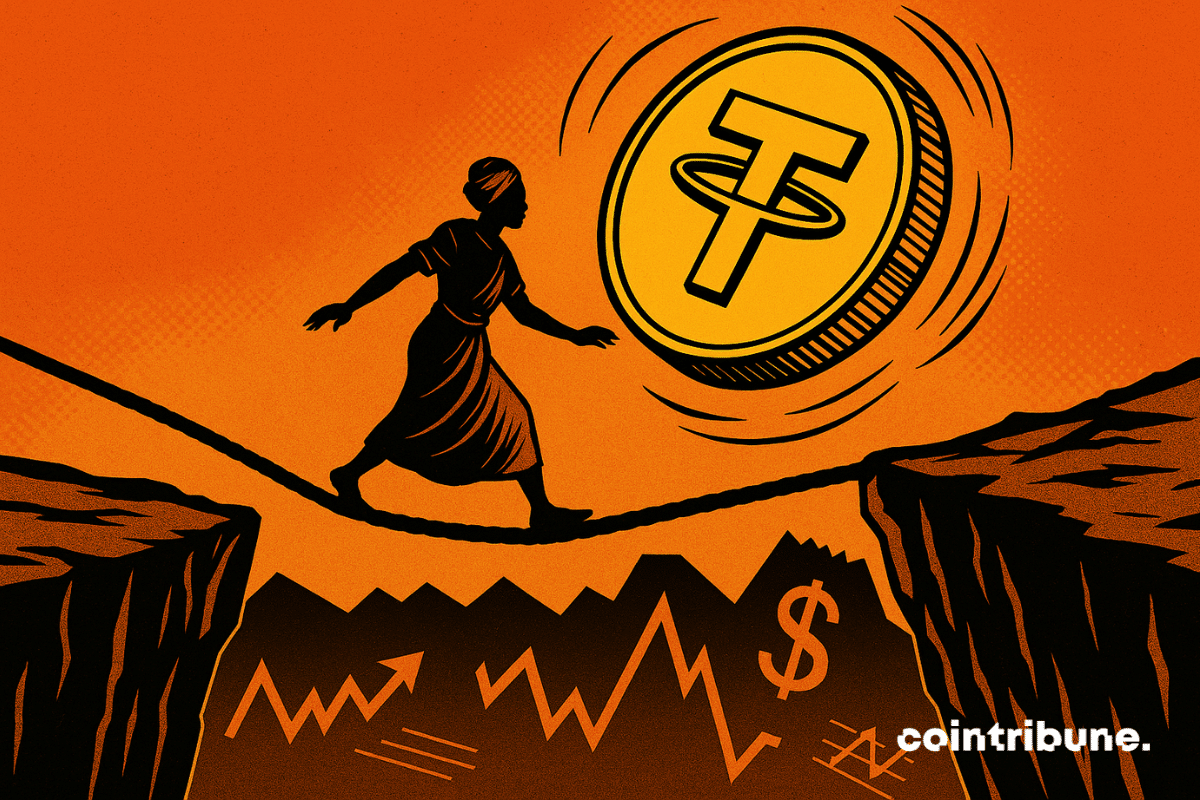
What if the promise of financial inclusion hid a major systemic risk? Popular in countries in crisis, stablecoins have become the preferred tool for millions of citizens to escape hyperinflation. However, behind this massive adoption, a concern is growing: by draining savings into the digital dollar, these assets could weaken the most vulnerable economies. As their use explodes, a dilemma arises: are stablecoins a bulwark for people or a silent threat for States?
In brief
- Stablecoins are seeing mass adoption in emerging economies hit by hyperinflation and devaluation.
- These dollar-backed cryptos are used as a safe haven to protect citizens' savings against the collapse of local currencies.
- Their success is based on four assets: stability, mobile accessibility, borderless use and resistance to state restrictions.
- According to Standard Chartered, up to $1 trillion could leave local banks to be converted into stablecoins by 2028.
A financial inclusion tool or a time bomb?
In many emerging economies, stablecoins have established themselves as a tool for preserving purchasing power in the face of the collapse of local currencies.
From Latin America to Africa, currency conversion to US dollars is an everyday practice, and stablecoins have “turbocharged this process”providing a fast, accessible and widely adopted digital alternative.
In a country like Zimbabwe, 85% of transactions are now denominated in US dollars, an illustration of this informal dollarization. This movement, now amplified by blockchain technologies, is extending to other areas affected by chronic monetary instability, such as Argentina, Turkey or Nigeria.
Behind this craze for these cryptos, the main motive is the preservation of capital in contexts where financial institutions no longer inspire confidence. The Standard Chartered study underlines that, for millions of people living in economies in crisis, “the return on capital matters more than the return on capital”.
In other words, the priority is not to generate returns, but to escape the brutal depreciation of their national currency. Stablecoins meet this need thanks to several key features :
- The stability of the dollar: by being backed by the USD, these cryptos offer a credible anchor to a strong currency;
- Digital accessibility: they are available via a simple mobile application, without the need for a bank account;
- Borderless use: they facilitate savings, payments and international transfers;
- Resilience in the face of local restrictions: they circumvent exchange controls and account freezes often imposed by authoritarian regimes or in crisis.
In short, stablecoins have become much more than a trading tool. These cryptos embody a form of private monetary insurance for populations exposed to systemic failures. However, this dynamic, although legitimate on an individual scale, is not without consequences for the economies concerned.
A systemic risk for vulnerable economies
Behind this massive adoption, Standard Chartered is sounding the alarm. According to on-chain data from its report published in October, up to $1 trillion in deposits could leave emerging market banks and migrate to stablecoins by 2028.
“This transfer of wealth could pose a profound risk to the foundations of many national credit systems”warns the British bank, which has a strong presence in Asia, Africa and the Middle East. Indeed, each conversion of local currency into stablecoin dries up the liquidity of the domestic banking system, and with it, the ability of commercial banks to lend to businesses and households.
This mechanism also undermines the effectiveness of monetary policies. Central banks, deprived of visibility on these outgoing flows, lose control over the money supply and over their traditional instruments such as interest rates. Chronic monetary instability is being created, accentuated by the possibility of capital flight 24/7, via crypto platforms not subject to exchange controls.
Beyond local erosion, stablecoin reserves are mainly invested in US Treasury bonds. Thus, the digital savings of emerging countries contribute to financing the debt of the United States, today estimated at 38,000 billion dollars. This form of “digital dollarization” could ultimately increase the dependence of emerging economies on the North American financial system, while weakening their own monetary sovereignty.
Maximize your Tremplin.io experience with our 'Read to Earn' program! For every article you read, earn points and access exclusive rewards. Sign up now and start earning benefits.