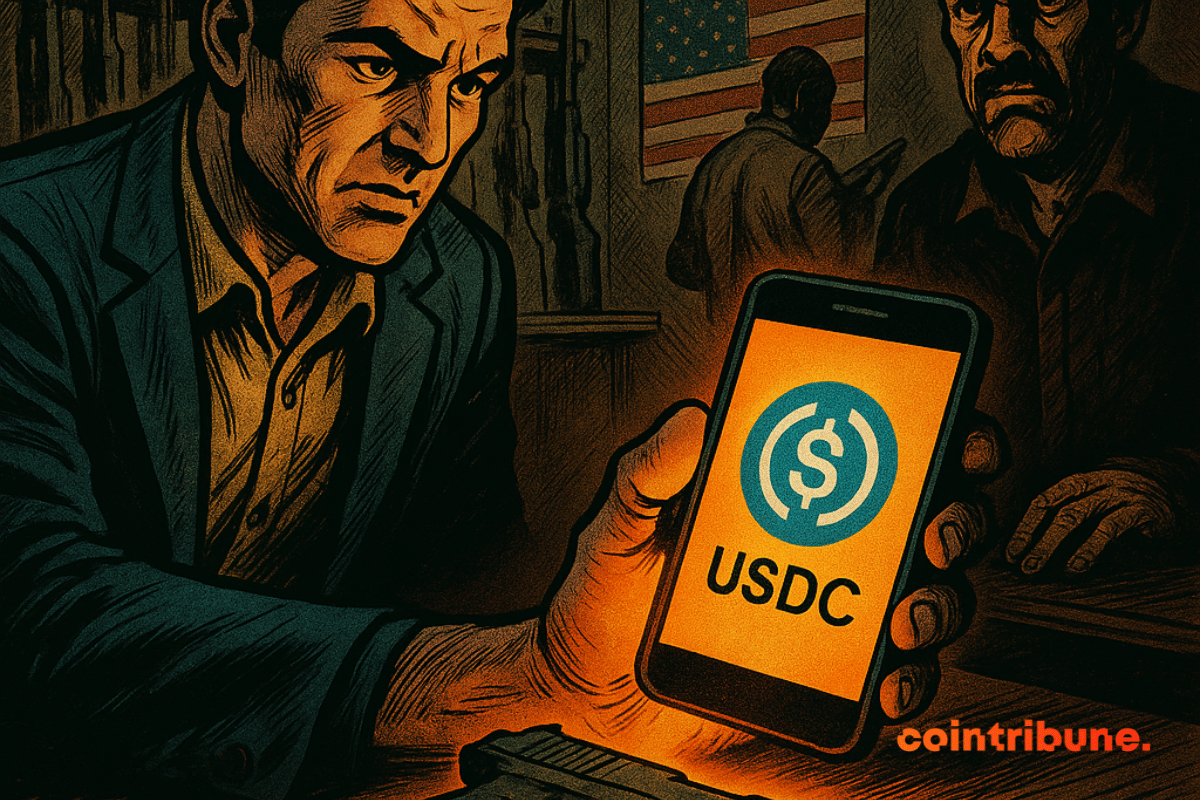
The line between crypto and politics is becoming even more refined. By now allowing the legal purchase of firearms with USDC, Circle is bringing the issue of financial neutrality to the forefront. This decision, welcomed by some and contested by others, reveals the tensions between the promise of decentralization and institutional realities, while reigniting the debate on what crypto can or cannot allow in a legal framework.
In brief
- Circle now allows legal purchase of firearms with USDC, reigniting debate over crypto's financial neutrality
- The decision, welcomed by some and criticized by others, comes as Circle also launches a testnet with partners
- The case highlights the paradox of stablecoins: useful and compliant, but exposed to political pressure, far from the independence of Bitcoin.
When crypto enters the gun debate
The boundary between crypto and politics has once again crumbled. USDC stablecoin issuer Circle has officially changed its internal policy to allow the legal purchase of firearms. In the same context, and with the support of several partners, the company launched a testnet, extending its policy review and its opening to legally regulated uses.
This gesturehailed by defenders of the Second Amendment, marks for some a return to a certain financial neutrality, and according to others, a submission to the political pressures of the moment.
Until now, Circle prohibited any transaction related to “weapons, ammunition or explosives”. But in the face of criticism from organizations like Americans for Tax Reform, the company revised its terms of service. Now USDC can be used for any “legally authorized” transaction.
This change, reported by journalist Eleanor Terrett, puts a burning question back on the table: can crypto really be neutral in a polarized world?
Beyond the symbol, this turnaround illustrates a deep tension within the ecosystem: that which opposes the promise of decentralization to the reality of institutional control.
A crypto under influence: between freedom and conformity
Circle, despite its image as an innovative Web3 player, remains an American company, therefore subject to the laws and political moods of Washington. “A private company cannot issue neutral crypto, because it remains dependent on national policies,” recalled Kadan Stadelmann, CTO of Komodo.
This observation is disturbing. Crypto, supposed to embody financial freedom and resistance to censorship, finds itself caught up here by the constraints of the real world. Where Bitcoin remains a decentralized tool, stablecoins like USDC remain instruments managed by centralized companies, exposed to societal debates.
Some Republican elected officials, such as Bill Hagerty and Cynthia Lummis, praised Circle for “aligning its terms of service with the constitutional rights of citizens.” Others, on the contrary, denounce a form of political accommodation masked under the pretext of legal compliance. Thus, crypto becomes an ideological battlefield: should it be regulated in the name of security or preserved in the name of individual freedom?
USDC and the paradox of financial neutrality
This policy change also has an economic dimension. The stablecoin market is now worth several hundred billion dollars, and Circle is trying to consolidate its position against Tether (USDT). By relaxing its restrictions, the company is undoubtedly seeking to broaden its adoption, while reassuring users attached to the freedom of use of cryptocurrencies.
But this decision raises a paradox: the more accessible and legal crypto is, the more it is exposed to regulatory censorship. By authorizing certain uses and prohibiting others, centralized actors are redefining the very notion of monetary neutrality.
For sector purists, this confirms one thing: real crypto remains that which escapes the control of institutions. USDC, despite its transparency and compliance, cannot claim the same independence as an asset like Bitcoin.
Maximize your Tremplin.io experience with our 'Read to Earn' program! For every article you read, earn points and access exclusive rewards. Sign up now and start earning benefits.