
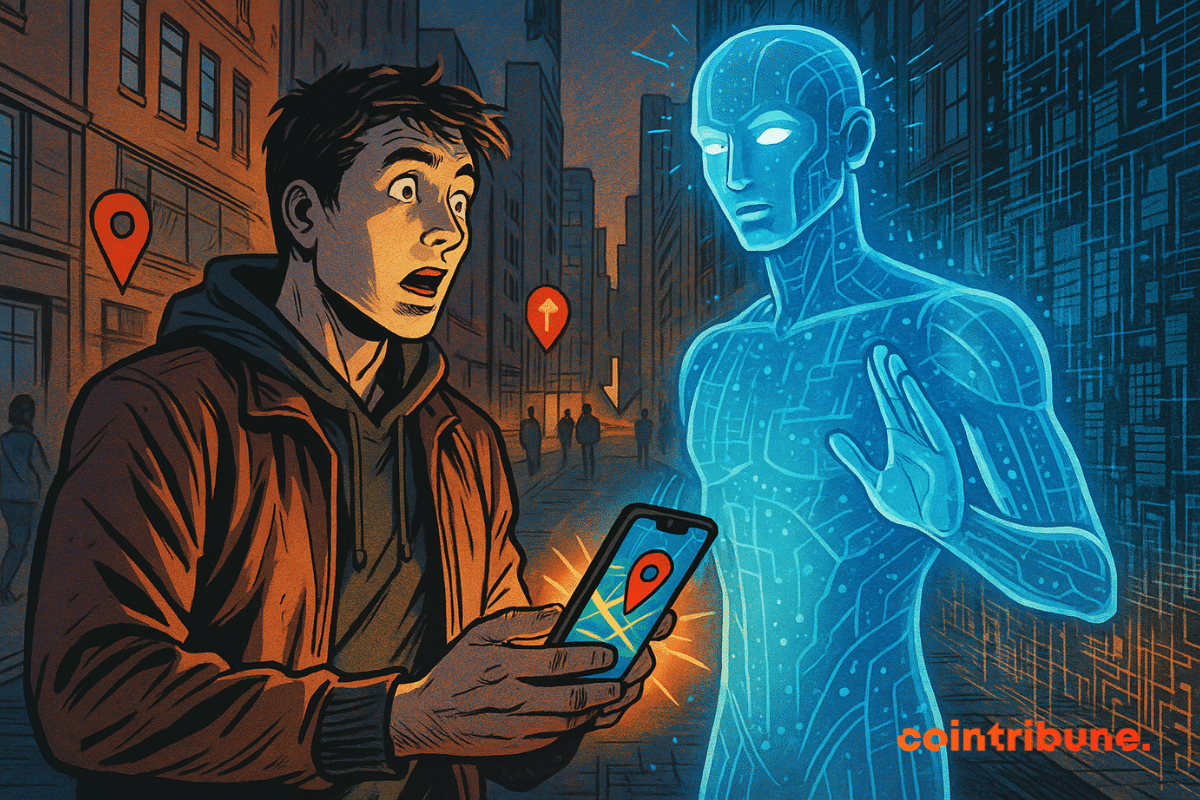
Google is accelerating its offensive in the world of artificial intelligence as the firm plunges one of its flagship applications, Google Maps, into the heart of the action. The Mountain View giant is no longer content with exploring: it wants to dominate a new technological territory, that of embedded AI in real life. With the integration of Gemini, the ambition is clear: to offer a unique navigation and interaction experience. The bet? May Google soon take the place of undisputed leader…
In brief
- Gemini responds to complex queries by voice by integrating Maps, Calendar and news on Android.
- The AI guides journeys via real landmarks: restaurants, stations or buildings visible on the road.
- Lens mode allows you to interrogate locations in real time using a connected camera and microphone.
- Target market: 38 billion in 2030, Google is establishing itself in mobile AI against Siri and Alexa.
When Google Maps becomes an intelligent and vocal co-pilot
With the arrival of Gemini in Google Maps, the application is transformed into a conversational co-pilot. The user can make voice requests such as: “A cheap vegan restaurant on my route, including parking? », and Google's artificial intelligence responds live.
The system analyzes more than 250 million locations and uses Street View to display concrete visual landmarks like the Thai Siam Restaurant, replacing the usual abstract instructions.
The experience doesn't stop there. As you drive, you can signal “accident,” “flood,” or “slow down” by voice, and the app adjusts the route accordingly. This fluid interaction creates a direct link between AI, geolocation and user experience.
As Google Maps summarized on X:
Google Maps navigation gets a powerful boost with Gemini. Ask what you want, like planning a restaurant stop or getting parking details, and Gemini takes care of the rest.
Visual cues, talking camera and contextual AI
There new navigation is anchored in reality: Google Maps no longer simply tells you “turn in 500 meters”, but “turn after the Shell station”. It’s a revolution in the driver experience. Gemini draws on a colossal database of locations, cross-referenced with Street View, to transform the abstract into the tangible.
Another new feature: Lens with Gemini. You point the camera at a location — restaurant, store, building — and you can ask, “What is that?” Is it popular? What is the style? » And Google answers you. All in a natural dialogue.
Gemini can even, if you allow it, add events to your calendar by voice. Google explains it like this:
With your permission, Gemini connects to your calendar and automatically adds the event. You can ask a more specific question, like: “What are the popular dishes there?” » or even update you on last night's match or the latest news, all without taking your hands off the wheel.
Official Google Blog
This fluidity gives Google's AI an edge over Siri, Alexa or other embedded AIs which still struggle to contextualize with such finesse.
Google aims for the embedded AI jackpot
The market for embedded AI – navigation, voice assistants, connected cars, is estimated at 19 billion dollars in 2025, and could rise to 38 billion in 2030. In this race, Google already seems several steps ahead. Gemini in Maps is just a taste of what Alphabet has in store. Artificial intelligence is becoming an everyday tool, almost invisible, but omnipresent.
This progress repositions the relationship with digital. We don't type anymore. We talk.
Behind the appearance of a gadget, Google is developing a vocal, visual and geolocalized architecture capable of supervising all movements. Rivals like Apple or Amazon must adapt quickly. Otherwise, they risk being mere spectators of a shift that has already begun.
The figures to remember about Google and embedded AI
- 250 million locations analyzed in real time by Gemini;
- Gradual launch on Android and iOS in the United States;
- 19 to 38 billion dollars market estimated between 2025 and 2030;
- Navigation based on concrete visual cues (e.g. restaurants, stations);
- AI capable of adding an event to your calendar by voice.
Google is no longer in fiction. The company is pushing the known boundaries of artificial intelligence. Recently, its AI even managed to solve a mathematical problem deemed insoluble. From now on, Gemini invites itself into the car, into the street, into our daily lives. Artificial intelligence no longer looks at itself: it listens to itself, it speaks to you, it guides you.
Maximize your Tremplin.io experience with our 'Read to Earn' program! For every article you read, earn points and access exclusive rewards. Sign up now and start earning benefits.


