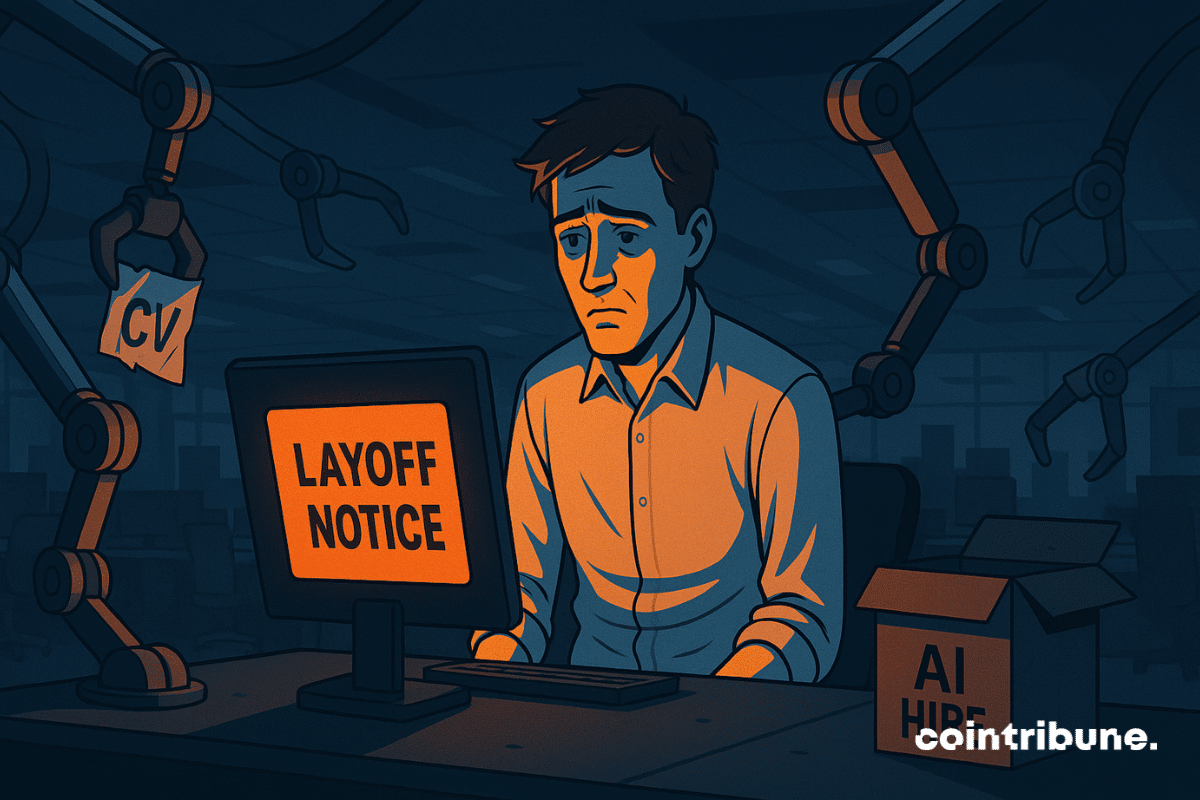
While artificial intelligence radically transforms the job market and particularly threatens several positions, Openai is launching an ambitious counter-offensive. Chatgpt's parent company is developing a platform for employment specializing in AI, positioned as a direct competitor to Linkedin.
In short
- OPENAI launches a employment platform fed by the AI, expected for mid-2026.
- The project is accompanied by a certification program aimed at 10 million Americans by 2030.
- Young workers 22-25 years old is a decline in employment of 13% in the most exposed sectors at AI.
- Giants like Salesforce and Klarna have already deleted thousands of positions thanks to IA agents.
Openai's irony, create jobs after destroying them
OPENAI has officially announced the launch of its employment platform, called Openai Jobs Platform, whose deployment is scheduled for 2026. The objective is clear: to connect employers to candidates with artificial intelligence skills.
According to Fiji Simo, director of applications at OpenAI, this initiative is already based on partnerships with industrial giants such as Walmart and John Deere, in order to facilitate the transition to a labor market reinvented by AI.
This announcement comes in a paradoxical context. On the one hand, generative AI radically transforms the professional landscape by automating many tasks. On the other, it creates new specialized skills needs.
A Study of Digital Economy Lab from Stanford University reveals that young workers aged 22 to 25 are subjected to a 13 % drop in employment in the sectors exposed to automation, illustrating this tension between destruction and job creation.
To support this mutation, Openai also launches a free certification program called “AI Fluency”. A pilot phase will be proposed from the end of 2025, with the ambition to certify 10 million Americans by 2030. This approach testifies to the recognition by the company of its responsibility in the transformation of the labor market.
A generation crushed by automation and the development of AI
The Z generation pays the high price of this technological revolution. Entrance stations, long considered to springboard for young graduates, disappear at high speed.
Marc Benioff, CEO of Salesforce, illustrates this trend: he reduced his customer service to 9,000 to 5,000 employees, replaced by IA agents capable of managing more than a million conversations.
This transformation strikes the full force of sectors such as software development and customer support. According to the International Labor Organization, the rise of generative models – capable of producing voice, images and videos – has greatly increased automation scores.
Result: young professionals find themselves deprived of the opportunities that traditionally allowed them to acquire a first experience.
At the same time, Sam Altman, CEO of Openai, defends an optimistic reading of the situation, believing that the current era represents an exceptional moment to start a career. A striking contrast with the daily reality of a generation faced with a job market already reshaped by automation.
The emergence of a new professional paradigm
Openai's initiative is part of a larger transfer to what experts now qualify as agentic AI.
Unlike the first language models, which were limited to generating text, the new AI agents are able to perform concrete actions: carrying out online research, carrying out code, reserving a plane ticket or making a call. This development calls into question the relevance of giant, expensive and energy -consuming models, in favor of more modular and effective approaches.
This transition deeply redefines working methods. Tools like Deepresearch allow reports to be compiled in a few minutes reports that would have required several hours, while V0 By Vercel transforms simple ideas into ready -to -use web applications.
In this new landscape, developers become architects of solutions, analysts turn into data strategists, and technicians evolve in orchestrators of smart systems.
But this mutation requires rapid adaptation of skills. The future Openai platform could play a central role by connecting talents trained in the concrete needs of the market. There remains a sensitive question: the concentration of power in the hands of technological giants, which design both the tools and standards of skills necessary to use them.
In reality, Openai seeks to solve a problem that she herself helped to create. Its initiative illustrates the extent of current upheavals and underlines the urgency to support workers in this technological transition.
Maximize your Cointribne experience with our 'Read to Earn' program! For each article you read, earn points and access exclusive rewards. Sign up now and start accumulating advantages.