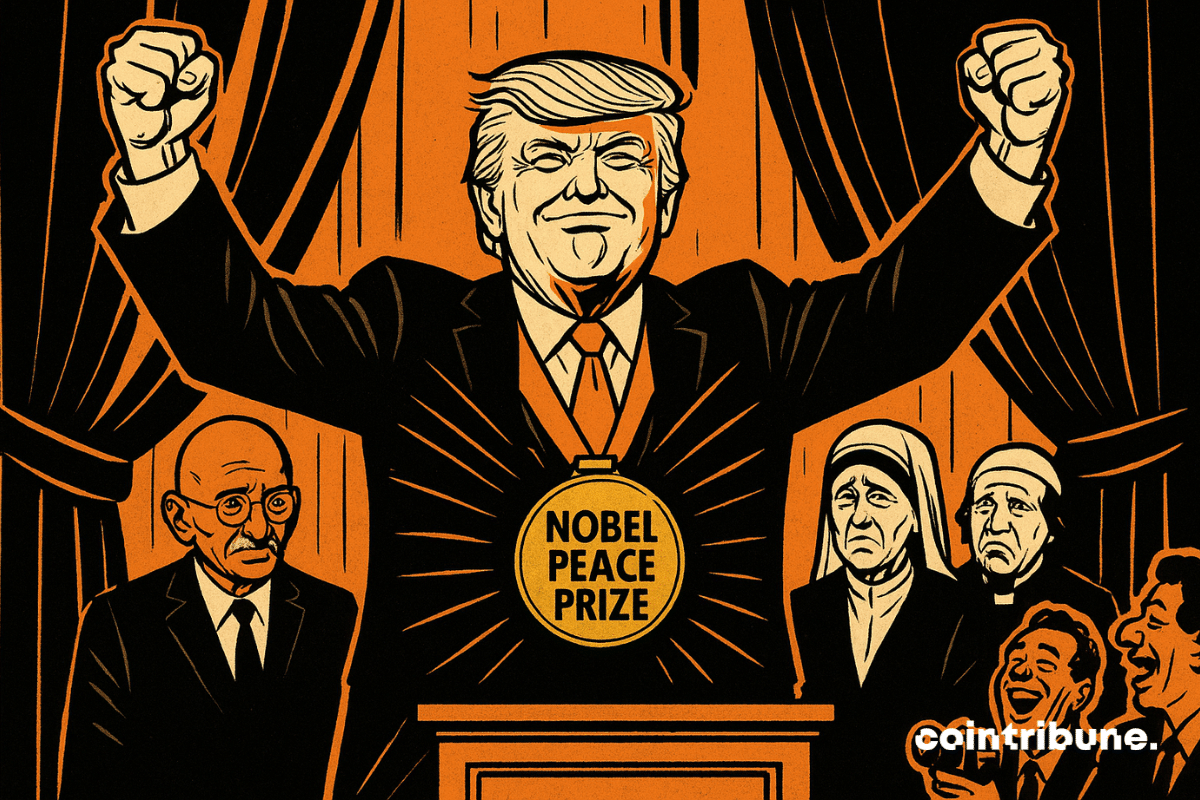
In a high -tension global climate, an unexpected name is essential in bets linked to the Nobel Peace Prize: Donald Trump. Indeed, given favorite on the Polymarket and Kalshi platforms, the American president is ahead of several historic figures. This breakthrough, carried by geopolitical dynamics and relayed in Crypto circles, triggers as many speculations as questions. Simple reflection of a strategic craze or index of an international repositioning?
In short
- Donald Trump is among the favorites for the Nobel Peace Prize for 2025, according to the Polymarket and Kalshi prediction platforms.
- In these blockchain -based markets, Trump comes second behind Yulia Navalnaya, with ratings of 11 % and 13 %.
- These platforms illustrate the rise of crypto predictive markets as tools for geopolitical perception.
- The predictions reflect more speculative bets than real probabilities, influenced by news and political polarization.
Trump propelled in the Nobel race by predictive markets
While its administration has put the global economy under pressure with customs duties, on Polymarket, a decentralized Paris platform using Blockchain technology, Donald Trump is currently ranking second in predictions for the Nobel Peace Prize 2025. 11 % estimated chancehe is only preceded by Yulia Navalnaya, wife of the Russian dissident Alexei Navalny, who collects 18 % of bets.
On the side of Kalshi, platform regulated by the Commodity Futures Trading Commission (CFTC), Trump poster A probability of 13 %, compared to 25 % for Navalnaya. This noticed presence in the dimensions feeds an unexpected media debate. Trump has thus become the improbable dolphin of a price at which little associated it, at least traditionally.
Here are the key elements noted on the main predictive platforms:
- $ 1 million was bet on Polymarket for this prediction;
- Kalshi displays a total volume of $ 3.1 million in the category;
- Trump exceeds traditional figures of the Nobel Prize like Doctors Without Borders or the UN.
The reasons for this craze are to be found on the side of political declarations and recent media maneuvers. Hillary Clinton would even have assertive what “Would support his appointment if he managed to end the war in Ukraine”.
This unexpected outing of an old rival underlines the complexity of the context and the ambivalence of reactions. The prediction markets reflect these developments in concrete signals.
The rise in the Crypto predictive markets and their limits in the analysis of reality
What truly distinguishes this news, beyond the only figure of Trump, is the growing role played by the crypto predictive markets in the construction of media stories.
Polymarket and Kalshi are not simple Paris sites. They aggregate on-time data in real time and user anticipations, the choices of which often reflect a speculative, but also emotional reading of future events.
Other players are well represented: UNRWA (9 %), Doctors Without Borders (11 %), the International Court of Justice (8 %), or figures like Greta Thunberg, Antonio Guterres and Francesca Albanese. This diversity illustrates a strong polarization of expectations, against the backdrop of persistent world conflicts and pressing climatic issues.
However, it would be risky to confuse these ratings with objective probabilities. The predictive markets reflect bets, not verdicts. Their volatility is influenced by media cycles, cognitive biases and sometimes even coordinated contracts for the purchase of contracts to make certain candidates artificially climb.
In the case of Trump, its high visibility, could explain this sudden rise. The Trump surprise is perhaps less institutional recognition than a signal on the state of opinion of part of the crypto and political ecosystem.
However, this quest for recognition is not free from criticism. Several analysts underline the contradictions between the appointments and the realities in the field, recalling the American strikes in Iran or the absence of tangible results on certain files. With the approach of the award ceremony, scheduled for October 10, 2025, these tensions should intensify, fueling the debate on legitimacy and symbolism of such recognition.
Maximize your Cointribne experience with our 'Read to Earn' program! For each article you read, earn points and access exclusive rewards. Sign up now and start accumulating advantages.