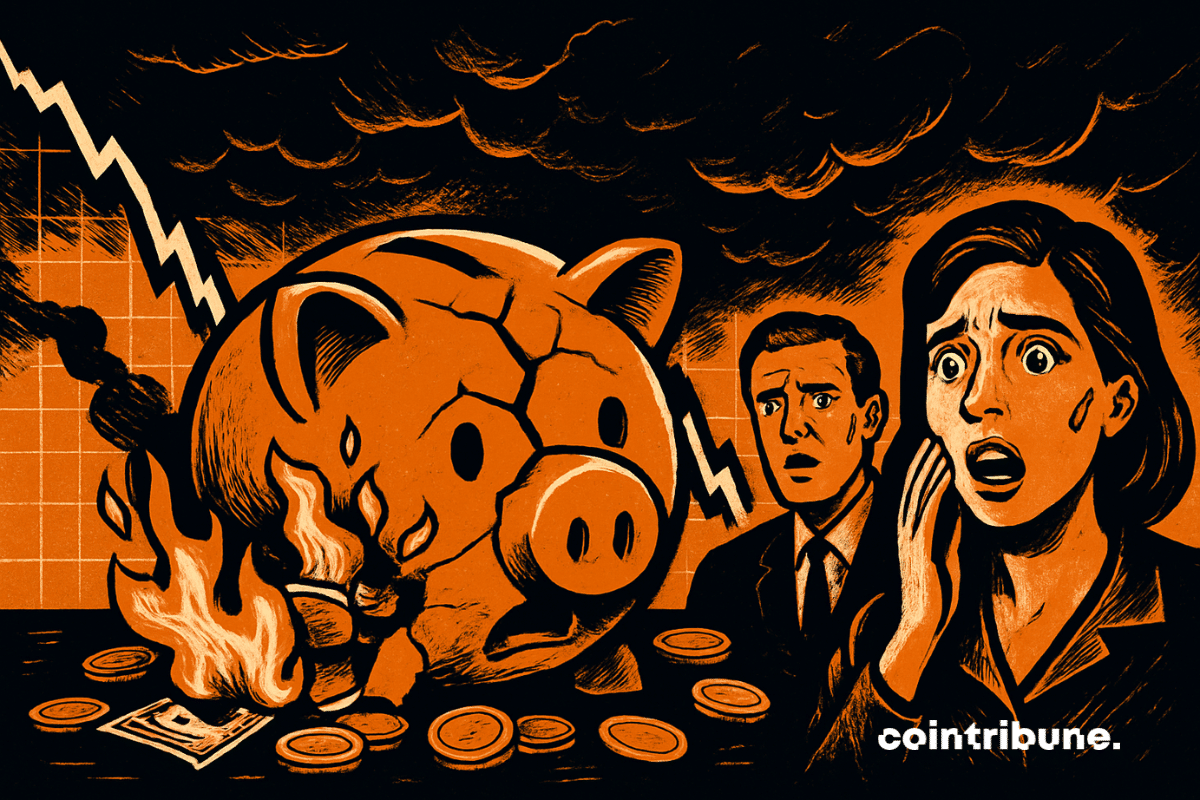
Alarm signals are everywhere. Between the explosion of inequalities and record debt, the global financial system is dangerously waving. Faced with $ 37,000 billion in debt just in the United States, a question is necessary: are we witnessing the end of capitalism as we know it?
In short
- Financial repression acts as an invisible tax that erodes savings by maintaining interest rates under inflation.
- The debt of American households reaches $ 18,000 billion, forcing millions of people to go into debt for their essential needs.
- Capitalism evolves towards a techno-feudalism where the tech giants extract annuities such as medieval lords.
- Real wages have stagnated since the 1970s despite massive productivity gains.
Financial repression, this invisible tax on your savings
Financial repression constitutes the secret weapon of governments To reduce exploding debt. This perverse mechanism deliberately maintains interest rates under inflation. Thus, your savings gradually lose its value without any government having to announce new unpopular taxes.
Here is how this sly mechanism works:
Governments issue obligations to finance their expenses. However, with astronomical debt levels, voluntary buyers are scarce. Consequently, the authorities force banks and pension funds to hold these unprofitable obligations.
Japan already applies this strategy massively. Japanese financial institutions are crumbling under state bonds. Europe follows the same path. The United States follows suit.
Russell Napier, recognized financial historian, warns us that This silent confiscation will last decades. The savers will pay the bill for public debt. Meanwhile, the real value of government debt will melt slowly, which will allow policies to be re -elected.
Capitalism cracks under the weight of the debt
American consumer debt now exceeds $ 18,000 billion. This dizzying figure includes mortgages, credit cards and student loans. Credit cards alone represent more than 1,000 billion.
Average interest rates exceed 20 % on these cards. Millions of Americans use them to pay the grocery store and invoices. It is no longer comfort credit, but Credit survival.
Student loans crush a whole generation. Young people delay the real estate purchase and the foundation of a family. Mortgages devour ever greater shares in monthly income.
This debt spiral interconnects with financial repression. On the one hand, savings melts. On the other, the debts accumulate. Purchasing power collapses Between these two jaws.
Capitalism lifts towards a techno-feudalism
Capitalism has not always existed. He emerged ash from medieval feudalism. The 14th century black plague decimated a third of the European population. This disaster paradoxically created the conditions for change.
The shortage of labor strengthened the power of peasants. They negotiated better conditions. Feudalism gradually fell. Capitalism took its place, and this is how the industrialization of the 19th century created an unprecedented richness.
But barons like Rockefeller monopolized whole sectors. Theodore Roosevelt broke these monopolies at the beginning of the 20th century.
Today we slip towards what some call the Techno-feudalism. Apple takes 30 % from each application sale. Google dominates online advertising. Meta controls communications between individuals. Nvidia, the computing power.
These giants are no longer really innovating. They extract annuities thanks to their dominant position. As the feudal lords levied tax on their land.
Emerging alternatives in the face of the collapse of capitalism
Basic universal income (RUB) is gaining popularity, including in tech giants, with promoters like Sam Altman, the CEO of Openai. However, funding remains problematic. Through tax, the Rub could create deflation. By monetary creation, it would feed inflation. Experiments also show a drop in productivity.
Cryptocurrencies also offer a different escape. Bitcoin works outside the traditional banking system. It protects against financial repression and inflation, thanks to its fixed money supply: 21 million BTC. Today Bitcoin represents an alternative financial infrastructure to the dollar system which is credible.
Finally, the last alternative would be an in -depth reform of capitalism. Demarate the tech monopolies like Google and Amazon. Close the tax loopholes of multinationals. Invest massively in education and health. Put the subject of the repudiation of national debts on the table.
Protect your heritage in this storm
To preserve its savings and diversify in antifragile assets with the aim of protecting it, or even making it grow, it is vital to know the sectors that may suffer from it. What are they?
- Banks and insurers may particularly suffer. Financial repression crushes their beneficiary margins. Obligations report less than inflation.
- Consumer dependent companies may also be affected. Retail, automotive, residential real estate. Their model is based on ever more indebted customers.
On the other hand, the tangible active will most likely shine.
- Gold, silver and raw materials perform historically well. Central banks themselves accumulate gold massively.
- The sectors aligned on government priorities will no doubt prosper, especially while the conflict between the United States and China is increasingly threatening. Infrastructure, energy, health and defense. Governments should massively increase these expenses.
- Bitcoin deserves an allowance in any portfolio. This Numerical value reserve escapes state control. Its programmed rarity protects against monetary devaluation.
- Geographical diversification becomes crucial. Economic turbulence unevenly strike the regions. Distribute its investments between countries and currencies considerably reduces risks.
Capitalism will not collapse tomorrow morning. But the next ten years will deeply transform our economic system. Financial repression, massive debt and techno feudalism force this development. Investors wise investors are adapting now by favoring anti-fragile active ingredients such as Bitcoin.
Maximize your Cointribne experience with our 'Read to Earn' program! For each article you read, earn points and access exclusive rewards. Sign up now and start accumulating advantages.