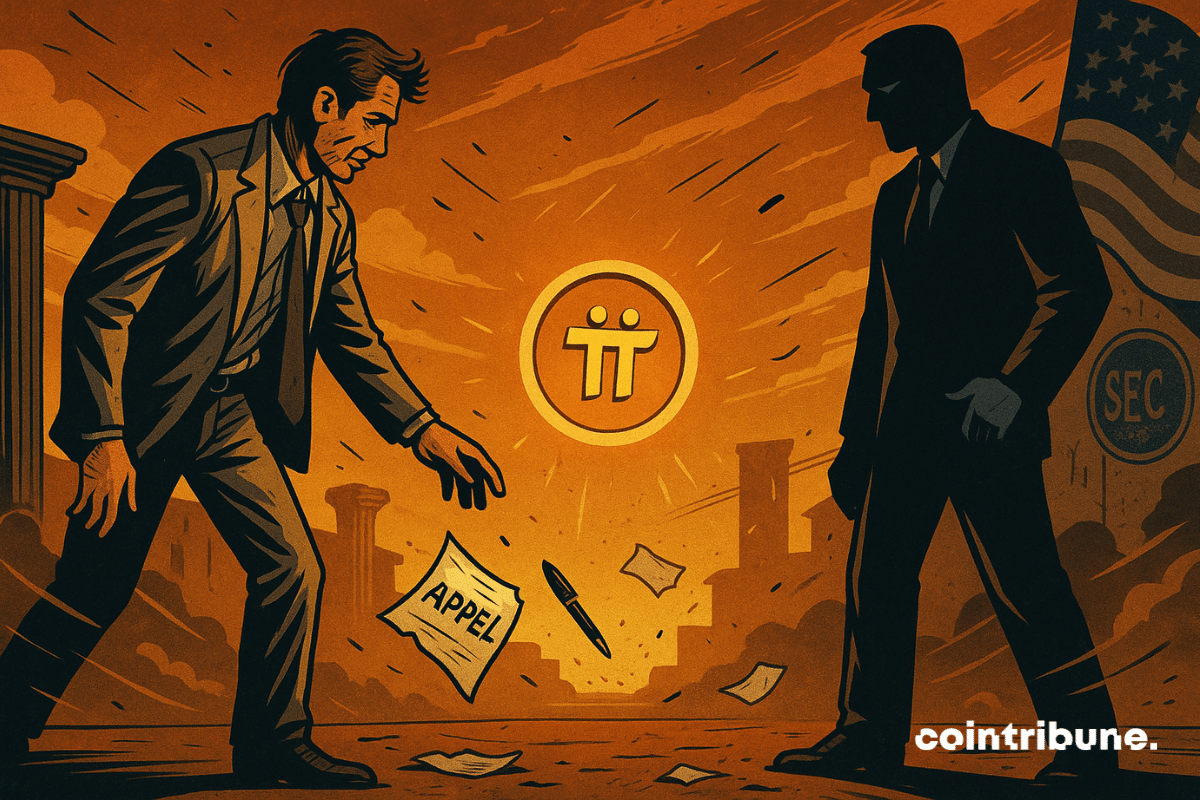
After more than four years of legal battle and a global decision, Ripple puts an end to his standoff with the dry. The withdrawal of his call, and that expected from the regulator, seals the epilogue of an emblematic litigation for the crypto industry. In a climate where each gesture of the authorities influences the market, this outcome permanently clarifies the legal status of the XRP and redefines the lines of the regulatory framework in the United States.
In short
- After more than four years of procedure, Ripple officially abandons his appeal against the dry in the XRP case.
- Judge Analisa Torres refused to modify the final judgment, now the fine of $ 125 million and the injunction against Ripple.
- XRP retains its crypto status not considered a title for sales on exchange platforms.
- This decision puts an end to one of the most followed trials in the history of the crypto, and could influence other current cases in the United States.
The confirmed judgment, the judicial page turns definitively
While the American justice had rejected the agreement between Ripple and the SEC, the closure of the dispute between Ripple and the SEC was formally acted on June 27, 2025, when Brad Garlinghouse, CEO of Ripple, announced publicly on X: “Ripple withdraws his cross -call, and the dry should abandon hers, as she has already indicated. We definitely close this chapter to focus on the essentials: building the Internet of value. We take action “.
This declaration follows the judgment the day before by the federal judge Analisa Torres, who rejected the joint attempt of Ripple and the dry to modify the final decision. The court thus maintains a financial sanction of $ 125 million against Ripple, accompanied by a permanent ban on making new unregistered institutional sales of XRP.
In her decision, the judge was firm: “The parties do not have the power to agree not to be bound by a final judgment rendered by the Court […] This is clearly not the case here ”.
In other words, the judiciary takes precedence over any bilateral agreement between the parties. This refusal concerns a proposal filed on May 8, 2025 by Ripple and the dry, which aimed for:
- Reduce the initial fine from $ 125 million to $ 50 million;
- Remove the permanent injunction prohibiting non -compliant institutional sales;
- Agree with an amicable settlement without officially modifying the recognition of the violation of the law on financial securities.
Judge Torres rejected this attempt because she stressed that the parties had not demonstrated the “Exceptional circumstances” necessary for a revision of a final judgment.
Consequently, the decision rendered in July 2023 remains unchanged. Ripple has violated federal laws on securities in its institutional sales, but the XRP does not constitute a title in itself, in particular for programmatic sales on exchange platforms.
A reinforced regulatory framework and a strategic signal for Ripple
With the abandonment of appeals, the legal vagueness surrounding the nature of the XRP fades more. Stuart Alderoty, Legal Director of Ripple, wanted to publicly reaffirm that the regulatory status of the asset remains unchanged: “The legal status of XRP as a movable non-value remains unchanged”.
His message, published on June 26 on X, aimed to reassure Ripple's markets and partners, while certain concerns circulated following the rejection of the regulation proposed by the court.
In the same spirit, lawyer Bill Morgan was expressed In these terms: “Programmatic sales do not constitute investment contracts. Ripple found other ways to sell XRP to institutions. The XRP itself is not a valuable value “. These words underline the technical outcome, but also symbolic of the trial: Ripple will not be forced to give up the use of XRP as a freely negotiable crypto.
Far from being a simple legal relief, this decision allows Ripple to reposition himself strategically. Released from an uncertainty that weighed heavily on its credibility with institutions and partners, the company announces that it now wants to focus on the development of “The Internet of value”.
By this expression, Brad Garlinghouse designates a decentralized financial infrastructure, integrating cross -border payments, tokenization of assets and decentralized banking services. This perspective now seems more realistic for Ripple, which can redirect its resources towards growth initiatives rather than defending itself in court.
Beyond Ripple, this conclusion could be a school. By fixing a clear legal border between institutional sales and sales on public platforms, the judgment of Judge Torres could influence other ongoing files against major players in the sector, in particular those included by the SEC against Coinbase or Binance. Some lawyers already see it as indirect jurisprudence on the qualification of cryptos, a central question at a time when the United States is still looking to build a coherent regulatory framework. In this context, the end of the Ripple/Sec saga could well become a historic marker, both legal and strategic, for the entire industry.
Maximize your Cointribne experience with our 'Read to Earn' program! For each article you read, earn points and access exclusive rewards. Sign up now and start accumulating advantages.