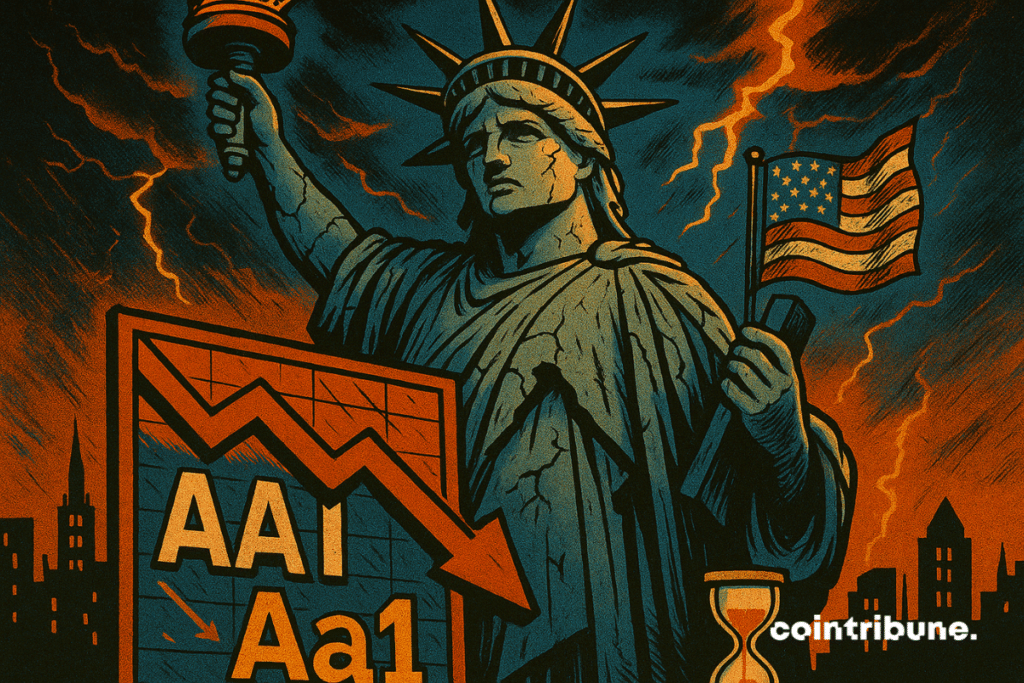
Have the trade wars and the announced budget cuts really improved the economic health of the United States? Does Donald Trump's grandiloquent speech hide an inability to stop the country's financial degradation? Moody's lowered the American sovereign note, a sign that the figures do not lie. This essential indicator reveals that the speed of reforms does not follow that of economic damage. The question arises: is the president a real magician or a simple illusionist in the face of the collapse of the American economy?
In short
- Moody's retrograde the US note in AA1, alerting to a debt that has become too massive.
- American debt will reach 134 % of GDP in 2035, according to official projections.
- Interest burden could absorb 30 % of federal income within ten years.
Moody's degrades the United States: an alarm signal for the global economy
On May 16, 2025, Moody's lowered the Sovereign Note of the United Statespassing From “AAA” to “AA1”. This downgrading, the last among the major rating agencies, marks a historic stage. It reflects the loss of confidence in the face of A debt deemed too heavy and persistent deficits. Moody's underlines:
Successive American administrations and Congress failed to reverse the trend in annual budget deficits and growing costs of interest.
This degradation is not only symbolic. It alerts investors and could increase the funding cost of the United States. This increase could repercussions on the entire world economywhose dollar remains the pillar. In addition, this signal weakens the American position as a world economic leader, throwing a shadow on the credibility of the country.
Stephen Moore, close to Trump, strongly criticizes this decision, qualifying thelowering of the note of “scandalous”.
The markets reacted by an increase in yields of treasury bills, reflecting ambient nervousness. The challenge is size: to ward off this spiral before it has permanently slowed down the American and global economy.
American debt: a burden that threatens economic stability
The weight of American debt is at the heart of concerns. Currently, La federal debt exceeds $ 36,000 billion. Moody's plans that it will reach 134 % of GDP by 2035, against 98 % in 2024. This explosion is explained by growing deficits, the increase in compulsory spending, in particular interest, and tax revenue that stagnates.
The report Specifies that the burden of interest will drop from 18 % of federal income in 2024 to almost 30 % in 2035. This weight increases the budget and limits the room for maneuver for daring economic policies. In addition, if the extension of the 2017 tax cuts is confirmed, it could further widen deficits, adding almost $ 4,000 billion over ten years.
These figures translate an American economy increasingly suffocated by its debt. Consequently, the ability to invest in growth, innovation and competitiveness is called into question. This trend could lead to a gradual degradation of the standard of living and a weakening of American economic institutions.
US economy today: Tensions and future prospects
The American economy is going through a delicate period. The trade war initiated by Trump, with its customs tariffs, created Tensions that disrupt global supply chains. In addition, budget cuts aim to reduce public spending, but their impact is uncertain.
The inability to stabilize the debt feeds concerns. Efforts to reduce deficits come up against political oppositions and structural constraints. There Fragility of the financial system This feels, in particular with the increase in bond rates. This context generates an atmosphere of uncertainty for companies and consumers.
- Federal debt: $ 36,000 billion (2025);
- Debt/GDP ratio: 98 % in 2024, planned at 134 % in 2035;
- Interest load: 18 % of income in 2024, 30 % planned in 2035;
- Tax impact of tax cuts: +4,000 billion over ten years;
- Planned inflation: 2.9 % in 2024.
Faced with these challenges, voices are raised to plead an alternative to simple budget cuts. Among them, Bitcoin is gaining popularity as a refuge value, and diversification tool. Donald Trump himself seems to pay particular attention to this new deal, which could influence the economic strategy of the years to come.
Maximize your Cointribne experience with our 'Read to Earn' program! For each article you read, earn points and access exclusive rewards. Sign up now and start accumulating advantages.