
The stablecoins have drawn their way, at the crossroads of crypto and traditional finance. They embody a bridge between decentralized finance and classical institutions. Today, their adoption by banks continues to accelerate, a sign of a deep change. This phenomenon is no longer limited to the crypto sphere, but marks a major strategic evolution. Indeed, these digital assets arouse real institutional enthusiasm, shaping the new global financial architecture.

In short
- 90 % of institutions adopt or test stablecoins to modernize their payments.
- Banks favor cross -border payments to reduce deadlines and ineffective costs.
- The speed of settlement, cited by 48 %, largely motivates this Crypto adoption.
- Clear regulation and ready infrastructure facilitates the rise of stablecoins.
Banks rush to stablecoins: a strategic turn in finance
In recent years, banks have had a prudent, even skeptical posture, vis-à-vis Stablecoins. However, a Fireblocks recent report reveals that 90 % of financial institutions use or plan their use. This tilting is explained by the desire to avoid obsolescence in the face of the growing demand of customers.
In addition, the use of stablecoins allowsImprove the speed and efficiency of paymentsin particular cross -border. Banks see these assets as an opportunity to modernize their aging infrastructure, while remaining competitive in the face of fintechs.
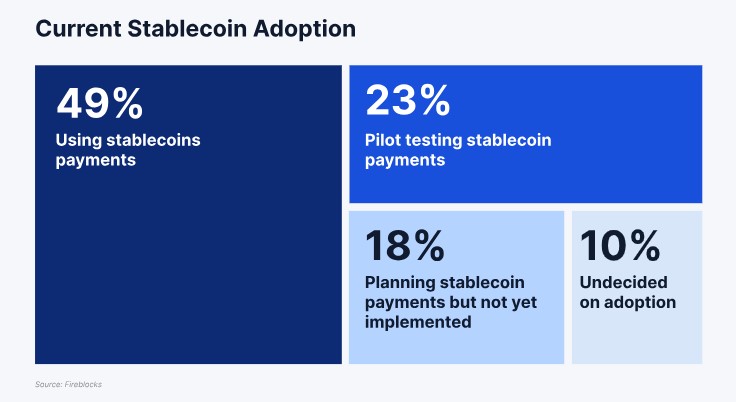
The survey, published in May 2025, questioned 295 banking, fintech executives and payment providers. Among them, 49 % already use stablecoins for paymentswhile 23 % test their integration. These figures demonstrate a very advanced adoption, especially in cross -border payments, where conventional systems are struggling to meet expectations.
According to Fireblocks, this massive adoption translates a strategic turn:
The Stablecoins race has become a question of avoiding obsolescence while customer demand accelerates and the use cases mature.
Why this crypto flip-flop? The challenges behind the massive adoption of stablecoins by banks
This turn translates a double imperative. On the one hand, Lthe banks must meet customer expectations in full change. On the other, they face the competitive pressure of fintechs and new crypto entrants. Stablecoins, being backed by Fiat currency, offer a clear advantage: their integration into existing cash systems is simplified.
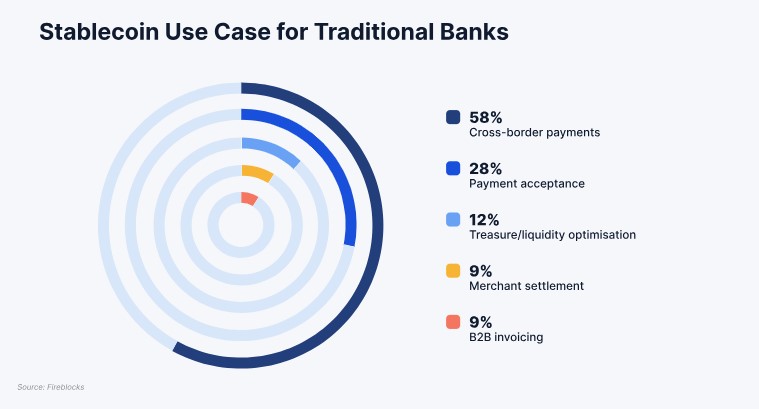
So, 58 % of banks use stablecoins To speed up international payments, a strategic functionality in a context of globalization.
Moreover, The speed of regulations is a key benefitquoted by 48 % of respondents. This efficiency is essential to capture growing volumes of B2B transactions, especially in emerging markets. Furthermore, transparency, best liquidity management and reduction in transaction costs strengthen the attractiveness of stablecoins. Ran Goldi, senior vice-president at Fireblocks, sums up this trend:
Our research shows that 90 % of companies are advancing in the implementation of stablecoins because they see them as a key growth lever.
Key figures and trends to follow in the Stablecoins Revolution
The institutional adoption of stablecoins results in impressive figures that reflect a turning point in the crypto finance. Here are some significant data from the Fireblocks report:
- 90 % of institutions have initiated a stable process, use or planning;
- 86 % claim that their infrastructure is ready to move from pilots to large -scale adoption;
- 48 % value the speed of regulations as a main advantage;
- 58 % of banks already exploit stablecoins for cross -border payments;
- 9 out of 10 consider regulation and industrial standards as adoption engines.
This dynamic reflects a strategic movement where crypto is reinventing itself at the very heart of financial services. Regions such as Latin America, Asia or Europe testify to differentiated, but convergent trajectories towards the integration of stablecoins. This phenomenon could redraw the global landscape of payments, imposing crypto as an essential pillar.
Could this change in the banks on the stablecoins be linked to the rise of the USD1 of Donald Trump and the Rusd of Ripple? These two players are now competing for shares in an increasingly competitive and regulated crypto market. Indeed, while the institutions massively embrace the stablecoins, the rivalry between these tokens symbolizes a battle to dominate the future of digital finance. Thus, this race is not only technological, but also political and economic. It could well define the next era of crypto and banks.
Maximize your Cointribne experience with our 'Read to Earn' program! For each article you read, earn points and access exclusive rewards. Sign up now and start accumulating advantages.