
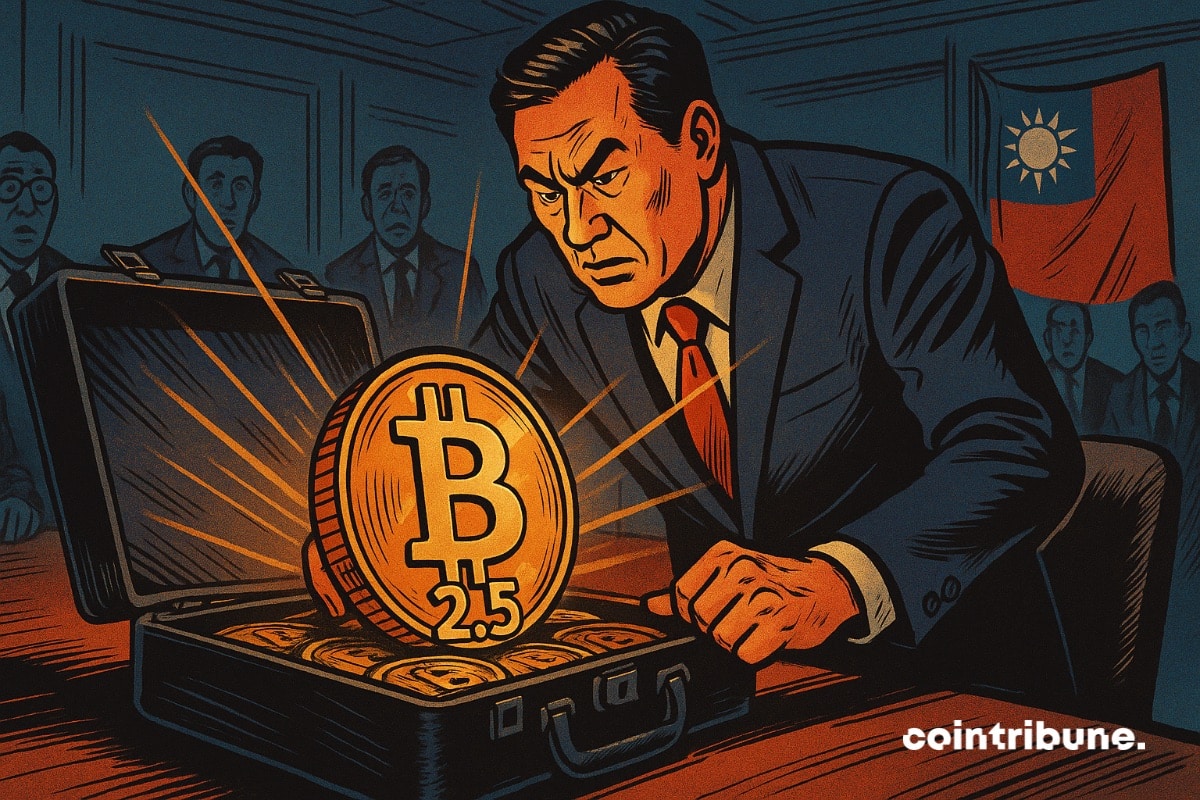
When New Hampshire has chosen to integrate Bitcoin into its reserves, the initiative has resonated little beyond its borders. But today, the echo becomes global with Taiwan who studies the same strategy, considering allocating $ 2.5 billion. A strong signal of a possible global monetary turn.

In short
- Taiwan plans to invest $ 2.5 billion in Bitcoin to diversify its national reserves.
- The objective is to strengthen its financial sovereignty in the face of geopolitical tensions and dependence on the dollar.
- This initiative is part of a global tendency to adopt Bitcoin as a strategic asset by several states.
From New Hampshire to Taiwan: same currency, different issues
The New Hampshire, a pioneer in the United States, was the first to test bitcoin as reserve assets. For this federated state, the objective was to explore monetary sovereignty at the local level. Taiwan, on the other hand, evolves in a much more complex environment. Between pressure from China and dependence on the dollar, its proposal to integrate 5 % of BTC into its reserves is a strong gesture.
This initiative is part of a redefinition of the role of national currencies, with clear geopolitical motivations. The integration of this digital asset could symbolize a desire for strategic emancipation in the face of the dominant powers.
Why Taiwan wants to secure his reserves with Bitcoin
MP Ko Ju-Chun believes that Bitcoin offers coverage against financial and monetary uncertainties. With its technical characteristics – limited offer, decentralization, portability – it could supplement a portfolio of assets made up of $ 577 billion in currencies and 423 tonnes of gold. Taiwan seeks to protect himself from a possible financial war, anticipating sanctions or gels of assets. According to Ko, the BTC could offer:
- A reserve of insensitive value to international political decisions;
- Immediate liquidity, useful in the event of shock or crisis;
- Increased independence from foreign central banks.
The challenges of a Crypto-Soveraine transition
Integrating Bitcoin into a national reserve policy involves structural challenges. Technically, robust infrastructure is necessary to secure digital assets. MP KO met Samson Mow, CEO of Jan3, to approach these aspects. On the legal level, Bitcoin remains classified as a speculative active, not as a legal currency.
Finally, politically, this choice could arouse tensions with Western allies, especially the United States, very attentive to the strategic use of crypto-active. This transition therefore requires an alignment between:
- National regulations;
- Banking system;
- Economic diplomacy.
Bitcoin: Towards a new mapping of international reserves?
Bitcoin is gaining ground as a strategic asset. If Taiwan adopts this path, she will join an emerging club of jurisdictions exploring alternative models to conventional reserves. Salvador, Russia, Iran and the Central African Republic have already taken the plunge, each according to its constraints.
For technologically advanced savings like Taiwan, the signal would be strong: monetary diversification becomes also digital. This movement could:
- Strengthen the legitimacy of bitcoin as a state reserve;
- Reconfigure geoeconomic balances;
- Accelerate the emergence of a multipolar monetary order.
Bitcoin therefore goes from the status of local experimentation with a geostrategic issue. Taiwan, in search of monetary autonomy, could open the way to a new era of digital reserves. This movement begins a switch where states rethink their economic security by integrating decentralized assets like the BTC, as a lever of sovereignty.
Maximize your Cointribne experience with our 'Read to Earn' program! For each article you read, earn points and access exclusive rewards. Sign up now and start accumulating advantages.


