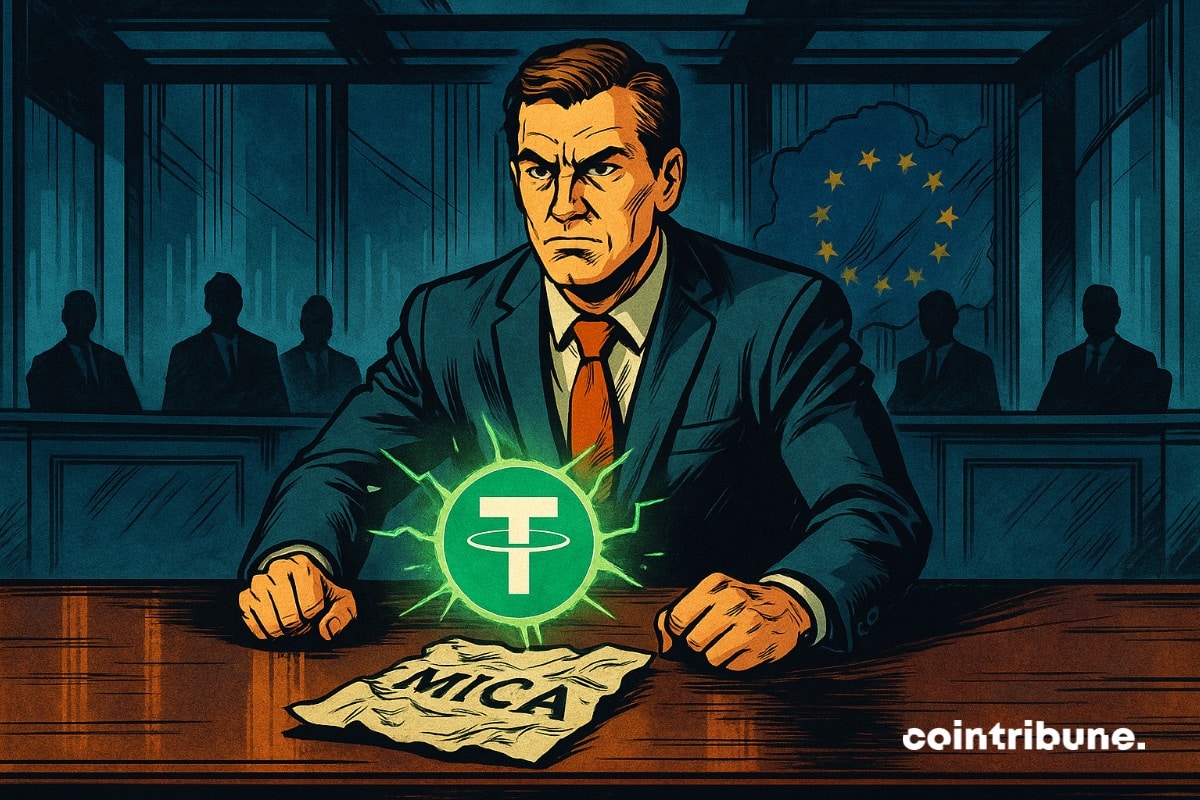
Tether throws a pavement in the European regulatory pond: his CEO categorically refuses to submit the USDT to the Mica frame. A decision that could upset the Stablecoins market in Europe, weakening crypto exchanges, and highlighting a frontal opposition between global regulation and innovation.

In short
- The CEO of Tether rejects the registration of the USDT under European Mica regulations.
- The CEO of Tethe judges the requirements of mica dangerous for banks and contrary to financial freedom.
- The EU sees the USDT as a threat to its monetary sovereignty against the dollar.
- Several platforms remove the USDT in Europe, redistributing cards on the Stablecoins market.
A regulatory framework that is too restrictive to Tether
In a daring gesture, the CEO of Tether, Paolo Ardoino, confirmed that the company will not seek to comply with the Mica regulations for its stablecoin USDT, despite the entry into force of the new crypto rules in Europe. At the Token2049 summit in Dubai, he denounced a framework ” dangerous For Stablecoins, saying that he could weaken European banks.
According to TETHER leader, the requirements of the mica – such as the obligation to place 60 % of the reserves of stablecoins in bank deposits assured in the EU – would pose major risks for the European banking system. “” I have to protect our 400 million users worldwide, not just Europeans “, he said. He accuses the European Central Bank of using mica as a lever to promote the digital euro and restrict the financial freedom of citizens.
Towards marginalization in Europe?
Europe fears the growing influence of Tether, because behind its stablecoin hides a geopolitical threat: it is backed by the US dollar, consolidating the domination of the greenback at the very heart of the euro zone. By letting the USDT circulate freely, Brussels fears a loss of monetary sovereignty, increased dependence in the United States, and a weakening of the digital euro project.
Mica then becomes a regulatory bulwark to limit the expansion of an asset considered as a financial influence weapon. Crypto platforms like Kraken and Binance reacted by removing several stablecoins, including the USDT, to remain in accordance with this regulation. This could slow down the use of Tether, the most capitalized stablecoin in the world in Europe, forcing the actors to turn to other regulated crypto such as Bitcoin or Ethereum.
Tether's refusal to adopt Mica illustrates the showdown between European regulation and the giants of the crypto. This decision could upset the balance of stablecoins in the EU, accentuate the regulatory fracture and push the platforms to review their strategy in the face of a market in full reconfiguration.
Maximize your Cointribne experience with our 'Read to Earn' program! For each article you read, earn points and access exclusive rewards. Sign up now and start accumulating advantages.