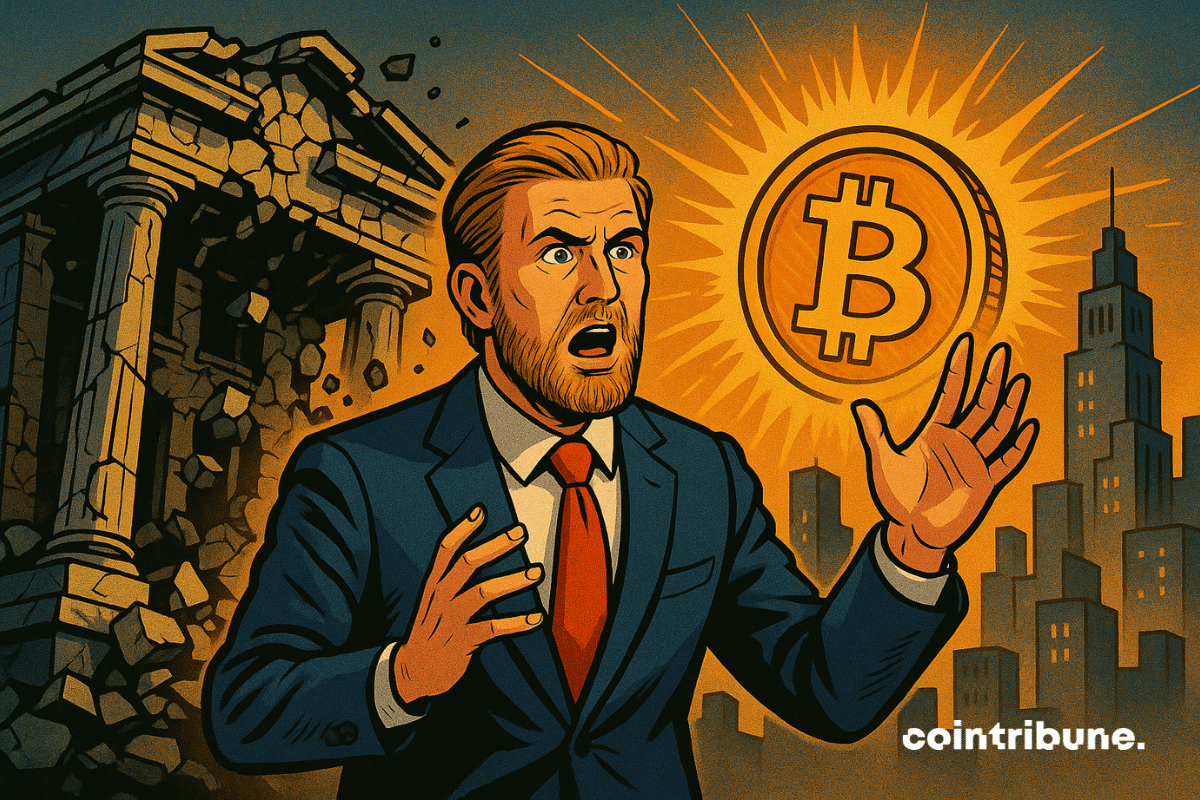
What if banks, centuries -old pillars of world finance, lived their last years? It is not the alert of a crypto maximalist, but that of Eric Trump. From the Tribune de la Liberty University, the businessman has warned: without rapid adoption of cryptos and blockchain, banks could disappear in a decade. Thus, in a context where decentralized finance gains ground, this position reveals the faults of a frozen system in the face of an acceleration technology.
In short
- Eric Trump, son of the American president, warns that banks could disappear within ten years without turn to cryptos.
- During a speech at Liberty University, he denounced the technological delay of banks in the face of the rise of blockchain and decentralized finance.
- According to him, the young generations reject traditional banking institutions in favor of faster and transparent crypto solutions.
- Eric Trump's declaration challenges the future of the banking system, crypto regulation and the evolution of the global financial landscape.
A public warning: banks on the hot seat
It was during a speech delivered to the Liberty University, an emblematic event for the American conservatives, that Eric Trump launched a strong signal with regard to the traditional banking sector.
Faced with a hearing acquired to his ideas, he did not minced His words:
Traditional banks could be extinguished within ten years if they do not adopt the crypto.
This impactful declaration, made without detour, is part of a criticism of the technological delay taken by banks in an accelerated changing world.
Eric Trump's intervention is based on a qualitative and ideological analysis, more than encrypted financial data. However, several elements clearly emerge from his speech:
- Banks, according to him, are lagging behind: they are slow to understand and integrate the fundamental innovations that blockchain and cryptos represent;
- The rise in decentralized finance (DEFI) is seen as a credible alternative, which seduces an increasingly wide audience, especially among young people;
- He considers that the transition is inevitable: either the banks adapt and integrate these technologies, or they will disappear;
- Speech is also addressed to a political audience: Eric Trump is inserted into anti-etablishment rhetoric which finds an echo in generalized mistrust towards major financial institutions.
Eric Trump does not offer a precise roadmap for banks or technical solution, but he alerts a strategic necessity: integrate web3 tools, at the risk of becoming obsolete. The strength of his message is mainly based on generational and political intuition, more than a detailed economic argument.
A political and generational vision of change
Beyond the alert launched to banks, Eric Trump presented blockchain and cryptos as an essential lever for the future, because he highlights their growing adoption by the young generations. He suggested that these tools are not only a technological fashion, but a cultural and financial revolution that could redefine the global economic landscape.
“Young people no longer want banks as we know them”he said. He points to a paradigm shift in the way in which the new generation designs the management of his assets, his confidence and his financial sovereignty.
It should be noted that Eric Trump's speech is not based on precise economic data or projections, but on a socio-political reading of the moment: that of a connected youth, disillusioned by banking institutions, and more comfortable with the idea of smart contracts and decentralized portfolios than traditional counters.
This posture is aligned with the increasingly visible strategy of part of the American conservative camp, which appropriates technological tools to reaffirm a form of independence vis-à-vis large institutions perceived as corrupt or ineffective.
Such an intervention testifies to a major ideological tilting: the crypto is no longer just the business of geeks or monetary anarchists. It becomes a leading political subject, mobilized in the discourse of influential public figures. If this dynamic continues, it could reshape financial regulation, but also the electoral alliances and future economic policies. It remains to be seen whether this breakdown of rupture will result in the years to come, by concrete measures or if it will remain a mobilizing rhetoric. In any case, the pressure is now public, frontal and difficult to ignore for banking institutions.
Maximize your Cointribne experience with our 'Read to Earn' program! For each article you read, earn points and access exclusive rewards. Sign up now and start accumulating advantages.