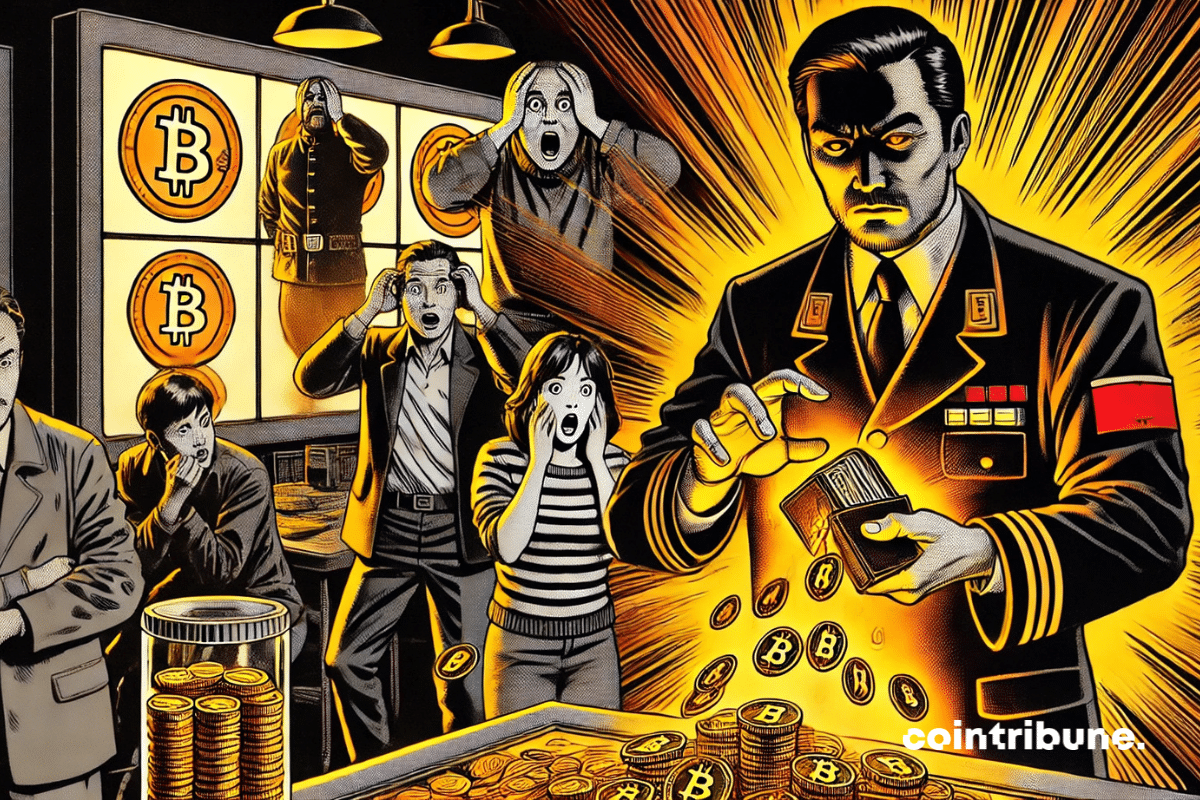
While Beijing maintains a strict prohibition on cryptocurrencies, a paradoxical reality emerges: local governments discreetly sell digital assets seized, feeding their public funds. Between opacity and financial emergency, this practice reveals the cracks of a system torn between repression and economic pragmatism. An imbroglio which relaunches the debate on the legal supervision of these assets, in a geopolitical context where China observes with distrust of cryptocurrency advances.
China bypassing its own laws to sell its entered cryptos
Under the radar of national regulations, local Chinese communities have found an escape: entrust to private companies the sale of entered cryptos.
Jiafenxiang, a company based in Shenzhen, would have converted for more than 3 billion yuan into liquidity since 2018. These transactions, carried out via offshore platforms, bypass the prohibition while irrigating local budgets. A logic of financial survival, while the economic slowdown weighs heavily.
“This practice is a legal rustine”underlines Chen Shi, professor at Zhongnan University. In the absence of a clear framework, each region improvises. Some sell via foreign crypto exchanges, others store while waiting for hypothetical legalization.
This disparity nourishes the risks of corruption and arbitrariness, while offering offenders a reason for contestation. “The state prohibits trading, but uses it within the underwentity”, quips Guo Zhihaospecialized lawyer.
The recipes, converted into yuan via local banks, land directly in public funds. In Hua'an or Xuzhou, these liquidity made it possible to compensate for increasing deficits. A lucrative mechanism: According to River, local governments would have 15,000 bitcoins ($ 1.4 billion), making China a leading crypto-clandestine actor.
If these sales relieve in the short term, they also expose Beijing to a strategic dilemma: how to control a market that the State feeds in spite of itself?
China debates rules for managing cryptocurrencies seized
The explosion of crimes linked to cryptos – fraud, whitening, illegal games – paradoxically doped local finances.
In 2023, the sums involved reached 430.7 billion yuan, according to Safeis. The fines and confiscations followed, generating 378 billion yuan of income, or +65 % in five years. “These assets have become a budgetary pillar in certain cities”confirms Liu Honglin, lawyer advising communities.
Faced with the emergency, judges and experts plead for a unified framework. During seminars, proposals emerge: legal recognition of cryptos as active, sale centralized by the central bank or creation of a strategic reserve, like Trump's projects. “Centralized management would maximize their value”argue winston ma, ex-frame of China Investment Corp. Hong Kong, where trading is legal, could serve as hub, according to Ru Haiyang de Hashkey.
Behind these debates is looming a Sino-American rivalry. While Trump relies on deregulation and Bitcoin reserves, Beijing hesitates between repression and opportunistic exploitation. “China cannot ignore the geoeconomic value of cryptos”, Sun Jun analysis, lawyer in Shanghai. A silent race is committed: to control these assets without legitimizing their use, in a fragile balance between sovereignty and realpolitik.
Maximize your Cointribne experience with our 'Read to Earn' program! For each article you read, earn points and access exclusive rewards. Sign up now and start accumulating advantages.