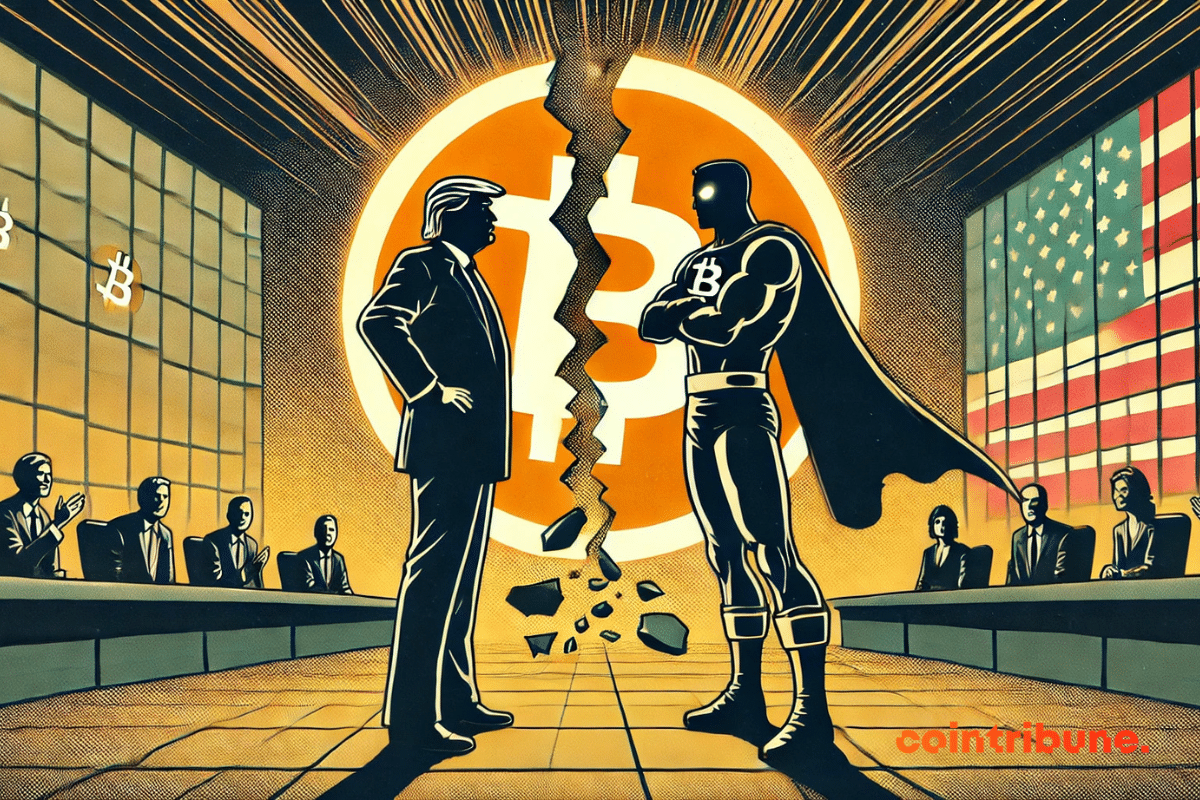
On April 14, Donald Trump received the Salvadoral President Nayib Bukele at the White House to discuss immigration, security and trade between the two nations. A meeting which, if it was marked by concrete discussions on thorny subjects, ignores a question however dear to the two leaders: Bitcoin. The moment, however, seemed ideal to approach this crypto, but, strangely, it was not mentioned. A deliberate choice or simply a timing that was not lent there?
The axis of the Trump-Bukele meeting: immigration, security, and trade
During this meeting, it's good bilateral security and immigration who took over. The United States and El Salvador have a close relationship on these subjects. Trump, still concerned about the Fight against illegal immigrationproposed to send American criminals to the Salvadoral prisons, in an effort to lighten the prison system of the United States while strengthening collaboration between the two countries.
It's a part of the famous $ 6 million agreement signed between the two nations, which provides for Deportation of foreign criminals to Salvador.
With this in mind, Trump also suggestedenlarge the prisons in Salvador to welcome even more deportees.
In parallel, he addressed the question of trade, by evoking the trade war with China. Trump proposed A temporary exemption for American car manufacturers In order to help them relocate their production. A pragmatic and immediately relevant angle, while the automotive industry is still looking for its marks after disruptions in world supply chains.
I like the people of Salvador and they have a hell of a president.
So it was a meeting marked by Serious discussions on internal policy and international trade issuesfar from the crypto scene. And if Bitcoin had been put aside, it was probably because the immediate security and diplomacy issues won.
Bitcoin put in standby: an absence of choice?
However, this meeting takes place in a context where Bitcoin occupies a central place in the agendas of the two leaders. Salvador was the first country to adopt Bitcoin as legal currency in 2021, a daring decision piloted by Bukele. As for Trump, he also supported this idea in his own way, by signing a decree in March 2024 aimed at Create a Bitcoin Strategic Reserve in the United States. The idea was to accumulate bitcoin seized in criminal cases and to use it to constitute a national stock of cryptocurrency.
Despite these common positions on the crypto, the discussions of April 14 absolutely did not address the subject of the crypto. A strange silence, especially when you know that Trump is more and more positioned as a global anti-institutions in recent times. In fact, the two men seem to have favored more “tangible” subjects for the moment, leaving aside the debate on the regulation or adoption of Bitcoin on a global scale.
Some will see a deliberate strategy to divert the attention of questions about the crypto, or perhaps a way of Reorient the focus towards subjects deemed more “urgent” by their respective administrations. Global economic policy, especially in the period of geopolitical tensions, seems to prevail over the question of crypto, which, although revolutionary, remains an evolving subject.
The meeting between @nayibbukele and @realdonaldtrump represents a turning point in the history of Salvador.
But the absence of discussions on Bitcoin will not fail to arouseare questions in the coming months.
The main lines of the Trump-Bukele meeting:
- Immigration : Discussion on deportations, with a plan to send American criminals to Salvador;
- Security : Proposal to expand prisons in Salvador to accommodate more foreign prisoners;
- Trade : Temporary exemption for American car manufacturers in the face of the trade war with China;
- Bilateral relations : Strengthening security and economic links between the United States and Salvador;
- Absence of bitcoin : Despite their support for the crypto, no subject on Bitcoin was discussed during the meeting.
Salvador in compromise with the IMF: dotted bitcoin
While Bitcoin remained on the sidelines, another major subject linked to Salvador came to slip into the background: his Agreement with the IMF. In December 2022, the country signed a loan of $ 1.4 billion with the International Monetary Fund. An agreement which included strict conditions, in particular the need to review its Bitcoin policy and reduce the involvement of the public sector in cryptocurrencies.
This decision marked a turning point for the Salvadoral government, which had hitherto been Bitcoin a centerpiece of its economic strategy.
Although the legislators had to modify the BTC laws to comply with this agreement with the IMF, the country continues to continue its daily Bitcoins purchases. To date, Salvador holds around 6,000 BTCwhose value amounts to around $ 520 million.
Bukele therefore had to juggle his ambitions for the crypto and the imperatives of the IMF, which paved the way for compromises necessary to maintain the economic stability of the country.
Trump, for his part, could ignore this international pressure. It has always been a virulent critic of global institutions such as the IMF or the World Bank, and its priorities seem to be more turned towards national solutions, such as the relocation of automotive production.
This anti-institutional posture could also partly explain why it did not address the question of bitcoin during his meeting with Bukele.
In the end, this meeting was not marked by discussions on Bitcoin, but rather by immediate geopolitical challenges. Security, immigration and trade have overshadowed the crypto, although the latter remains an essential subject for Trump and Bukele. The future of BTC in relations between the two countries could take shape according to future economic and political developments.
Maximize your Cointribne experience with our 'Read to Earn' program! For each article you read, earn points and access exclusive rewards. Sign up now and start accumulating advantages.