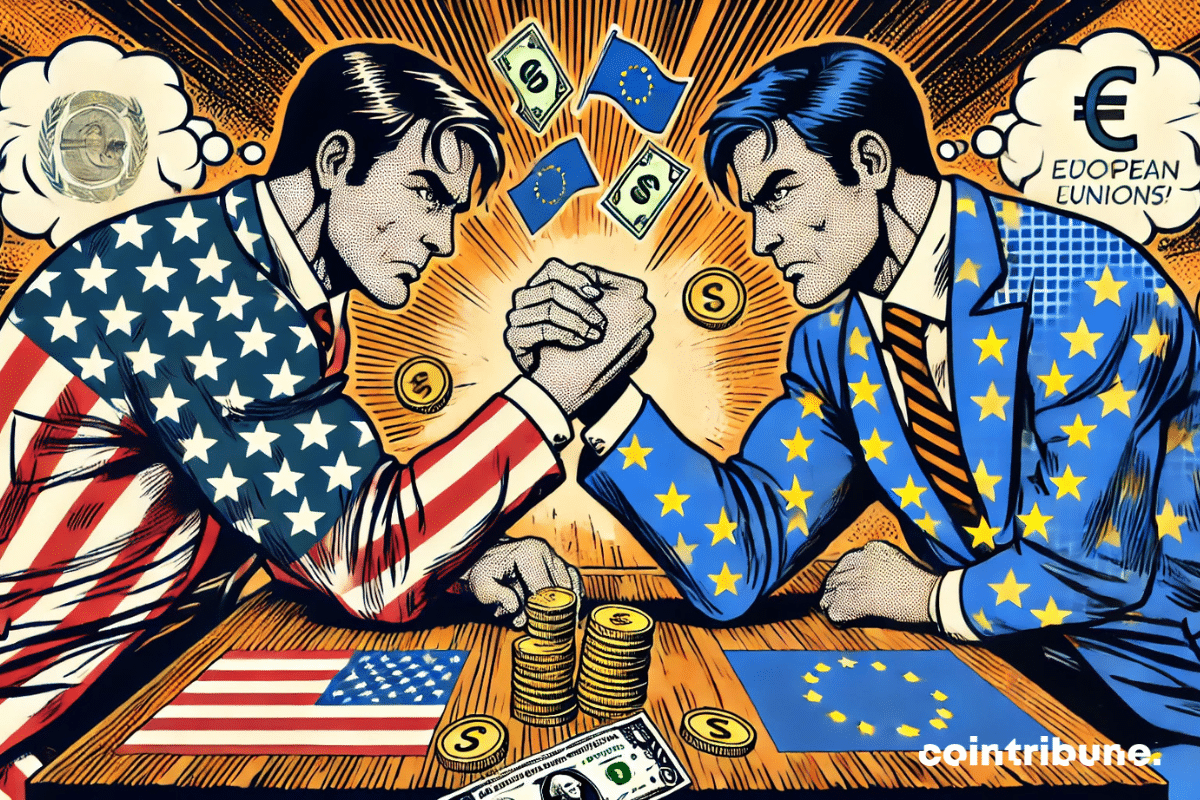
Trade tensions between the United States and its main partners are surfaced, and revive the spectrum of a new economic war. Washington has announced an increase in customs duties aimed at Canada, Mexico and China. This decision marks the return of protectionism dear to Donald Trump. The price offensive immediately sparked reactions to the four corners of the world, especially in Europe, where the European Commission is monitoring the situation carefully. If the European Union is not yet directly affected, Brussels fears an enlargement of American measures and warns that it will not remain passive. The Commission has already expressed its firm disagreement with this policy and says it is ready to adopt retaliatory measures to protect the economic interests of the continent. Faced with this new commercial offensive of the United States, the risk of climbing between the two blocks cannot be ruled out.
Washington relaunches trade war: Europe on alert
The American administration has decided to increase customs duties on several products imported from Canada, Mexico and China, and thus reaffirms the protectionist policy defended by Donald Trump. This decision is part of a strategy that aims to strengthen the competitiveness of American companies in the face of what Washington considers unfair competition.
Although the European Union is not yet directly affected, Brussels remains on alert and closely monitors the evolution of the situation. With the fear of expanding European export restrictions, the Commission immediately reacted and denounces these new commercial barriers. In a press release, it affirm “Regret these new commercial restrictions and be ready to ride firmly if European interests were targeted”.
This position contrasts with the usual prudence of the EU in its trade relations with Washington. From now on, Brussels no longer excludes targeted retaliatory measures to protect companies on the continent. If the United States decided to extend its customs duties to Europe, an escalation of trade tensions between the two powers would become inevitable.
Towards a new economic confrontation between Washington and Brussels?
So far cautious, the European Union intensifies its consultations to anticipate a possible hardening of trade with the United States. In Brussels, the European Commission already examines several riposte scenarios in order to protect the economic interests of the continent. Among the options envisaged, an increase in customs duties on certain American products is at the top of the list. Industry and agriculture could be the first targeted sectors, including American exports of manufactured and agrifood products, of which Europe still partially depends.
In this context, European companies remain alert. An escalation of trade tensions would not be limited only to political decisions. Its effects would be felt in strategic sectors such as automotive, food and high technology. A hardening of American measures in response to possible European sanctions would further weaken transatlantic trade, with direct repercussions on supply chains and consumer prices.
Some economists fear a domino effect, where each retaliatory measure would lead to an escalation, which would accentuate economic uncertainty. If the EU decided to hit certain sensitive sectors for Washington, the White House could replicate with new restrictions, which would extend the instability of commercial relations. In a context where the global economy is struggling to regain its balance, a tariff war between the two blocks would be a negative signal for investors and the financial markets. It remains to be seen whether a diplomatic dialogue will avoid a new showdown, or if Brussels and Washington are heading for an extended commercial reprisals.
The global economic climate remains fragile, and a trade war between the European Union and the United States would further accentuate the uncertainties on the markets. An escalation of tensions would affect growth on both sides of the Atlantic, with direct repercussions on trade and investments. The outcome of this crisis now depends on the choices of Washington. Thus, will the White House seek to include Europe in its protectionist policy, or will it prefer to favor the diplomatic path to avoid a new economic showdown? The current negotiations will be decisive for the future of transatlantic relations.
Maximize your Cointribne experience with our 'Read to Earn' program! For each article you read, earn points and access exclusive rewards. Sign up now and start accumulating advantages.