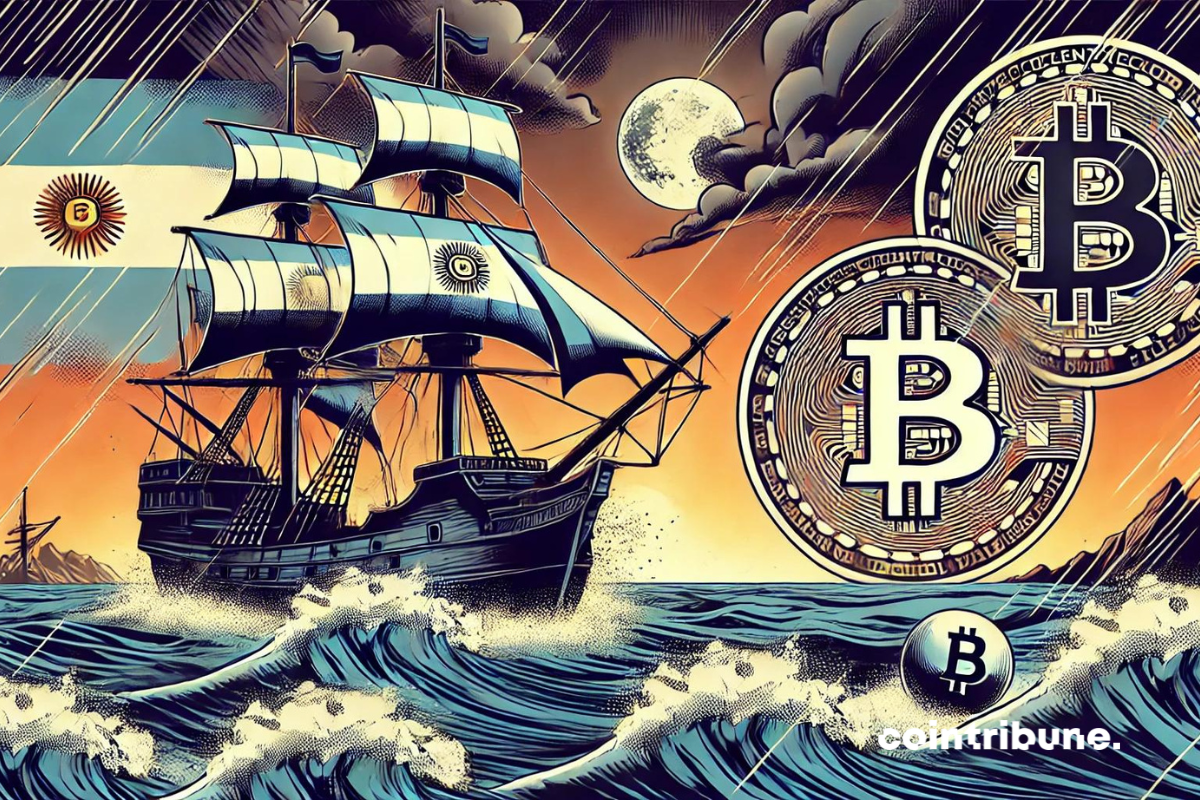
Argentina is at a crossroads. Is libertarian President Javier Milei about to make a crazy bet on bitcoin to save his country from inflation, or will he bow to Washington and embrace the dollar?
Argentina used to be rich
At the beginning of the 20th century, theArgentina was one of the richest countries in the world. Equipped withabundant natural resourcesits economy was experiencing a average annual growth of 6 to 7%driven by exports of wheat, flour, meat and corn.
In the 1910s, the Argentina's GDP per capita exceeded that of France and Germanyreaching 80% of that of the United States at its peakThe choice between emigrating to the United States or Argentina was then difficult for many Europeans.
However, over the next century, the economic fortunes of the two countries took radically different paths. While the United States became the world's leading economic superpower, Argentina's wealth has gradually dissipated.
What are the causes of this decline in Argentina?
The causes of this decline are complex, but they can be summed up in two words: bad political decisions and corruption.
The country has gone through repeated cycles of economic and political upheaval, including several military coupsof the economic depressions caused by socialist policies and episodes ofhyperinflationThese events have prevented Argentina from fulfilling the promise that once attracted foreigners to its shores.
Again and again the printing press!
The printing of money also played a crucial role in Argentina's decline.. This phenomenon has never been more evident than in the 1980s.
At the beginning of this decade, Argentina faced a debt crisisaggravated by the fall in raw material prices. Since the Argentine economy is heavily dependent on exports, Economic growth stagnated and financial markets collapsed.
Faced with falling tax revenues, the Argentine government has succumbed to the temptation to turn to its central bank to finance its deficit by the printing press. This practice culminated in Argentine hyperinflation of the 1980swhere inflation has reached almost 5000% in 1989. Average annual inflation rates have exceeded 100% in the 1970s and 1980s.
While a few decades earlier Argentines enjoyed a respectable standard of living, by the end of the 1980s it was estimated that 2 to 9 million people in Buenos Aires depended on soup kitchens to feed themselves.
This disastrous hyperinflation led to drastic changes in Argentine policies. The country has adopted the economic measures promoted by the IMFknown as ” Washington Consensus“. These measures included the privatization of public enterprises, budgetary austeritythere removal of trade restrictions and theopening of the economy to foreign investment.
The dollar peg
Argentina went even further to prevent his government from printing money. In 1991, the convertibility law was adopted, creating a currency board in charge of fix the exchange rate at 1 Argentine peso to 1 US dollarThe measure put handcuffs on the government, forcing it to keep the number of pesos in circulation backed by an equal amount of dollars in its reserves.
This eliminated the central bank's ability to finance the public deficit that had caused the inflationary spiral. This policy has therefore succeeded in stopping inflation.
Argentina then experienced a significant growth in the 1990swith inflation being pushed into the background. The country became the darling of emerging markets and an example to the IMF of what could happen if a country adopted its Washington Consensus reforms.
However, although the monetary peg with the dollar helped eliminate inflation and ensure economic stability in the 1990s, it did not end the government budgetary profligacy. Instead, it has led to a fast-growing but fragile economy, susceptible to crisis in the event of an economic downturn.
The fixed exchange rate regime had other disadvantages. Argentina had to give up its autonomy in monetary policy to stabilize its local currency.
From one crisis to another
When the Asian monetary and Russian financial crises occurred in 1997 and 1998 respectively, causing a contagion effect throughout the world, Argentina found itself in a extremely vulnerable position.
The country was riddled with debt, its growth was slowing rapidly and it could not control its own exchange rate.
This situation has led to a economic, banking and political crisis in its own right, culminating in the IMF refusal to disburse funds for the nation. Finally, Argentina has abandoned the monetary anchor, frozen bank deposits And defaults on its external debt of 141 billion dollars.
At the time, it was the biggest sovereign default in history!
From bank runs to freezing of accounts
After the dollar peg was abandoned, the peso went into free fall, depreciating 50% in a few days. To end the bank run, the government has issued a new law limiting Argentines' withdrawals to a maximum of $300 per week.
This freeze on bank deposits has been dubbed ” Corralito“, which means “children's park” in Spanish, because Argentines felt that the government was treating them like children by not allowing them to access their own money.
At the same time, the government began to exchange all US dollars in Argentine bank accounts for pesos. This monetary conversion resulted in a loss of about 75% of Argentine savings, just two months after the abandonment of the anchor…
The problem of inflation in Argentina
L'Argentina in 2023 is a mirror of 1989. Since the Argentine economic crisis of 2001, the country does not seem to have learned from its past mistakes. Coming out of the deep recession, Argentina has experienced a political instability and the poor budget management has only continued.
Over the past decade, the government has consistently recordedhuge budget deficits financed by its central bank. Today, the public spending represents more than 30% of GDP Argentina, a threshold that has historically preceded hyperinflationary episodes.
As a result of this spending, Argentina has seen its growth increase, but also its inflation. Inflation in Argentina has now reached its highest levels since 1991.
Faced with this inflation, the government has taken several measures. It has emptied its central bank reserves to try to support the pesocarried out a brutal devaluation of 18% in August 2023 and maintained strict capital controls.
It is not surprising that Argentines are increasingly withdrawing their dollars from Argentina to store them abroad. After all, many have seen how this story ends and do not want to find themselves frozen out of their bank deposits again if things get worse.
The debt problem
Inflation is only part of the problem. Argentina also faces a mountain of debt due to many years of poor fiscal policy. The country received the largest loan in IMF history in 2018in the amount of $57 billion, only to default just two years later in 2020.
This was the ninth sovereign default in its history.
Since then, the IMF has again bailed out Argentina with another loan of $45 billion. Today, Argentina is by far the IMF's largest debtor.
This is the context in which Argentina finds itself today: a triple-digit inflationA debt/GDP ratio of around 90% And one in four Argentines living in poverty!
Javier Milei, is he the Messiah of Argentina?
All this led to the election of President Javier Mileiwhose campaign promised to end fiscal profligacy, close the central bank and of dollarize the economy.
But as we have seen in history, this may not be a miracle solution for Argentina.
Although Milei wants to profoundly transform Argentina, he inherits a chaotic economy. That is why one of the first things Milei has done since taking office is to meet the IMF to discuss the conditions of refinancing Argentina's debt, avoiding a new default and a possible hyperinflationary event.
Javier Milei and bitcoin, an impossible marriage?
President Milei has spoken publicly in a positive manner about the bitcoinwhich has led many to label him as a pro-Bitcoin candidate, but it will likely be very difficult for him to openly support BTC as president. because of his country's dependence on the IMF.
Generally, governments tend to put in place Tighter capital controls to combat inflation. They do it for prevent their citizens from getting rid of the depreciating local currency, which would worsen the inflationary crisis.
If Milei decides to tackle alternative forms of currency like bitcoin to protect the falling peso, he would likely be doing his people a disservice…
Argentina already occupies the Ranks 15th worldwide in terms of cryptocurrency adoption. BTC offers a way for Argentines to protect themselves against a government that has mismanaged its economy for decades. In addition to being an inflation-resistant currency, bitcoin also allows individuals to hold their wealth outside the banking system. This will most likely resonate with Argentines, given the fresh memory of their bank accounts being frozen.
Milei's Argentina leans towards dollarization
President Milei wants to push for the dollarization to resolve the economic crisis in which his country is currently immersed, but history shows us that It's not a miracle solution.
Dollarization can help lower inflation, but it will not solve the debt problem or the continuation of bad policy decisions. Furthermore, in this process of dollarization, Milei would be giving up his country's monetary sovereignty to a foreign country.
What he should consider is adopting a currency that is not controlled by anyone, that cannot be inflated and that can allow his people to save and build their future.
Nayib Bukele of El Salvador has shown what can happen to a country when it embraces bitcoin. Since BTC became legal tender, El Salvador has experienced one of the highest growth rates in Latin America and repays debts rather than accumulating more.
While pro-bitcoin legislation in Argentina is likely a far-fetched dream at this point, a more reasonable hope is that President Milei doesn’t actively prevent bitcoin adoption within his borders as he attempts to right the Argentine ship. He has an uphill battle ahead of him. But if he can embrace a new monetary technology, perhaps Argentina will start to resemble the prosperous nation it once was.
Maximize your Tremplin.io experience with our 'Read to Earn' program! For every article you read, earn points and access exclusive rewards. Sign up now and start earning benefits.