

Over the last 20 years, inflation in the euro zone has reached more than 52%. That is to say that the purchasing power of a euro in 2003 was on average twice as high as that of a euro in 2023. A figure that is all the more considerable as the euro has lost its dynamism on the foreign exchange market against the dollar or the Swiss franc. But despite the stability of certain currencies, inflation remains a constant and persistent rule in economic history. The return of inflationary cycles reminds us that inflation can go out of control at any time. If the purchasing power of households is affected, holding assets often protects against this impoverishment.
Inflation: a poison for savings?
Inflation affects the population in two ways. On the one hand, inflation reduces purchasing power, that is to say the quantity (and/or quality) of goods and services that can be purchased. This effect concerns the entire population, and in particular those for whom savings capacities are the lowest. In 2017, the poorest 10% of French people had a savings rate of 2.7%. Conversely, the richest 10% of French people had a savings rate of more than 28%. It is therefore obvious that inflation first hits those who have little or no savings.
However, inflation also hits savings. The purchasing power of savings of €10,000 in 2003 would be equivalent to the purchasing power ofa savings of €20,000 today. Inflation therefore confiscates the purchasing power of savings that are not invested. On average, each French person (all age and income categories combined in 2021) has nearly €90,000 in savings in various means. The distribution of savings generally corresponds to the table opposite.
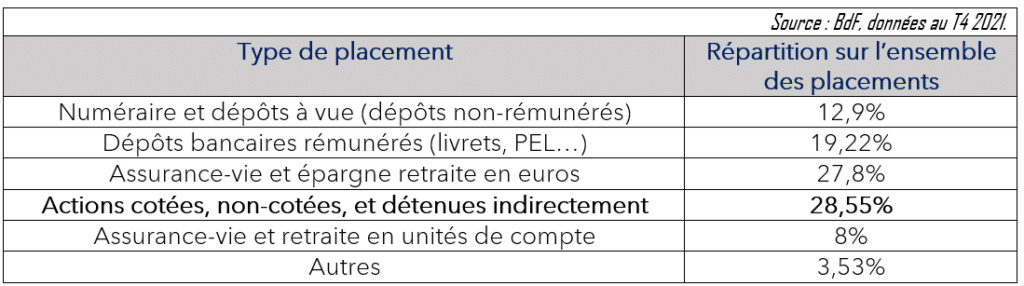
The dominant investments among the French are shares, life insurance and retirement savings, and savings accounts. Despite everything, the choice of savings in each household has great differences depending on income, field of activity, etc. Consequently, if saving a lot limits the loss of purchasing power, the risk of devaluation savings is real.
Bonds, shares, booklets…?
The best lesson in economics is often that of the past. Indeed, we observe great regularity in the behavior of different assets over the long term. Among the specialists who have studied the question, Jeremy Siegel is author of the book Stocks for the Long Run. It compiled the evolution of the main assets since 1800.
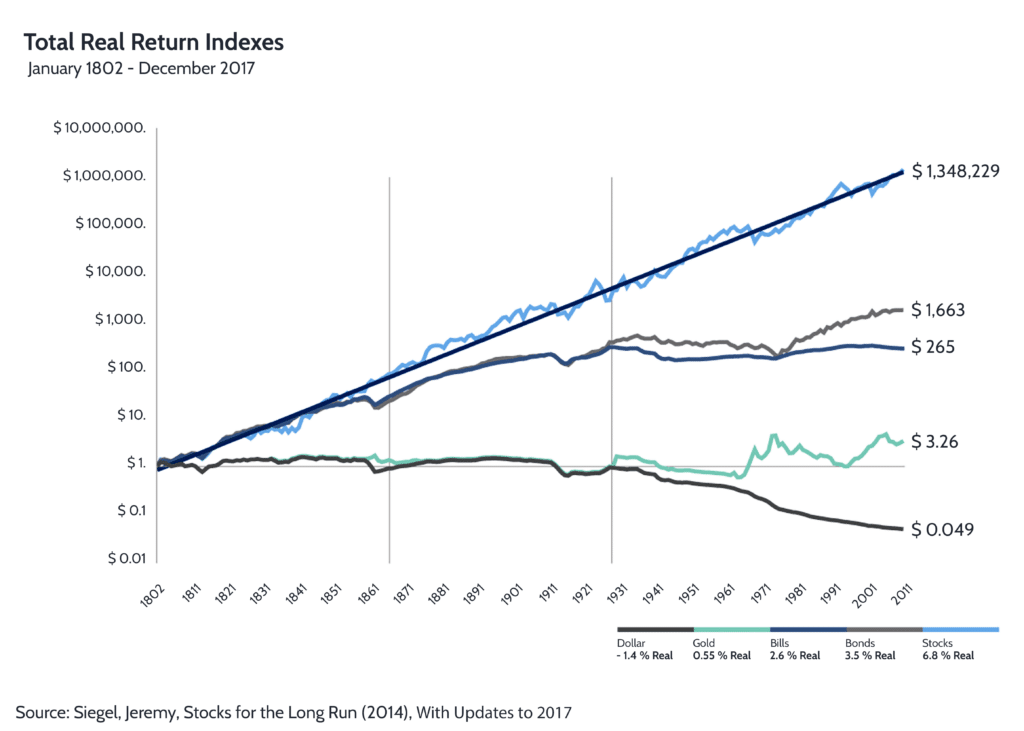
Since 1800, the following conclusions have emerged:
- Holding cash is one of the worst options for long-term savings. Inflation in the 1970s significantly reduced the purchasing power of money.
- Gold allows you to maintain your purchasing power, and sometimes even to make it grow slightly.
- Bonds generally protect against inflation. But since the 1930s, and even more so over the last 10 years, bonds seem less attractive.
- However, in general, shares allow you to greatly increase your savings. Inflation has little or no impact on the long-term trajectory of stocks.
- The case of real estate could also have been addressed, because it presents a profile quite similar to that of stocks.
But since the 2010s, the remuneration of bonds or passbooks has presented a clear disadvantage in the face of inflation (with sometimes negative returns!). Some bond rates are becoming more attractive again with the recent rise in rates, but in general, rate products have underperformed against inflation in recent years. It is therefore important to compare any investment with the rate of inflation, because otherwise, it will be detrimental in the long term for everyone’s savings.
Furthermore, it is important to point out that a higher return often goes hand in hand with higher risk. That is to say, seeking to protect your portfolio against inflation (shares, certain bonds, gold, etc.) often generates greater instability in your portfolio. What not all savers are ready to assume.
Deflations are rare!
Deflations (price drops) exist throughout economic history. However, they are very rare. In the case of deflation, all relationships are reversed. Companies with debt are often penalized, and stock performance can be reduced. Likewise, cash takes “naturally” value, as well as interest rate products.
Deflations are often caused by periods of economic depression. Economic activity is at half mast, demand is blocked, prices are falling. The chart below shows that the last two years of declining prices in the United States were 2009 (recession) and the mid-1950s. Inflation is therefore the normal regime of the economy in the broad sense (inflation raged under ancient Rome, and well before…).
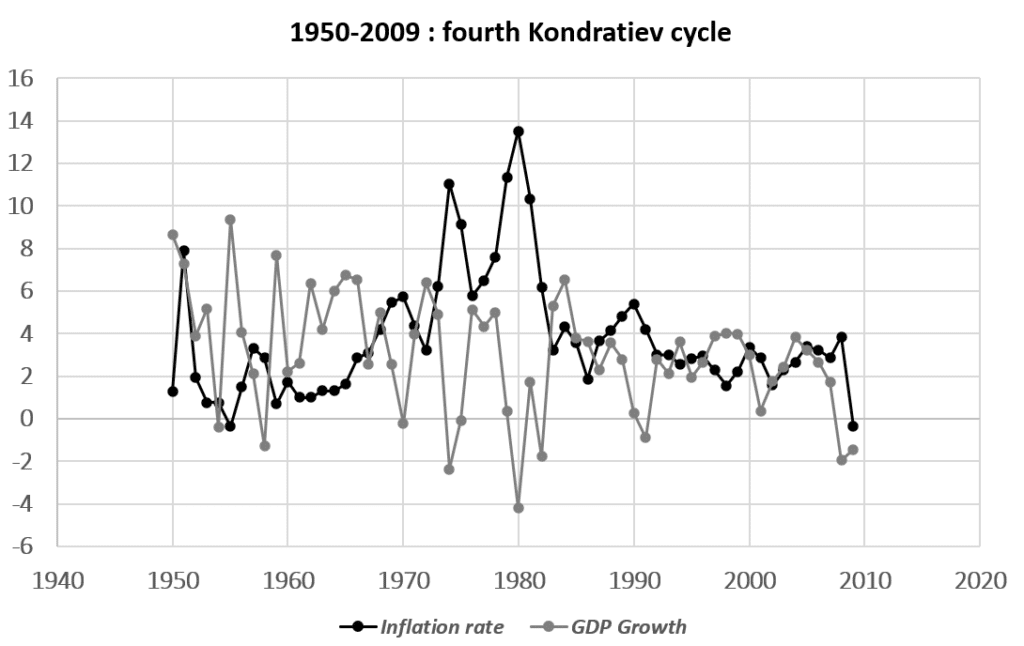
Furthermore, the rate of inflation may vary. Inflation often remains moderate, between 1% and 3%. But it happens that it deviates sharply from this trend for several years. It’s the inflationary crisis. This is often the result of shortages, wars, and generally monetary excesses. It is notable that the rate of inflation evolves according to long cycles, also known as Kondratiev cycles.
In any case, this shows us that inflation remains the main threat to purchasing power and savings. It is therefore absurd to start from the idea that accumulated savings are secure or immobile; they are not, whatever the medium. Obviously, the rise in prices is often accompanied by an increase in wages, business results, or public revenues (without which inflation would not be sustained). But inflation remains a threat for those keen to build savings.
Savings: a generational affair?
The reasons for saving are diverse: to have liquidity (to carry out transactions), to prepare a project, or simply to take precautions, or to grow one’s assets. It is clear that a major element of savings remains liquidity and projects. In this case, agents keep their savings for a few months or a few years, but the effect of the devaluation remains significant in an environment of high inflation.
It is also interesting to note that savings capacities are linked to generational cycles. In any case, this is the point of certain academics. In 2002, three academics showed the close link between stock market cycles and demographic cycles. The main explanation would be to find savings and consumption capacities, which influence the interest rate and the valuation of stock markets.
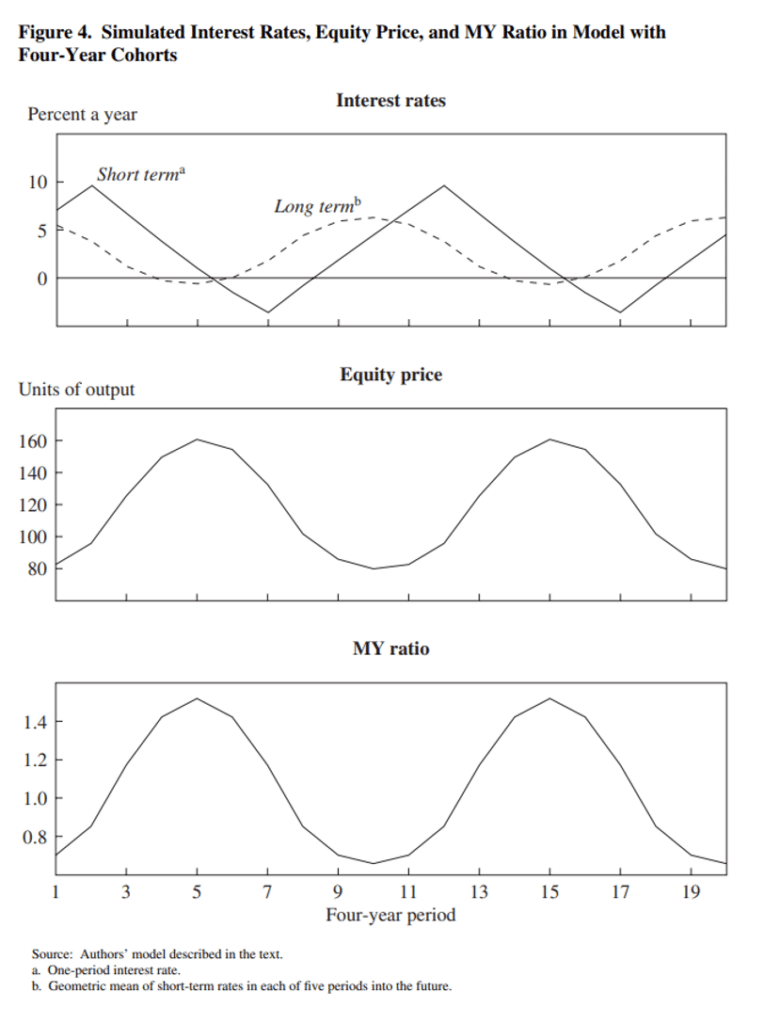
The fundamental hypothesis is based on the idea that the young working population (20-34 years old) saves less and consumes more than the older working population (35-49 years old). In the case where the working population is predominantly elderly (35-49 years old), or more precisely in progression, savings capacities increase and consumption needs are less significant. This first has the effect of reducing the interest rate, and increasing the valuation of the shares (the P/E ratio).
The ratio which relates the older working population to the younger working population is called MY ratio. We generally see a good correlation between the MY ratio and the valuation of stock markets in general. This has some saying that the current bull market could last “ until 2035“ . This approach demonstrates the fact that savings do not benefit equally from different investments depending on the generation to which one belongs. The simple fact of belonging to a proportionally larger generation therefore partly offers a predisposition, perhaps greater, to the conservation of savings.
Savings doomed?
Ultimately, we have seen that inflation is a constant rule of the economy. Deflations, that is, price drops, are rare in history. Therefore, a few decades can be enough to almost completely devalue the value of a savings. Faced with this, history teaches us valuable facts. Keeping your savings in foreign currency is often a bad decision in the long term. But alternatives exist. Gold thus makes it possible to maintain purchasing power fairly correctly in the long term. Likewise, bonds offer returns that help combat the devaluation of savings. But in recent years, the attractiveness of bonds has been affected.
There then remain stocks and various assets (including the most recent, such as cryptocurrencies, but whose low historical decline does not allow an affirmative judgment). Indeed, stock prices are not only a source of protection for savings, but often a means of diversifying and growing. Despite everything, these choices involve risks (bankruptcy, lack of diversification, errors, etc.) which reflect greater instability of one’s savings. As a result, even if it is difficult to completely eliminate currencies from one’s savings (for short-term or medium-term needs), assets appear to be the only real source of sustainable wealth protection. What everyone needs to be aware of and informed about.
Receive a summary of the news in the world of cryptocurrencies by subscribing to our new service daily and weekly so you don’t miss anything of the Tremplin.io essentials!


