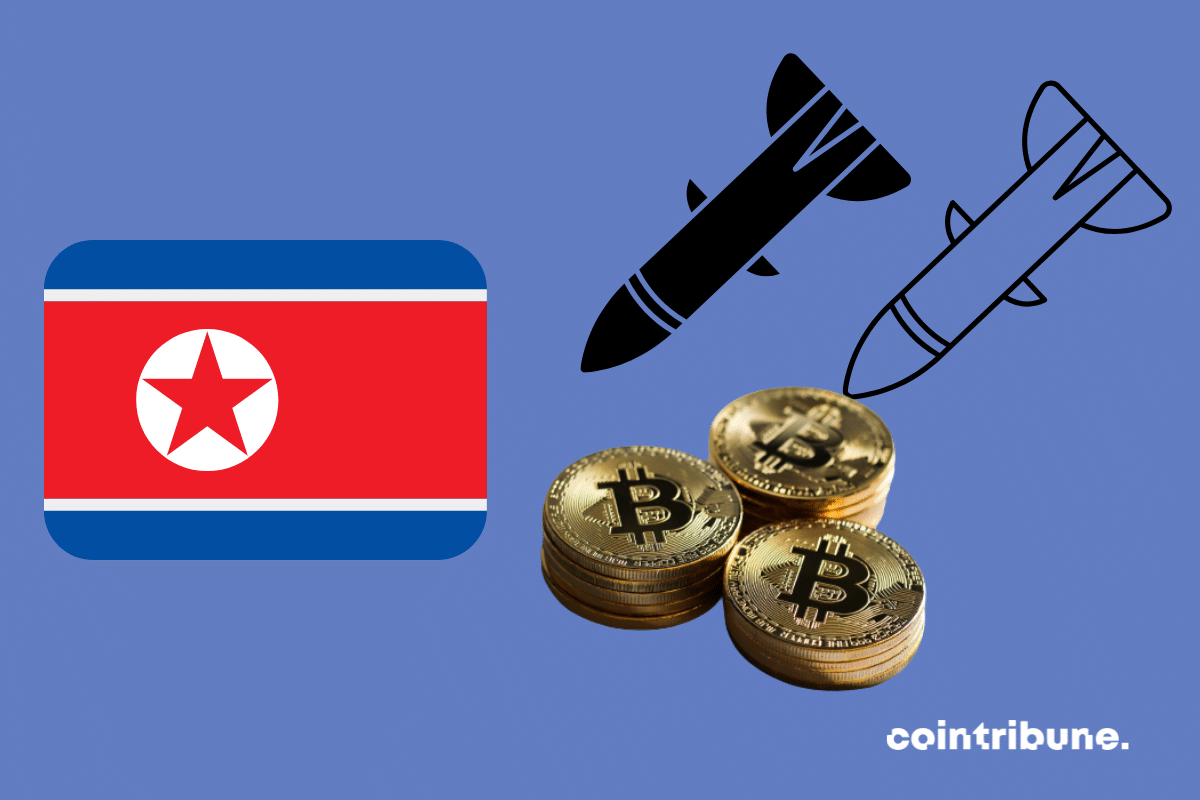
Since Kim Jong Un came to power in 2011, North Korea has been actively involved in the development of nuclear weapons. In recent years, the country has built several nuclear reactors and carried out tests. It has even developed ballistic missiles whose capabilities worry the international community.
Despite numerous international sanctions imposed on North Korea, its weapons program continues to thrive. How is it possible ? According to several investigations, North Korea is financing its military efforts through the theft of cryptocurrencies. In 2022 alone, North Korean hackers stole approximately $1.7 billion in loot!
Nuclear weapons, a priority for Kim Jong-un
North Korea has made a name for itself on the international scene thanks to its impressive military progress, particularly in nuclear armament. Now it is one of the few nations to possess nuclear warheads, ballistic missiles and hydrogen bombs.
To affirm its position of power, the country multiplies the tests with all kinds of nuclear weapons. For example, on January 6, Pyongyang announced the success of its first hydrogen bomb test. This confirms that nuclear weapons are a priority for Kim Jong-un.
Indeed, the North Korean power must consider that nuclear power will allow it to become a great power, and therefore to defy the United States which constantly threatens it. Accordingly, to support this military effort, it uses cryptocurrencies.
The Role of Cryptocurrencies in Korea’s Weapons Program
Developing nuclear weapons costs a lot of money. This money, the Kim Jong Un regime obtains it through the theft of cryptocurrencies. According to a senior American official, half of North Korea’s military efforts are financed thanks to this maneuver.
A strategy that has been used for several years
As a United Nations report indicates, Pyongyang has orchestrated “increasingly sophisticated attacks” via cyberspace since 2015. These attacks have two goals: steal funds from financial institutions and cryptocurrency platforms, and then recycle the stolen money so that it is untraceable.
The main targets of these attacks are cryptocurrency platforms, digital wallets, investment companies and Initial Coin Offerings (ICO). To penetrate their security systems, hackers use various methods such as:
- Phishing;
- Malware infiltration;
- social engineering,
- raw attacks,
- Attacks on infrastructure.
The stolen sums are then transferred to controlled accounts in North Korea. They are used to finance the illicit ballistic and nuclear programs of the country. The maneuver has been repeated for several years.
According to Chainalysis, the data analysis platform, the number of hacking cases linked to North Koreans between 2020 and 2021 increased by 40%. Western security agencies and firms rank these attacks among the top four state-owned cyber threats in the world, alongside China, Russia and Iran.
Worrying figures on crypto theft
Chainalysis estimates that in 2021 nearly $3.3 billion worth of crypto was stolen worldwide. Hackers linked to North Korea have stolen nearly 400 million. This figure increased considerably the following year.
Indeed, the year 2022 has seen an upsurge in criminal cyber operations from North Korea. Among other misdeeds, hackers are believed to be responsible for hacking more than $600 million from the Ronin network, used for the Axie Infinity video game in March. They are also believed to be linked to the $100 million hack of cryptocurrency firm Harmony in June.
In total, almost $1.7 billion was illicitly harvested for North Korean weapons of mass destruction programs in 2022. Also according to Chainalysis, this latest estimate brings the total amount to nearly $3 billion. gleaned by the country over the past five years.
FBI investigations accuse the APT38 and Lazarus groups which they consider to be associated with the General Reconnaissance Office (North Korean intelligence services, editor’s note). The Lazarus group was already known in the United States in 2014 for having hacked into Sony Pictures Entertainment studios, in retaliation for the satirical film about North Korea, “The killer interview“. Some believe that he is also behind the recent Atomic Wallet hack.
Efforts to recover stolen funds
According to Chainalysis, the FBI recently managed to recover $30 million in cryptocurrencies stolen during the Axie Infinity game hack. This act, which is a first, is joined by combined efforts of other security agencies who fight against attempted crypto thefts and money laundering.
However, it should be noted that these attempts are becoming increasingly sophisticated. Finding the stolen funds is therefore more difficult than it seems. So, failing to achieve this goal, law enforcement and national security agencies are focusing on building their capacity to fight digital criminals.
Theft of cryptocurrencies: what impact on the sector?
The increase in cases of cryptocurrency theft is having a significant impact on the industry. In particular, it is the cause of the loss of user confidence. The latter are probably afraid of losing their funds and are reluctant to invest or use cryptocurrencies. Similarly, the media coverage of cases of theft and issues related to the security of funds discourage potential investors and weaken demand.
In short, North Korea is financing the development of its nuclear weapons through the theft of cryptocurrencies. In recent years, North Korean hackers have managed to steal astronomical sums on the market, allowing the country to circumvent international economic sanctions.
Their various attacks are at the root of the crisis of confidence that is shaking the cryptocurrency sector. Thus, security becomes a major challenge to be met in order to facilitate the evolution of the sector, but also the ethical use of cryptocurrencies. Fortunately, several efforts are being made in this direction.
Receive a digest of news in the world of cryptocurrencies by subscribing to our new service of daily and weekly so you don’t miss any of the essential Tremplin.io!