

The rise in interest rates in recent months has been unprecedented. Indeed, the US central bank’s key rate went from nearly 0% in February 2022 to nearly 5.25% in May 2023. A real 180° reversal, justified by the importance and virulence of the ‘inflation. Nevertheless, two indicators hold our attention. The first indicator is the maintenance of the inversion of the yield curve. And this is not without impact on the financial markets. The second indicator is the maintenance of the gap between real growth and the real rate. Decryption of the anomalies induced on the rates in 2023.
The roots of the interest rate
The interest rate often has a negative connotation in the collective imagination. However, it has not always been so. Moreover, the word interest comes from the Latin interestedresulting in “to be among”. This underlines the role of the social link in the word interest. Therefore, interest is above all what generates social ties, without this being considered in its negative or positive acceptance. Interest is therefore not necessarily monetary. Many sociologists and economists have already written about the role of exchanges and gifts that support this logic of social ties.
But in the case which interests us, the interest assumes a purely monetary form. If the interest rate was little democratized before the industrial revolution, today it is unavoidable. In a previous article, we explained…
“In the first Mesopotamian civilizations, the interest rate was around 20%. Sometimes the rates charged could rise to 50% or more. It is necessary to wait for antiquity to see the rates decrease relatively and to see the supervision of the credit develop. »
The mechanics of cryptocurrency interest rates – Tremplin.io
The interest rate is back in the news at a time when debt is very high. The issue of interest rates is all the more central as it determines the attractiveness of traditional markets. Thus, cryptocurrencies, which are particularly sensitive to liquidity, are very exposed in the long term to monetary dynamics.
The disconnect between the real rate and real growth
How is the interest rate determined? And what is a “fair” interest rate?
A necessary connection between growth and the rate?
The question eternally divides economists. Nevertheless, a generally accepted rule was formalized as early as the 18th century. David Ricardo in particular (1772-1823) thus formulated the idea that the rate of interest should be equal to the rate of growth. In this case, no one can get relatively rich through interest. This rule amounts to saying that interest increases at the same rate as income. We will explain this rule, which is verified in economic data.
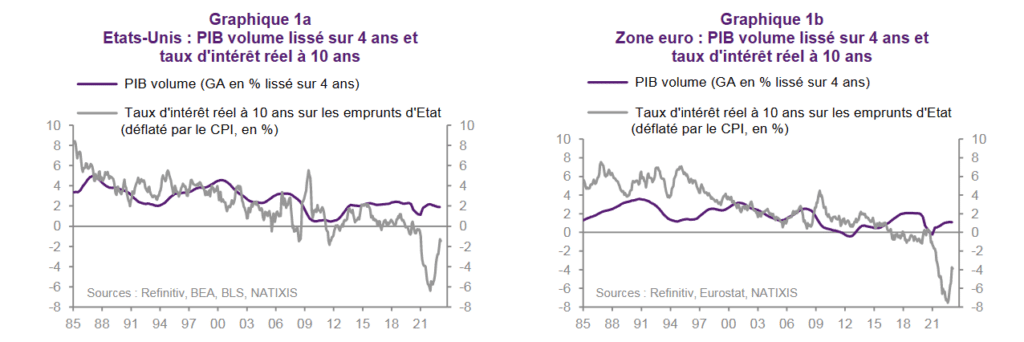
Indeed, this law is found in the empirical data. In a recent study published by Patrick Artus, we clearly find this link between real growth and the real rate. Also, the real rate tends to equalize with real growth (as explained below). Despite everything, the real rate was above the real growth before the 2000s, then the real rate fell below the real growth since 2000. This trend of depreciation of the real rate has particularly increased since 2020, under the effect of inflation.
An asset bubble?
As a result, the stronger progression of growth in the face of interest has strongly encouraged States and companies to resort to credit for several decades. A growth rate higher than the cost of credit encourages borrowing… We therefore find ourselves in economies with excess debt, with less productive activities, and an effective disconnection. There is now a lag between the value of capital (too abundant) and economic growth, ie the long-term productivity of the economy. This amounts to saying that there is a disconnect between the value of assets (low interest rates) and the real output of the economy.
An invariable economic law?
- We note the real interest rate (r) and the real growth rate (g), which also corresponds to all the income received by the agents. If the interest rate is higher than the growth rate (r > g), then the capital “gets rich” and the incentive to save is stronger. This situation is unfair because capital is overvalued. This may provide an incentive to increase savings, and thus reduce the interest rate so that it catches up with real growth.
- Conversely, if the interest rate is lower than the growth rate (r < g). In this case, the increase in income received by agents is greater than the cost of capital mobilized. The share of capital in the economy will be reduced, ie saving becomes less attractive and a source of relative impoverishment. The interest rate increases again under the effect of the reduction in savings, so as to equalize with growth. A real rate lower than real growth may also reflect greater investment demand. Hence an excess of indebtedness.
- With a real rate equal to real growth, there is a balance between what investment generates in growth, and what it costs. In this way, only really productive activities will be financed. The capital factor is balanced so that interest received grows at the same rate as income. Another approach is to say that the incentive to go into debt with growth that is stronger than the interest rate increases, which increases the risk of inflation.
Therefore, history teaches us that the real rate equals real growth. It is therefore clear that the dynamics observed for several decades will not last forever.
The (always worrying) inversion of the yield curve
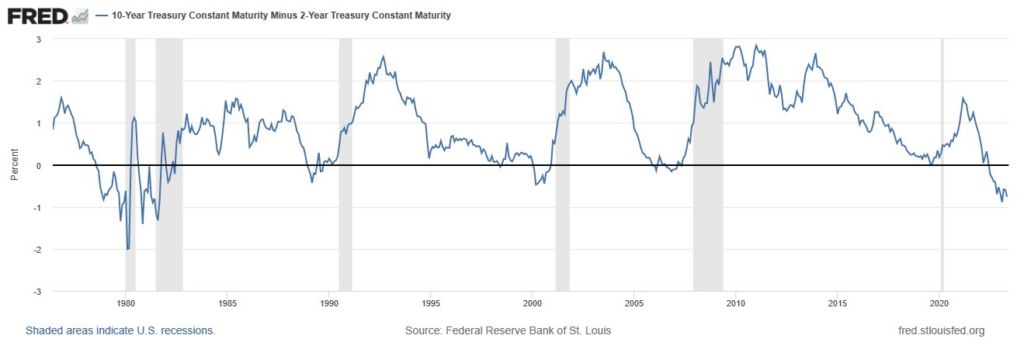
We have shown that real rates are still well below their historical norm. At the same time, financial markets continue to anticipate a gradual easing of inflation. This has the effect of noting the existence of short rates (2-year loans) that are higher than long rates (10-year loans). We also say that the difference of 10 years minus 2 years is negative. We also talk “yield curve inversion”. In other words, investors are more confident in the long term than in the short term.
In general, the inversion of the yield curve announces an economic recession. However, when we look in detail, recessions take effect more precisely, and most often, when the gap (10 years – 2 years) has become positive again. The recession then occurs 12 to 18 months after this return “normal”. While the probability of a recession is still strong, it will continue to be delayed by this phenomenon of prolonged inversion of the yield curve. Moreover, the last time the yield curve was so inverted was in 1950!
A recent note by Patrick Artus again shows the following conclusion: “financial market participants underestimate the risk of persistent inflation in the euro zone”. He adds : “they believe that the ECB will pursue a restrictive monetary policy until inflation has returned to 2%; however, the anticipated monetary policy is not very restrictive”. In other words, the markets, at least for the euro zone, would exaggerate the phenomenon of the inversion of the yield curve… And this is not without consequence.
The problem of anticipation for the markets
The interest rate plays a major role in the markets. In addition to determining the attractiveness of the various markets (bonds, equities, etc.), it also expresses periods of greater or lesser volatility. Indeed, the rise in interest rates has considerably affected the attractiveness of the equity market. And despite good corporate results (and often the best dividends), stock prices continue to fall.
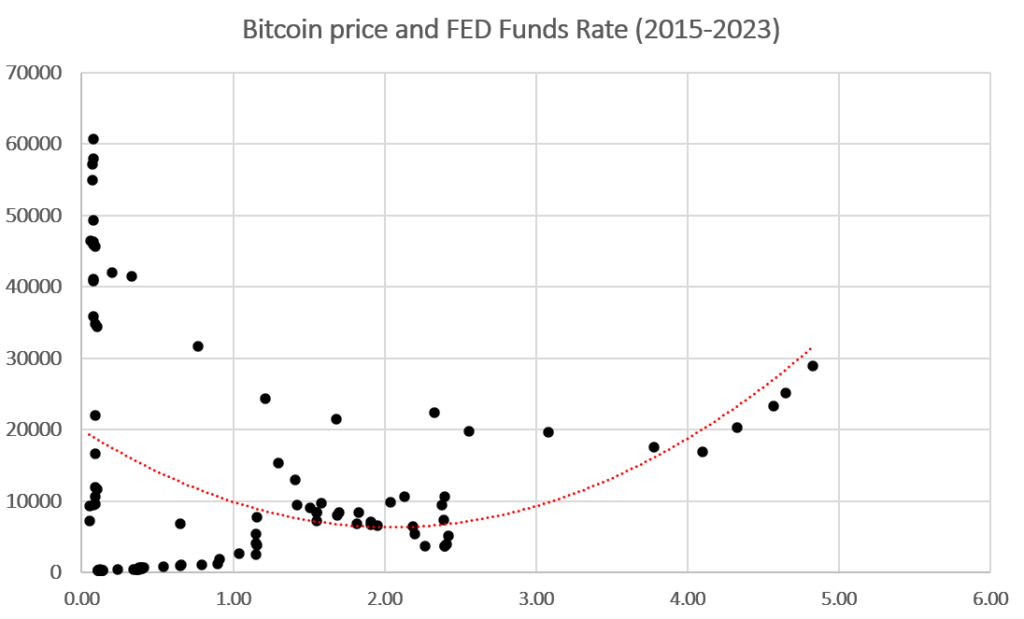
In this respect, bitcoin price shows some stability in the face of rising rates, as shown in the curve above. Nevertheless, low rates have so far accompanied the price of bitcoin (BTC). In addition, the price of bitcoin benefits in the long term from lower stock price volatility. In effect, “a minimum of stock market index volatility often reflects a maximum in the price of bitcoin”. We therefore understand that the anticipation of a “pivot” or a reduction in the rise in rates is likely to cause the price of bitcoin to rise again.
Synthesis
Ultimately, we have seen that the interest rate today has a determining character. The behavior of the interest rate in 2023 is historically abnormal. On the one hand because of the historic rise in rates, and on the other hand because of the causes stated. Indeed, there is a historic gap between the real interest rate and real growth. This rule (r=g) is often little known to the public, yet it is essential to the long-term balance of the economy. The economy can thus enter a period of productivity deficit (r
Moreover, the spread between long rates and short rates is historically high (unprecedented since 1950!). Investors anticipate an improvement in long-term credit conditions. However, as some studies point out, these expectations may be exaggerated. A deterioration in these expectations would bring a halt to “the inversion of the yield curve”. That is, the probability of a recession would be significantly high. Finally, we have shown that the improvement in expectations was likely to push up certain financial assets. Consequently, a deterioration in rate expectations would be likely to have repercussions on the price of certain assets.
Receive a digest of news in the world of cryptocurrencies by subscribing to our new service of daily and weekly so you don’t miss any of the essential Tremplin.io!


