International tensions are godsend for Bitcoin. It is a turnkey solution to circumvent financial penalties. Russia has understood this well.
Bitcoin is not sanctioned
Bitcoin is decentralized. He is by definition stateless. Any nation can use it, and even dedicate excess electricity to bolster its foreign exchange reserves.
The countries representing almost 30% of the world’s GDP (and more than 40% of fossil energy resources) currently under sanctions certainly share this opinion.
Russia and Iran can no longer use the SWIFT international payment network. Russian and Afghan foreign exchange reserves have been frozen by the United States and Europe. England refuses to return Venezuela’s gold. China can no longer buy latest-generation microchips. Iraq must seek permission to spend its dollars. Cuba, Belarus, etc..
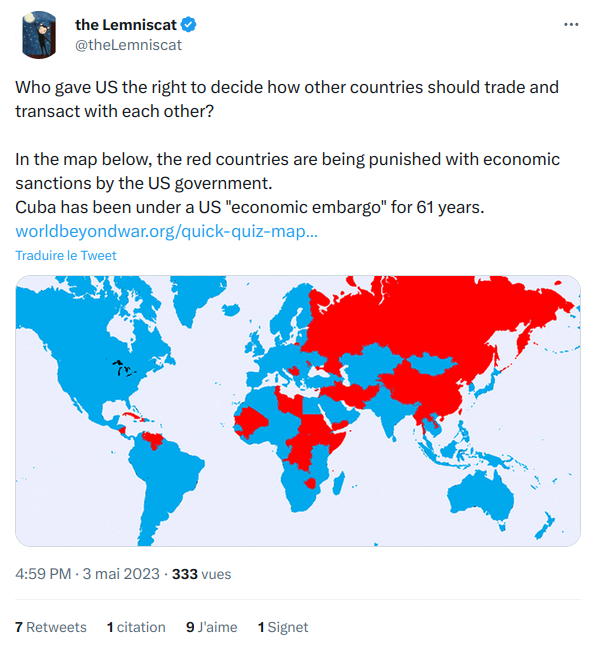
Cuba has been under an economic embargo for 61 years. »
https://twitter.com/theLemniscat/status/1653776319111471104
On closer inspection, Western sanctions mostly affect financial transactions. Payment networks have become military weapons.
Any government that does not have control over its national and international means of payment can be overthrown in the blink of an eye. A cut in the SWIFT network is synonymous with hyperinflation for a defenseless country.
Many African countries, for example, are forced to go through the French Treasury and the euro to trade. This mechanism offers France an immense means of pressure. Blocking transaction accounts is enough to destabilize any country in the CFA zone. Nicolas Sarkozy did not hesitate in 2011 to dislodge Laurent Gbagbo.
Bitcoin offers a plan B for nations wishing to emancipate themselves without fear of being financially isolated from the rest of the world.
Too much punishment
As the Chief Economist of the FinancialTimes Martin Wolf, “the G7 must accept that it cannot rule the world” :
“Today, hopes for a cooperative global economic order, which peaked at the G20 summit in London in April 2009, have evaporated. However, the G7 is not about to replace the G20. The era of G7 dominance is even more distant than that of G20 cooperation. Neither global cooperation nor Western domination seems feasible. What could ensue? Alas, division could be one answer and anarchy another. »
Indeed, the United States have every intention of multiplying baseness in an attempt to preserve their empire. Lindsey Graham’s recent statements fall into this category. The US senator told President Zelensky: “The Russians are dying” […] “We had never spent our money so well”...
This senator who has already called for the assassination of Vladimir Putin has since confirmed that his remarks were “taken out of context” and edited by the communication services of the Ukrainian President to appear pronounced afterwards.
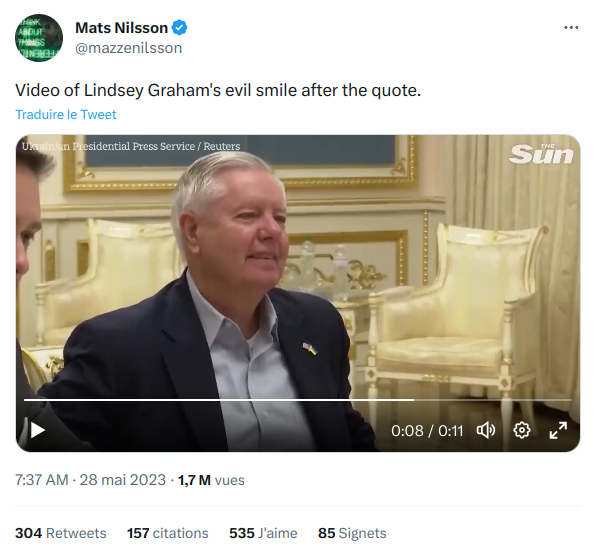
These kinds of inflammatory statements are meant to add fuel to the fire. This is the goal of the United States: to fight to the last Ukrainian to try to overthrow Vladimir Putin. Even if it means triggering a world war, because, in the background, it is American monetary hegemony that is at stake.
Counteroffensive
Despite the defeat at Bakhmout (50,000 dead on the Ukrainian side and 15,000 on the Russian side according to the private military company Wagner), V. Zelensky still does not want to negotiate.
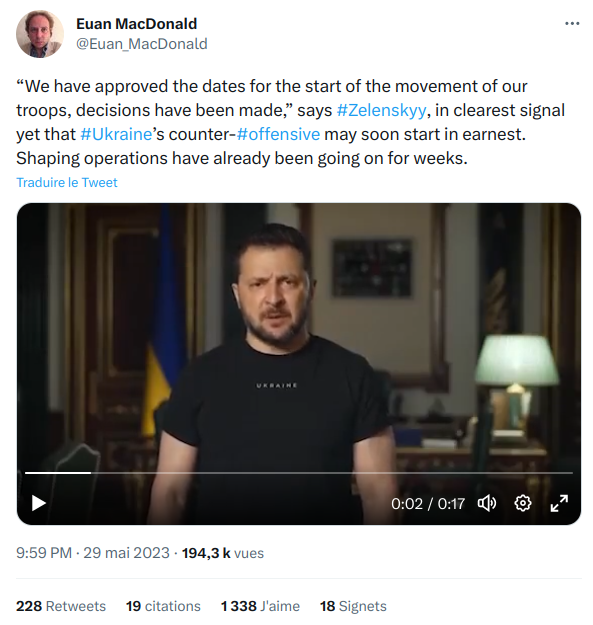
https://twitter.com/Euan_MacDonald/status/1663273885079355403
The Ukrainian counter-offensive will necessarily have to be accompanied by strikes against Russian logistics hotspots. Like when Ukraine managed to repel Russian forces on the right bank of the Dnieper in the fall of 2022.
Ukrainian forces had used US-provided HIMARS systems to cut off Russian supply routes. It had then become untenable for Russia to support its forces on the other side.
Since then, the Russian military has modified its air defense systems to neutralize HIMARS rockets. Supply lines have also been reconfigured to reduce the threat of HIMARS (80 km range). So much so that it is now with Storm Shadow missiles (range of 250 km) offered by the United Kingdom that Ukraine intends to carry out its offensive.
The UK crossed a red line by becoming the first country to supply Ukraine with missiles capable of hitting targets inside Russia. Hence the recent discussions to supply F-16 fighters to Ukraine since they are air-to-surface missiles.
All this to say that this war has gone on forever and that new alliances are becoming more and more salient. Many countries are joining Russia and China. Especially those who wish to join the BRICS and the Shanghai Cooperation Organization.
The BRICS should also announce new measures in August to dedollarize trade and counter Western financial sanctions.
Why not Bitcoin?
The latest news from Russia suggests that Bitcoin will be part of the BRICS monetary emancipation strategy.
According to the Russian media Izvestiya, the project to create a national exchange (like Binance, but nationalized) has been abandoned. Private exchanges will do the trick. Rather, it will be a question of fleshing out regulations, says Anatoly Aksakov, head of the Duma’s Financial Markets Committee.
The Russian Ministry of Finance has reached a compromise with the Central Bank to provide a legislative framework for the mining industry. In addition, exchanges can be used to circumvent sanctions by facilitating international transactions in bitcoins.
“This will minimize the risk of imposing sanctions, cyberattacks on infrastructure and eliminate abuse of dominant position” (SWIFT), points out Oleg Ogienko, director of government relations at miner BitRiver.
These exchanges will help domestic companies conduct international cryptocurrency transactions to circumvent sanctions, said Alexey Tarapovsky, founder of Anderida Financial Group.
From a legislative point of view, the exchanges will be operational a few months after the adoption of the legislation, estimates Evgenia Burova, director of communication of the exchange Garantex.
Thus, despite rumors of the creation of a new reserve currency by the BRICS and of the CIPS payment network, the attractiveness of bitcoin remains intact. Everything is already working. There is no more.
Receive a digest of news in the world of cryptocurrencies by subscribing to our new service of daily and weekly so you don’t miss any of the essential Tremplin.io!