
Does Europe finally want to regain control over the domination of American stablecoins? The Qivalis banking consortium has just sent a strong signal to the market. With the arrival of 25 new European banks, the euro stablecoin project takes on a new dimension a few months before its launch planned for the second half of 2026.

In brief
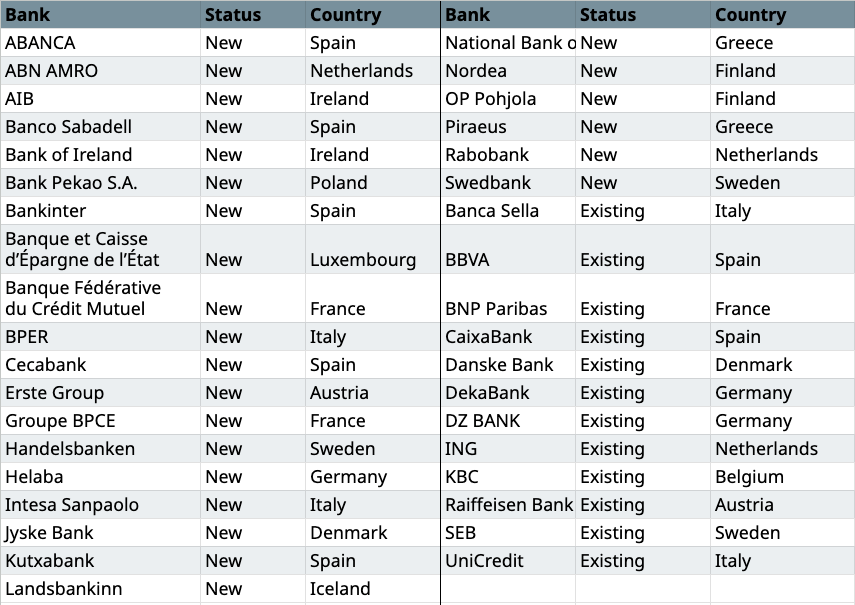
- Qivalis grows from 12 to 37 member banks after the integration of 25 new institutions in 15 countries.
- ABN AMRO, Rabobank, Nordea and Intesa Sanpaolo join the Amsterdam-based consortium.
- Spain is leading the charge with five new member banks.
Qivalis wants to build a European stablecoin champion
Qivalis, a banking consortium based in Amsterdam, formalized on May 20 the integration of 25 new European banks into its euro stablecoin project. Among them are heavyweights like ABN AMRO, Rabobank, Nordea and Intesa Sanpaolo. With this new wave of membership, the network now reaches 37 institutions spread across 15 countries.
The project aims to launch in the second half of 2026. Its ambition is clear: to create a European digital payment infrastructure capable of competing with American stablecoin giants like USDT from Tether or USDC from Circle.
This rise in power occurs in a very specific context. The global stablecoin market has just surpassed $323 billion. However, nearly 98% of this market remains dominated by assets backed by the US dollar. For Europe, the issue becomes as much monetary as it is strategic.
Spain appears to be one of the drivers of this dynamic. Five Spanish institutions have joined the consortium, including Banco Sabadell and Bankinter. This movement confirms the growing interest of European banks in tokenized payments and on-chain financial infrastructures.
Qivalis also seeks to reassure regulators. The project will be developed under the MiCA framework, the European crypto regulation gradually coming into application. The consortium emphasizes three pillars: compliance, data protection and financial stability.
This approach stands in stark contrast to the sometimes chaotic beginnings of the crypto sector. From now on, banks want to control the stablecoin infrastructure themselves instead of leaving this market to American players or crypto platforms.
MiCA pushes Europe to accelerate in the face of the digital dollar
THE development of Qivalis reflects a broader trend. For several months, euro stablecoins have experienced rapid growth thanks to MiCA. Their capitalization has more than doubled in one year, while transaction volumes are growing strongly on Ethereum.
This development shows that stablecoins are no longer just used for crypto trading. They become payment, cash flow and instant settlement tools. The tokenization of financial assets is also accelerating this transformation.
At the same time, the United States is moving forward quickly. The American administration is increasing discussions around crypto regulation, while BlackRock, PayPal and Western Union are strengthening their initiatives in tokenized assets and stablecoins.
Faced with this offensive, Europe is trying to avoid a scenario where the digital dollar would completely dominate on-chain payments. Christine Lagarde remains cautious and still favors the digital euro led by the ECB. But on the ground, European private banks are already moving forward at high speed.
The choice of Fireblocks as a technological partner illustrates this desire to build a solid and institutional infrastructure. Preservation of digital assets, compliance and tokenization are now becoming central building blocks of European finance.
In short, the Qivalis project probably marks a turning point for stablecoins in Europe. Long lagging behind the United States, European banks now seem ready to play a major role in the development of digital financial infrastructures.
Maximize your Tremplin.io experience with our 'Read to Earn' program! For every article you read, earn points and access exclusive rewards. Sign up now and start earning benefits.